

After the earth-shattering collapse of Terra/UST, the entire crypto world is filled with doubt and fear regarding the term "algorithmic stablecoin." Any project resembling the UST mechanism would immediately be labeled as dangerous. However, amidst the numerous controversies, the decentralized stablecoin USDD from the TRON ecosystem has been quietly developing. Is it really just another copy of UST? The reality may be far more complex than you think. This article will reveal three key facts about the USDD mechanism and design, aiming to clarify widespread misunderstandings and provide you with a more comprehensive and in-depth perspective.
1. Fact One: It is not another UST—the key is 'over-collateralization'
Many people see the minting/burning relationship between USDD and TRX (TRON's native token) and immediately associate it with the 'death spiral' of UST and LUNA. However, this is a core misunderstanding. The fundamental difference between the two lies in the collateralization model.
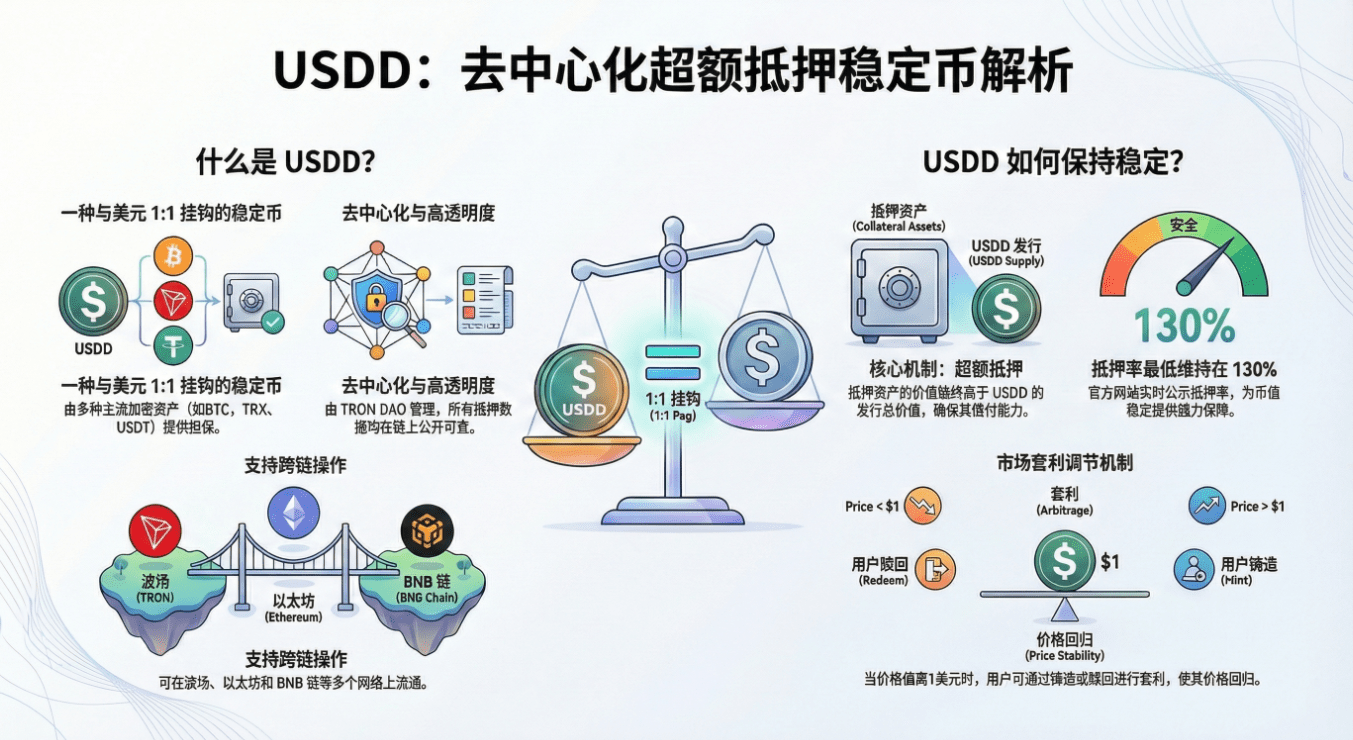
The value of UST was almost entirely supported by the confidence in its sister token LUNA, lacking real asset backing. In contrast, USDD adopted an over-collateralization model from the outset. Its value does not solely rely on TRX but is supported by a reserve pool containing various mainstream crypto assets, including Bitcoin (BTC), USDT, USDC, and TRX. While this diversified asset reserve is far superior to UST's single LUNA support, its value is still subject to market fluctuations, especially during extreme market conditions, where a drop in the prices of collateral (like BTC and TRX) may test the system's liquidation mechanisms.
According to its official settings, the minimum collateralization ratio of USDD must be maintained at over 130%, and according to real-time data published by the TRON DAO Reserve, its actual collateralization ratio often exceeds 200%. This means that for every $1 of USDD issued, there are real assets worth far more than $1 as 'insurance' backing it. This strong asset reserve provides solid assurance for the stability of USDD's value.
As the founder of TRON, Justin Sun said, they have learned lessons from history:
"We learned a lot from the collapse of Terra and Luna. We want to make it highly over-collateralized."
2. Fact Two: The 'secret weapon' to maintain the peg—Peg Stability Module (PSM)
In addition to over-collateralization, USDD has a robust mechanism to maintain its 1:1 peg with the US dollar—the Peg Stability Module (PSM).
You can think of the PSM as an official, always-online currency exchange window. It allows any user to exchange USDD with other mainstream centralized stablecoins like USDT, USDC, and TUSD at a fixed exchange rate of 1:1 within the TRON DAO Reserve.
The importance of this mechanism lies in its ability to create a strong arbitrage loop that can quickly correct deviations in market prices. For example: if USDD falls to $0.99 in the open market, arbitrageurs can immediately buy cheap USDD in the market, and then exchange it through the PSM at a 1:1 ratio for USDT or USDC worth $1, thus earning risk-free profit. This buying behavior will quickly push USDD's price back to $1. The effectiveness of this mechanism highly relies on having sufficient reserves of other stablecoins (like USDT/USDC) in the TRON DAO Reserve. If reserves run dry, the arbitrage stabilization effect of the PSM will fail.
PSM provides USDD with an almost 'hard peg' guarantee, greatly enhancing its price stability. More importantly, all assets used for collateralization and supporting the PSM are publicly available in real-time on the TRON DAO Reserve's official website, allowing anyone to verify the authenticity of the reserves at any time, which greatly enhances the system's transparency and credibility.
3. Fact Three: The commitment to decentralization—managed by TRON DAO Reserve
The ultimate goal of USDD is to become 'the most decentralized stablecoin in human history.' To achieve this vision, its governance is not held by any company or centralized entity, but entrusted to the TRON DAO Reserve.
TRON DAO Reserve is a decentralized autonomous organization (DAO) whose core mission is to protect the entire crypto market from potential financial crises and to use its reserves to stabilize the exchange rates of crypto assets. As the custodian and manager of USDD, the DAO determines the composition of reserves, risk parameters, and future development directions through community governance.
This sharply contrasts with centralized stablecoins like USDT (controlled by Tether) or USDC (controlled by Circle). Within the framework of USDD, the rules and reserve management are transparent and community-driven, which aligns more with the core spirit of blockchain decentralization. However, it is worth noting that the actual degree of decentralization of the DAO depends on the distribution of its governance tokens and community participation. If governance power is highly concentrated in a few entities, its operational model may still be distant from the true spirit of decentralization.
Conclusion
By deeply understanding its core mechanisms, we find that USDD is not the fragile UST imitator that many imagine. In summary, the three core facts about USDD are:
It is an over-collateralized stablecoin based on diversified mainstream assets.
It has a powerful PSM mechanism to ensure a hard peg on the price.
Its governance and reserve management are handled by a decentralized DAO.
These designs are clearly intended to avoid the pitfalls of UST's failure and attempt to find a more reliable balance between decentralization and stability. Of course, any project faces the test of the market and unknown risks. But in the world of stablecoins, whether transparent over-collateralization and strong stability mechanisms can truly pave the way for a decentralized future is something worth our continued attention and thought.


