

When I first looked into @Lorenzo Protocol and the idea of veBANK, I expected the usual token-staking spiel lock your tokens, earn a yield, maybe get some voting power. What I found instead felt more like a bridge between two worlds: the disciplined, governance-oriented culture of traditional finance and the fluid, permissionless experimentation of decentralized finance. This isn’t just another “stake-to-earn” mechanic. It’s an attempt to give people a stake a real functional stake in the way a protocol evolves over time. 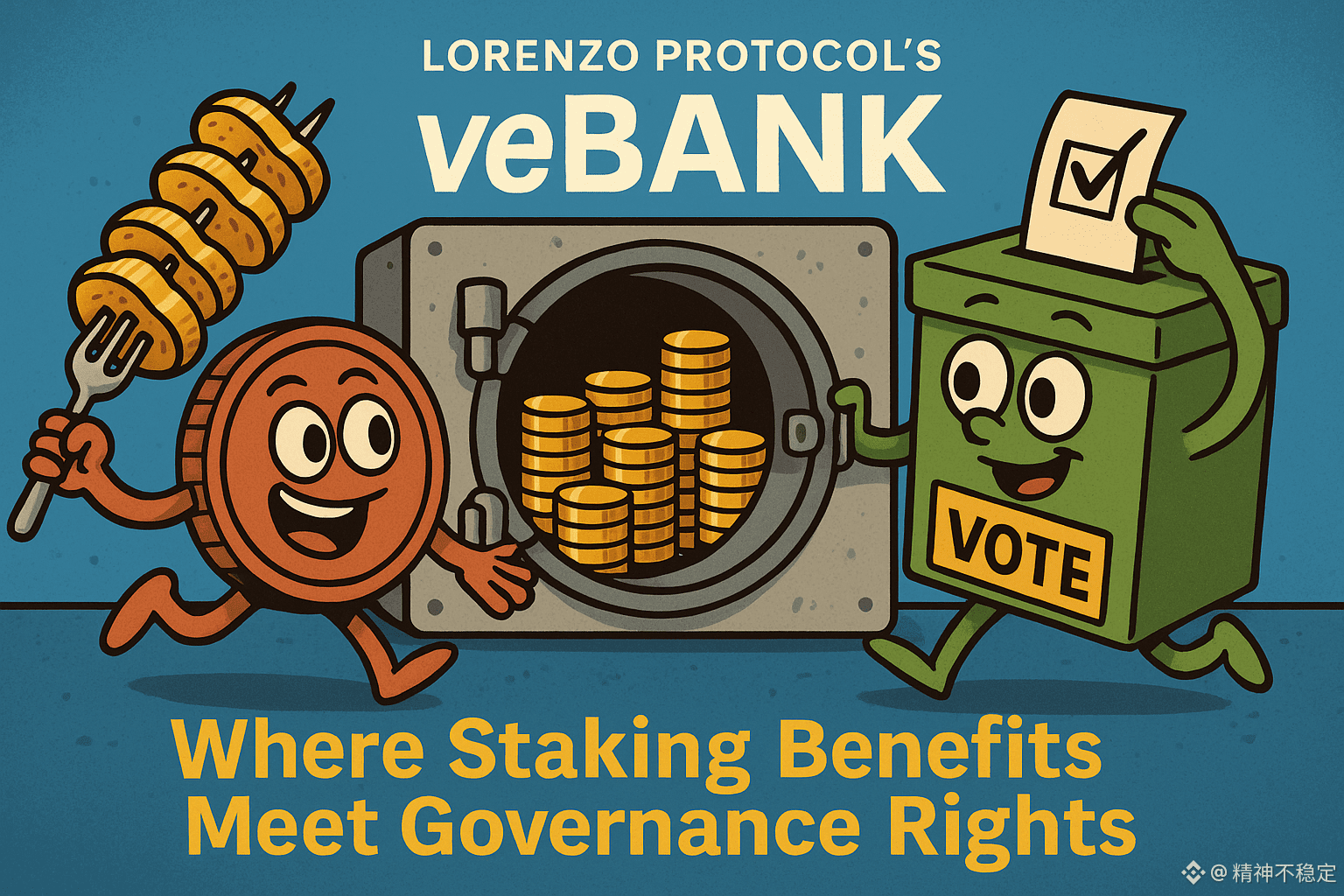
The core of Lorenzo Protocol and the reason people are talking about it now is that it positions itself as an on-chain asset management platform. It’s built to bring more structured financial strategies into the crypto world, especially around yield products that feel familiar to institutional investors: tokenized funds, structured vaults, and strategies that don’t require you to be a professional portfolio manager. But unlike a traditional mutual fund where decisions happen behind closed doors, Lorenzo weaves governance and transparency into its DNA through BANK, the native protocol token.
Now, veBANK — a term you’ll hear a lot — stands for voted-escrowed BANK. It’s what you get when you lock your BANK tokens for a period of time. The promise isn’t just yield incentives. Holding veBANK actually lets you participate in decisions about how the protocol runs. Governance isn’t a buzzword here; it’s tied directly to how deep your commitment is. The longer you lock, the more weight your voice carries in decisions about fees, reward distributions, emissions schedules, and broader ecosystem changes. This isn’t democracy precisely — it’s weighted participation that rewards long-term engagement over short-term flipping.
If you’ve ever dabbled with governance tokens before, you’ll know that voting rights can feel abstract. In many projects, governance proposals flop for lack of participation, or holders delegate their votes to whales and bots. What’s different about Lorenzo’s approach is the intentional link between time, stake, and voice. You can’t just buy a bag of tokens, cast votes for a week, and leave. The veBANK model encourages patience — a quality that traditionally hasn’t been native to crypto culture — and that encourages contributors to think in quarters and years instead of hours.
There’s a psychological payoff in that structure. When I first read about veBANK, I was struck by how it forces investors — retail or institutional — to reckon with the passage of time. In most crypto projects, yields and governance are immediate: stake now, claim rewards tomorrow, snap decisions, quick flips. Lorenzo funnels that energy into a longer horizon. It’s a shift worth noting, because it mirrors how traditional asset managers think. They measure performance over years, not minutes. veBANK nudges participants into a similar mindset, whether they intended to or not.
This shift also explains some of the recent interest in BANK. In November 2025, BANK was listed on major exchanges like Binance with a Seed Tag applied — a move that suddenly broadened access from niche early adopters to a much wider audience. That kind of listing almost always draws attention, volatility, and fresh capital, whether the market is bullish or grinding sideways.
But here’s the honest part: buzz and real substance are two different animals. After that Binance listing, markets did what markets do — BANK saw sharp short-term price moves and then pulled back. That tells you something familiar about crypto: accessibility brings noise. Whether that noise settles into something enduring depends on how the protocol’s core mechanisms — like staking into veBANK and real governance participation — actually get used.
Another interesting piece of context is Lorenzo’s broader ecosystem. BANK isn’t just for governance. The protocol supports tokenized yield products like liquid-staking Bitcoin (stBTC), wrapped yield tokens (enzoBTC), and stablecoin-linked funds. These help crypto holders earn returns without losing their principal to illiquid lockups. Within that landscape, veBANK holders can influence where the protocol allocates capital, how incentives are structured, and even how fees are distributed back to the community. That’s a blend of economic and decision-making power that’s rare outside of experimental governance systems.
All that said, there’s a balance to strike between vision and execution. I’ve spoken with people who are genuinely intrigued by the mechanics but cautious about signal versus noise. The idea of governance rights tied to staked tokens isn’t new; what’s new here is how intentionally it’s positioned as part of a wider asset management layer. Critics point out that any governance system is only as good as the participation it gets — an idle veBANK holder doesn’t influence anything, and concentrated holders still carry outsized sway. So the promise of shared governance has to be lived, not just coded.
In the end, Lorenzo Protocol’s veBANK feels like a thoughtful experiment in aligning incentives over time. It doesn’t promise instant riches, quick yields, or algorithmic guarantees. Instead, it invites stake — in both senses — in the long ride of a protocol trying to mature into something that feels less like a ruleless frontier and more like a space where participants actually shape the future together. If this ends up as a big DeFi example or a forgotten experiment won’t come down to clever token rules. It’ll come down to whether everyday users believe in it, keep using it, and are willing to help make decisions
@Lorenzo Protocol #lorenzoprotocol $BANK

