

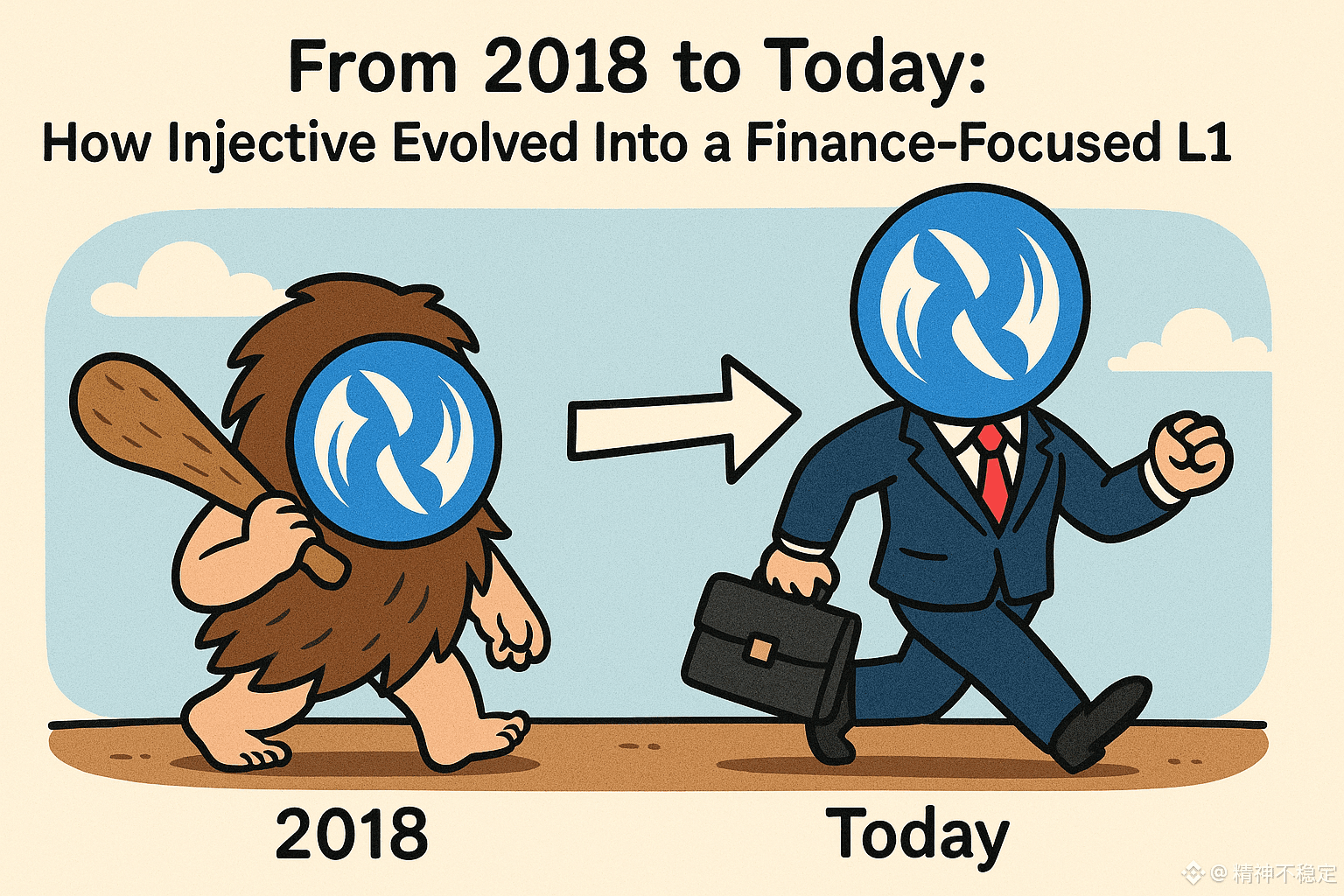
@Injective In the tangled history of blockchain projects, few have worn their ambition quite as plainly as Injective. It didn’t start as a vague experiment in decentralized buzz it began with a pointed idea: what if decentralized finance could be built without the compromises that hampered the earliest DeFi platforms? In 2018, two young entrepreneurs, Eric Chen and Albert Chon, sketched out a project that was meant to be practical first and radical second. They weren’t chasing “everything Web3” they were chasing one thing well: finance without gatekeepers.
In those early days, Injective’s identity was rooted in trading. Ethereum was already the DeFi backbone in 2018, but the systems that defined that era automated market makers and primitive DEXs lacked the tooling and throughput needed to match traditional financial markets. People wanted perpetual futures, derivatives markets, and full-on order books, and the existing infrastructure was too slow or too expensive to deliver them. Injective leaned into that pain point.
The first milestone that defined Injective’s direction came with its incubation through Binance Labs. That early backing wasn’t just capital. It was credibility — a signal that something distinctly financial could be built outside the confines of centralized exchanges. The team released a testnet in late 2020 that looked and felt different: a decentralized exchange system designed with scalability and trustlessness at its core.
By late 2020, Injective wasn’t just a whitepaper. It launched its native token, INJ, via the Binance Launchpad. That token wasn’t ornamental. It was governance, it was collateral for trading, it was the economic backbone of the future the team envisioned. The crypto community — hungry for alternatives that didn’t sacrifice decentralization for performance — greeted it with cautious interest.
Then came the mainnet era. In 2021, Injective started rolling out the pieces of its live network. A bridge for cross-chain asset transfers signaled that Injective was meant to interact, not isolate. The Canary Chain gave real asset trading on the network a first breath. And finally, by November 2021, the canonical mainnet was live — a functioning Layer-1 blockchain optimized for finance, not general computation.
Seeing that live network was one thing; using it was another. Injective’s architecture — built with the Cosmos SDK and a Tendermint-based Proof-of-Stake consensus — brought throughput and finality that traditional DeFi systems lacked. It wasn’t perfect, but the idea of sub-second confirmations with interoperability across ecosystems was proving itself beyond theory.
Injective didn’t stop at launch. In mid-2022, the project enabled smart contract support through CosmWasm, which opened the door for more complex financial applications beyond basic trading venues. Later that year, bringing Wormhole into play made cross-chain token movement with Solana and EVM chains even smoother, reinforcing the idea that finance on Injective wouldn’t be siloed.
A meaningful shift in identity came in early 2023 when Injective announced a $150 million ecosystem fund. This wasn’t just a marketing chest-thump. It was a strategic pivot toward building out a broader financial ecosystem — more lenders, more prediction markets, more institutional tools — all running on a network designed with financial primitives at its base. The fund brought in support from major venture players and underscored a long-term bet: Injective wasn’t just another chain, it was a financial mesh, where liquidity and markets could interoperate.
That pivot also brought new questions. Finance isn’t just code and markets; it’s regulation, liquidity pressures, competitive allure, and user trust. Injective’s leaders had to navigate real-world frictions that so many blockchain projects sidestep. How do you launch a derivatives market that’s truly decentralized? How do you attract institutional capital to what’s still fundamentally an unregulated network? These questions don’t have neat answers, but the way Injective kept advancing — bridging to other ecosystems, layering in more financial modules, and encouraging developers with incentives — suggests a keen awareness that technology alone doesn’t make finance. Adoption does.
By late 2025, Injective was no longer just a trading venue or a niche experiment. It was positioning itself as a foundational layer for Web3 finance — a blockchain where lending protocols, decentralized exchanges, and even real-world asset tokenization could coexist with performance and interoperability baked in. Its claim to be one of the fastest interoperable Layer-1 blockchains wasn’t merely marketing; it reflected years of iteration on latency, cross-chain mechanics, and developer tooling.
Looking back, what’s striking isn’t how Injective chased every trend — it didn’t. It chose a lane early: finance. That choice meant narrower appeal in some circles, but deeper relevance in others. Today’s Injective feels less like a generalist blockchain and more like a financial operating system — built by traders and developers who truly understood the shortcomings of the first wave of DeFi, and determined to build something that could sit alongside the legacy financial world rather than beside it.
That evolution, from a derivatives-oriented idea in 2018 to a full Layer-1 finance hub in 2025, isn’t just about technology. It’s about intent. Purpose matters in software, and in finance it matters even more. Injective shows that when a project stays committed to its plan, it can benefit as the w
orld shifts around it.
@Injective #injective #Injective $INJ
