
In the eyes of many, Bitcoin is either sitting in a cold wallet 'gathering dust' or being repeatedly harvested in the contract market.
This time, APRO has turned these dormant BTC on the Bitlayer mainnet into collateral assets that can continuously generate yield —
Every update of the stBTC/USD price stream lays the pricing foundation for APRO's future $1 billion TVL.
For BTC L2, without a reliable price pipeline, the BTC that comes across chains is just a set of static numbers.
APRO provides dedicated oracles to feed prices for stBTC/USD, converting the value of BTC on the mainnet into programmable inputs for Bitlayer DeFi Lego.
1. Why does APRO need to create an independent stBTC/USD price stream on Bitlayer?
On Bitlayer, those truly participating in DeFi are not 'native BTC addresses,' but various BTC derivative assets, especially LSTs (liquid staking tokens) like stBTC.
If only a generic BTC/USD price is moved over, many key pieces of information will be flattened.
APRO specifically designs price streams for stBTC on Bitlayer with several core goals:
It allows DeFi protocols to see the effective price of stBTC rather than an abstract theoretical price of BTC;
Balance 'price sensitivity' and 'Gas costs' on parameters such as deviation thresholds and heartbeat frequencies;
Provide a standardized settlement benchmark that can be directly called for lending, stablecoins, yield strategies, and other protocols.
When APRO sets a 0.5% deviation threshold and about 1 hour heartbeat on Bitlayer, what APRO is doing is an economic project:
It needs to keep the liquidation price close to the market while avoiding excessive on-chain update costs for L2 users due to L1 congestion.
2. How does APRO bring the value of BTC's mainnet into the Bitlayer economic loop?
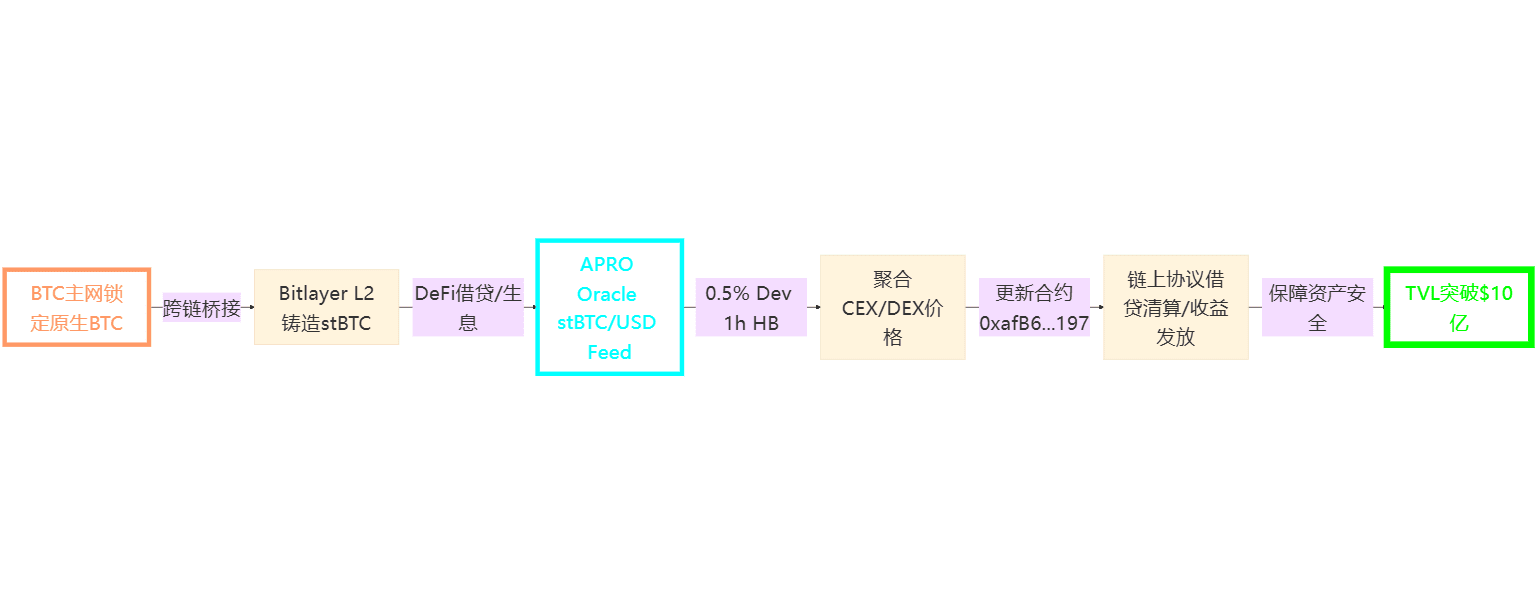
From this link, every key node cannot avoid APRO:
After BTC is locked and cross-chain, stBTC minting is completed;
All borrowing/yield demands based on stBTC must first go through APRO's stBTC/USD price stream;
APRO aggregates CEX/DEX quotes and writes them into designated oracle contracts;
The liquidation, lending, and yield distribution logic on Bitlayer is uniformly anchored to the price provided by APRO;
As the number of protocols using APRO's price feed increases, TVL may accumulate towards the 1 billion USD level.
APRO plays the role of a 'value converter' here, while Bitlayer serves as one of the main battlefields for APRO's services.
3. When BTC fluctuates violently, what problems does APRO solve on Bitlayer?
Once BTC enters a high volatility range, the risks of stBTC-related positions will rapidly amplify.
In this scenario, APRO on Bitlayer needs to guard three barriers at the same time:
Real-time pricing
APRO needs to continuously obtain quotes from mainstream exchanges and sufficiently deep DEX;
APRO aims to eliminate anomalies using a fault tolerance mechanism, providing stable weighted or median prices.
Uncertainty of network conditions
APRO must consider objective constraints such as BTC L1 congestion and cross-chain bridge delays;
APRO directly updates oracle contracts in the Bitlayer environment to ensure that L2 protocols can obtain timely prices in their own chain environments.
Multi-asset pricing demand
When different BTC derivative assets such as SolvBTC and M-BTC appear on Bitlayer,
APRO can expand multiple dedicated price streams instead of using a single BTC/USD price to cover all scenarios;Protocol developers can choose corresponding APRO Feeds for different assets to manage risks more finely.
In this structure, APRO is not just 'broadcasting a number,' but has built a pricing framework for a family of BTC assets within Bitlayer.
4. As TVL approaches 1 billion USD, APRO also faces amplified risk requirements.
The larger the TVL, the more the oracle becomes a consensus focus.
When positions worth hundreds of millions of dollars on Bitlayer simultaneously rely on APRO's stBTC/USD price feed, the market discussion will naturally focus on several issues:
Once APRO's price feed is abnormal, will it trigger a chain liquidation?
Does APRO have sufficient economic security and node redundancy to support the volume of BTC?
Have the protocols on Bitlayer introduced the risk protection measures provided by APRO (such as maximum price change limits, time-weighted prices, etc.)?
These concerns, in turn, will prompt APRO to do two things:
Improve the security threshold and node quality within the oracle network itself, strengthening the economic security layer of APRO;
Collaborate with leading protocols on Bitlayer to optimize liquidation parameters and calling methods, using 'protocol design' to buffer potential extreme price risk.
From this perspective, the more Bitlayer relies on APRO, the higher APRO's own security level must be, which is a mutually reinforcing relationship.
5. APRO's 'asset nativity': Why not be satisfied with just transporting BTC prices?
Many oracles entering the BTC L2 track simply synchronize the BTC/USD price from Ethereum to the new chain.
APRO deliberately did not do so, the reason is:
Assets like stBTC not only represent BTC itself but also include staking yields, premiums or discounts brought by protocol mechanisms;
Different BTC derivative assets have different liquidity structures on DEX and CEX, and the risk exposure is also different.
APRO's strategy is:
Directly maintain an independent stBTC/USD price stream for stBTC;
In the Bitlayer ecosystem, adjust aggregation weights and parameters based on asset types;
Price using 'understanding asset structure' rather than viewing all BTC-related assets as the same thing.
this is also the fundamental reason why APRO can secure an 'ecological niche' in the fiercely competitive oracle track on Bitlayer:
APRO does not just issue prices; APRO understands assets.
6. APRO's position in the BTCFi landscape: Pricing power is discourse power.
From a longer cycle perspective, Bitcoin is transitioning from a 'passive store of value' to a 'programmable collateral asset.'
On this evolutionary line:
L2s like Bitlayer provide the execution environment;
Assets like stBTC provide the mapping and yield rights carriers for BTC;
Through price streams like stBTC/USD, APRO provides the key 'accounting language' to turn BTC into DeFi collateral.
As more and more BTC participates in lending, stablecoins, and yield strategies through APRO's price feed,
APRO is actually participating in rewriting the way BTC's value is conveyed in the DeFi system.
If the BTCFi scale continues to expand in the future,
whoever masters highly credible, finely granular BTC-related price streams will naturally hold more discourse power—
and APRO is positioning itself at the center of this narrative with the stBTC/USD price feed on Bitlayer.
Risk warning
This article analyzes APRO's role as an oracle on Bitlayer and does not constitute investment advice or yield commitments;
Specific assets and contract addresses such as stBTC, SolvBTC, M-BTC are subject to the project's official and actual deployment on-chain;
Any DeFi protocol relying on APRO's price feed still carries multiple risks such as market volatility, liquidation, and smart contracts, which need to be assessed independently before participation.
I am a boat carving sword, an analyst who only focuses on essence and does not chase noise. @APRO Oracle #APRO $AT


