
Kite is building the next generation AI base layer, designed to create network effects through real utility in the decentralized AI economy. At its core is a trust layer, an open, decentralized network where modules operate with full interoperability and verifiability. Kite’s economy is designed to incentivize both the supply and demand of agentic services. Kite’s modular and composable design provides unified infrastructure for identity, payments, and governance, enabling agents to authenticate, transact, and coordinate securely, without any intermediaries.
In this article, we will explore how Kite’s design creates a value-accruing ecosystem, and how early ecosystem-incubated projects like Codatta have demonstrated measurable success within it.
Codatta (Kite’s data module): Showcasing real utility
Codatta is a decentralized data protocol that provides verified, high-quality datasets for AI applications. Codatta is a next-generation data marketplace, fully on-chain and integrated into Kite’s trust layer. Codatta focuses on curating datasets in fields like healthcare and robotics, where data quality and provenance are critical. Each dataset includes verifiable metadata, traceability, and built-in royalty mechanisms for contributors.
Codatta is a great showcase of Kite’s technology because it uses the network’s coordination and identity features to control and track data access. Data access requires verifiable credentials, such as the Kite’s identity passport, ensuring sensitive information, like patient health records, is only used by verified agents and under certain conditions where rules can be programmed using Kite’s smart contracts. Every access or computation is logged on-chain, creating an audit trail for data lineage and usage. This traceability is key for industries like healthcare, where compliance and trust depend on proving data usage.
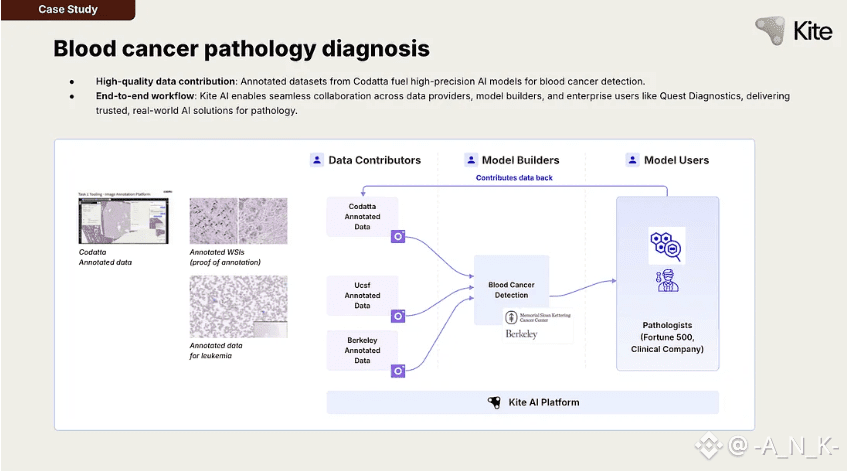
As Kite’s first data module, Codatta demonstrates how supply and demand connect on the platform. On the supply side, Codatta provides valuable resources (datasets). On the demand side, you might have an AI diagnostic application or a robotics simulation that needs those datasets to function. Through Kite, the two connect seamlessly, agents query data in a permissioned, trustless way, paying for that high quality data and receiving cryptographic assurances of integrity. Providers get automatic payments and retain governance rights, enforced by Kite’s coordination logic.
Codatta’s early success validates Kite’s ecosystem model. During its incubation, Codatta also received funding from Avalanche Foundation’s Infra BUIDL(AI) program — a $15 million funding initiative in which Kite sits as joint selection committee member. The Infra BUIDL (AI) program is designed to accelerate innovation at the intersection of AI and decentralized infrastructure. This funding not only provided critical resources but also connected Codatta to Kite’s broader ecosystem, accelerating both technical deployment and ecosystem collaboration. With this support, Codatta achieved key milestones such as launching the first autonomous medical data annotation workflow — combining blockchain’s auditability with AI’s problem-solving capabilities and underscoring the strong demand for high-value AI assets.
Note — Codatta also made significant strides in community engagement and market presence, particularly through deep collaboration with Binance in 2025. This included the Pre-TGE, a 12-week Booster program, and a Binance Alpha and Perpetual listing. Read more: Binance Announcement
Network Flywheel: Building a sustainable AI ecosystem
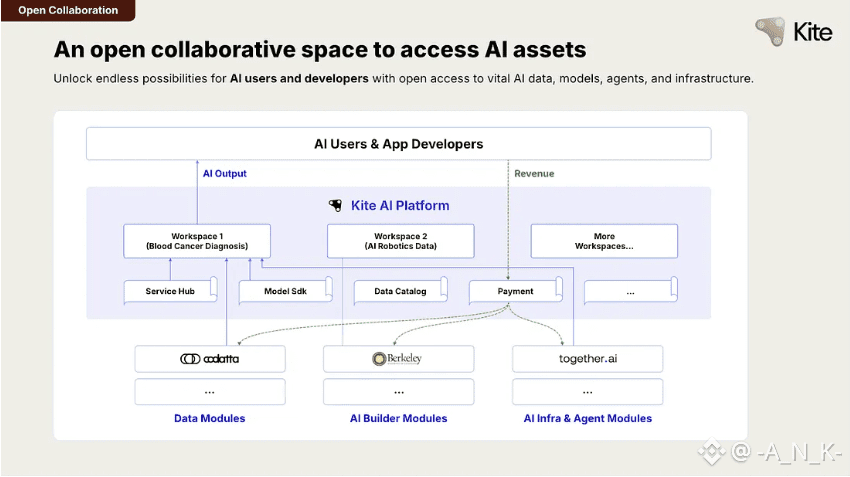
Kite combines outcome-focused design, modular architecture, aligned incentives, innovative tokenomics, and real-world utility through modules like Codatta to create a self-sustaining flywheel. Here’s how it works:
Modules drive usage: New modules, such as data providers (Codatta as an example ), computing services, or AI micro-services, bring in communities and use cases, boosting on-chain activity.
Usage strengthens the base layer: More activity increases demand for resources on Kite and generates fees and rewards for validators. This improves security and decentralization, which brings in larger enterprise and institutional interest.
Reinforced value capture: Because modules can work together, value flows between them, creating a flywheel effect and incentives for value generation. Kite’s economy captures this overall activity, rewarding both holders and contributors.
This flywheel compounds growth by prioritizing composability and interoperability, avoiding isolated services. Successful modules thrive based on real outcomes, while the “Protocol-to-Protocol” token model keeps incentives aligned around utility and long-term participation.
Why Kite is the next generation AI Base Layer for decentralized AI economy
Beyond Blockspace to real outcomes: Rethinking value in Layer 1s with real utility — Most blockchains monetize blockspace through transaction volume, often favoring short-term activities. Kite focuses on outcomes, orchestrating AI workflows measured by real-world impact. Its programmable coordination layer composes tasks, like medical diagnostics, treating successful completion using verified data as the value unit. This promotes utility and aligns growth with real value creation.
A Modular, Composable, and EVM-Compatible architecture — What differentiates Kite is its modular and composable architecture. Unlike a monolithic chain or isolated subchains, Kite is a network of modules that are interconnected through a shared coordination layer. Kite is fully EVM-compatible and designed for cross-chain interoperability, enabling seamless integration with existing Web3 ecosystems.This coordination layer unifies verifiable identity, rule enforcement, and on-chain settlement to enable trustless collaboration across modules, supporting secure data & value exchange and operating without intermediaries. This design avoids the pitfalls of fragmented ecosystems, where siloed resources trap value. All Kite modules share aligned incentives, allowing value to flow freely across the network. Each module increases the network’s utility, creating a flywheel effect by driving greater usage which in turn attracts more builders and growth.
Progressive decentralization and aligned incentives — Kite uses progressive decentralization, starting with Avalanche’s framework for a large validator set and transitioning governance to the community. Its Proof of Artificial Intelligence (PoAI) and contribution tracking reward based on outcomes, incentivizes cooperation among stakeholders, from developers to data providers, reducing noise and building a collaborative AI ecosystem.
Ecosystem alignment — Kite has a ‘Protocol-to-Protocol’ rewards distribution prioritizing builders, modules, and partners through rewards tied to performance. Transparency via on-chain rules ensures rewards are tied to valuable contributions such as validating or curating data. In addition, there is additional utility through staking rewards and long term utility, thus creating a loop where module success boosts network value. Kite builds on a new primitive for collaboration by eliminating silos and aligning incentives for all participants of the network. Projects like Codatta solve real problems, such as trustworthy medical AI pipelines, verified and secured data. Kite’s success is measured by the impact of each Module’s real world use case such as improved diagnostics and accelerated medical research. The Kite economy creates a community of builders unified by shared ownership and governance.
Outcomes over throughput — By focusing on outcomes over throughput, Kite challenges the status quo of traditional Layer 1’s. Networks built on “legacy subnets” or non-programmable or non-modular architectures have shown the limitations of fragmenting resources where value gets stuck in smaller pockets and network effects stall due to lack of a coordination layer. In the Kite network economy, every participant from an AI scientist to a data contributor to an everyday participant is in the same network with clear, fair rules. The result is an environment where innovation isn’t constrained by technical silos or misaligned incentives. We see already that projects like Codatta are leveraging Kite to solve real problems (e.g. trustworthy medical AI data pipelines). More modules will be launched soon — from AI agents to AI models to data and AI infrastructure — all utilizing Kite’s base layer infrastructure. Each module contributes to a larger vision, a decentralized and modular network where agents and services can easily find each other, exchange value, and work together with built-in trust.
Kite ecosystem success will not only be measured by traditional on-chain metrics but by the value generation and business impact of AI-driven applications it powers on its network collectively. Kite ecosystem will derive value from productive workflows and its community of developers and AI users, unified by a shared stake in a decentralized AI ecosystem that they collectively own and govern.

