
$ZEC The bullish sentiment is genuine, but the market makers say, "A significant price increase? Not happening; today we just want to sell high and buy low, while educating our heavily invested brothers along the way."
The ZEC monitoring signal is very clear: market maker direction = bullish, but market maker action = "not preparing for a significant price increase, currently in a range." This means today feels more like a "controlled fluctuation + sell high buy low" rhythm. The bullish sentiment is genuine, but it's not that kind of strong trend that continuously pushes up without any pullbacks. Therefore, while the trading advice remains to "look for buying opportunities," risk control is explicitly named: manage your position size, participate with a small amount, and don't chase with a trend mindset.

[1-hour key interval] Two layers of bear pressure above:
First layer 457.63-476.76 (near-term resistance zone, most likely to experience high resistance, upper shadows, and back-and-forth washing);
Second layer 500.04-509.09 (strong resistance zone, a point that must be digested for a real upward move).
Three segments of lower fund accumulation zone:
390.28-398.59
332.62-340.73
318.69-338.62
(The last two segments overlap significantly, essentially forming a wider deep water accumulation zone: 318.69-340.73).
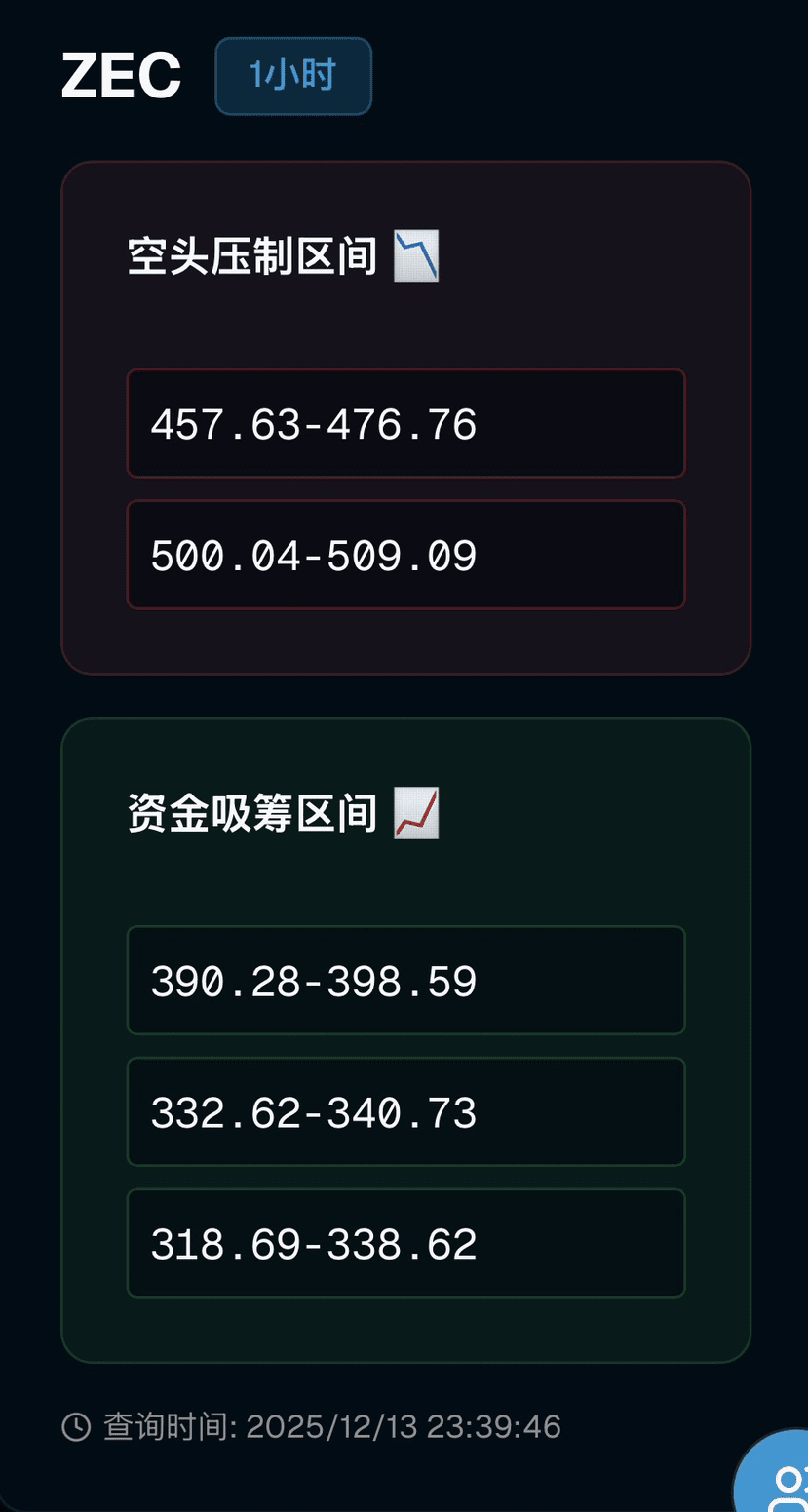
These accumulation zones are positions where 'retractions can hold stronger, making it easier for the operators to take in stock and push again,' but note that they are deeper, meaning today's 'swing' is likely to oscillate near the upper resistance zones, rather than necessarily returning to the deepest accumulation zone to start.
[How the market should move to align with 'bullish + swing'] Two typical scenarios: The first is a box swing: the price repeatedly pulls at or below 457.63-476.76, getting pressured on the upswing and caught on the downswing, washing out those who chase rises and panic sell through oscillation; the second is a stepwise increase: first break and stabilize above 457.63-476.76, then slowly lift after confirming the dip does not break, finally testing 500.04-509.09. Since the operators 'are not prepared for a significant push up,' it leans more towards 'slow grind + dip confirmation' in the second scenario, rather than a direct big surge. What you need to earn today is not the 'highest segment,' but the 'most certain segment of the structure.'
[Intraday Strategy (only buy on signals, but with small positions)]
1) Prioritize buying on dips: When the price falls from above and approaches the range of 457.63-476.76 (or returns to the upper edge of this range after a dip), focus on whether the 'dip is on low volume, whether a reversal pattern appears, and whether the lows are rising.' In a swing market, the most comfortable long positions are often 'dips that can't go lower,' rather than 'regretting not chasing after a rise.'
2) Follow after breakout confirmation: If the price breaks above 476.76, do not chase immediately; wait for it to dip near 476.76 without breaking, and regain strength again before following with a small position; this 'breakout - dip - then up' structure has a higher win rate in swing markets.
3) Target levels/reduction ideas: The first target naturally looks at the selling pressure response at the upper edge/inside the 457.63-476.76 range; if holding long above the range, the closer to 500.04-509.09, the more actively one should reduce positions, as that is a strong resistance zone where 'a rise followed by a drop + second round of washing' is most likely. Only if it can effectively stabilize at 509.09 and dip without breaking, can it be considered an upgrade from 'swing bullish' to 'trend bullish.'
[Stop-loss and position (this time is key)] Since the system emphasizes 'small positions,' your stop-loss must be 'short and clear,' do not rely on holding positions to solve problems: for buying on dips, use the critical support of the dip structure as the stop-loss basis (exit if it breaks and fails to recover); for breakout confirmation longs, use 'failure to hold the breakout confirmation level' as the retreat condition. In swing markets, heavy positions are most feared because they naturally oscillate back and forth, and holding heavy positions actively provides the operators with 'reasons to wash you.'
[Conclusion] ZEC is currently still biased towards bullish, but today is not a violent surge, rather a grind for swings: first, look at the near-term resistance at 457.63-476.76 for repeated games, with strong resistance truly at 500.04-509.09; the accumulation zones below are at 390.28-398.59 and the deep water zone of 318.69-340.73. The strategy can be summarized in one sentence: only seek to go long, but do not chase the rise, using 'dips for entry/breakout dips for confirmation' to capture certainty, with small positions for quick in-and-out, taking control at resistance zones. For learning and exchange purposes only, not investment advice.
