Do you know what has always annoyed me about crypto articles? Everyone writes about the same thing. DeFi, DeFi, DeFi. Token prices, liquidity, yield farming. As if the entire blockchain exists solely for people to speculate on prices and earn APY. I open the tenth article about oracles — and again: "Oracles are needed to obtain cryptocurrency prices in smart contracts". Well, thanks, captain, I would have never guessed.
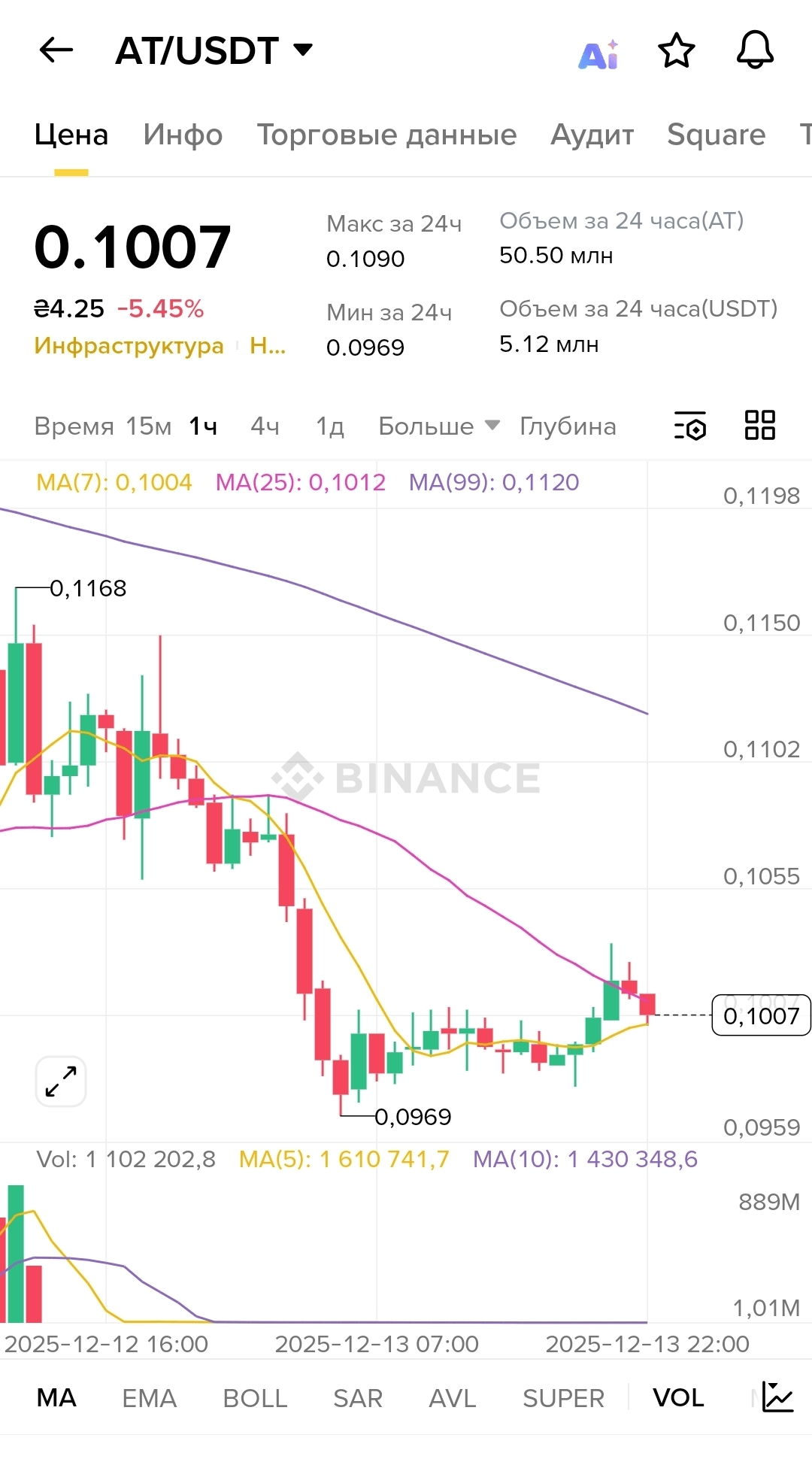
I look at the chart of $AT, which is trading at 0.1007 with a drop of 5.45%, and I think: @APRO-Oracle can do much more than just transmit bitcoin prices. It’s like using an iPhone only for calls — technically possible, but then why have all this power? Let me tell you about really interesting, non-obvious applications that almost no one writes about, but which can change not only crypto but also ordinary life.
1. Crop insurance for farmers in developing countries
Let me start with something that surprised me. Imagine: you are a farmer in Kenya or India. You don’t have a bank account, no access to traditional insurance, but you have a smartphone with internet. You plant corn, and your only fear is drought. If there is a drought, you lose the entire harvest, and your family goes hungry.
And now imagine a smart contract on the blockchain that automatically pays you compensation if the precipitation in your region falls below a critical level. How does the smart contract know about precipitation? From the oracle. #APRO can transmit weather data from weather stations directly to the blockchain. No need for insurance agents, no bureaucracy, no need to prove that your crop has really died. Precipitation less than 50 mm in a month? Here’s your money, automatically, in five minutes.
This is not science fiction. Such projects already exist, but most use centralized data sources or expensive oracles. @APRO-Oracle, with its low costs and support for different types of data, makes this accessible for mass use. When I first read about it, I got goosebumps. Because it really changes people's lives, it’s not about speculation and lambos, it’s about survival.
2. Real estate and tokenization of real assets
This is a topic that will explode the market in the coming years. Right now, if you want to buy real estate, you need millions, loans, lawyers, months of processing. But what if you could break an apartment into tokens? One token = 0.001% of an apartment. You could buy tokens worth $100 and own a micro-share in a penthouse in Manhattan.
But here’s the problem: how does the smart contract know the real value of this apartment? How does it know that the apartment even exists? That it hasn’t been sold twice? That it hasn’t caught fire? Real-world data is needed — cadastral records, market valuations, insurance data.
#APRO can transmit this data to the blockchain. Integration with land registries, appraisal companies, and real estate databases. And now the smart contract knows that the apartment costs $2 million, not $200. That it actually exists and is not mortgaged in three banks at the same time. The trading volume of $AT at 5.12 million USDT shows growing interest in such real applications because people are tired of pure speculation.
I seriously think that in five years we will be able to buy shares in apartments as easily as we currently buy stocks on the exchange. And oracles like @APRO-Oracle will be critical infrastructure for this. Because without reliable data on real assets, all this tokenization turns into a pyramid or a scam.
3. Game data and fairness in esports
Let’s move on to something lighter but no less important. Games. I’m not talking about some conditional crypto games with NFT monkeys, but about real gaming. Imagine: there’s a game where players bet money on the outcomes of their matches. Not a casino, but skill-based betting — the better player wins.
The problem is how to prove the result of a match? You can record a video, but it can be easily forged. You can trust the game server, but what if the server was hacked or the admin is cheating? An independent source of truth is needed. And here comes the oracle, which connects to the game API and transmits the real match results to the smart contract.
$AT on the chart may fall by 5.45%, but gamers do not stop playing, and the esports industry is only growing. #APRO with its verifiable randomness and data verification is ideal for this. It can not only transmit match results but also generate fair random numbers for loot boxes, drops, tournament brackets. No one can rig it, no one can predict.
I know several indie game developers who wanted to add blockchain elements to their projects but backed out because integrating with oracles was too complicated and expensive. With @APRO-Oracle, the barrier to entry is much lower. This means that more games will have a fair on-chain economy, and more players will be able to earn and own their in-game assets.
4. Supply chains and cargo tracking
Here’s a topic that sounds boring but is actually incredibly important. Have you ever ordered something expensive from abroad and worried — what if they lose it? What if they swap it? How do I know it’s the original and not a counterfeit?
Blockchain + oracles can solve this problem. Imagine: every stage of delivery is recorded on the blockchain via a smart contract. The cargo left the warehouse in China — event recorded. It arrived at the port — recorded. Passed customs — recorded. Each stage is confirmed by data from independent oracles, which get information from GPS trackers, barcode scanners, temperature sensors (important for medicines and food).
#APRO can integrate with logistics systems and transmit this data to the blockchain. And now you have an immutable record of the entire journey of your cargo. You know for sure that the package hasn't been tampered with, that the storage conditions are met, and that everything is legal.
This is especially critical for luxury goods and medicines. Do you know how many counterfeit medicines are sold in developing countries? People die because they buy 'antibiotics' that are actually sugar pills. With blockchain + oracles, every package can be tracked from the pharmaceutical factory to the pharmacy. It's impossible to forge.
5. Sports betting and fantasy leagues without intermediaries
Okay, back to entertainment. I’m not a betting enthusiast, but I know people who do it. And they all complain about one thing: bookmakers take huge commissions, plus there’s a risk that you won’t get paid your winnings if you win a lot.
Smart contracts solve this. Two people bet on the outcome of a football match, the money is locked in the contract. The match ends, the oracle transmits the result, the contract automatically pays the winner. No intermediaries, no commissions (well, only gas fees, but that's a pittance compared to 10-20% from the bookmaker).
@APRO-Oracle can obtain data on the results of sports events from official league APIs, from news agencies, from multiple sources for verification. The volume of 50.50 million $AT per day shows that the token is active, which means the infrastructure is working and scaling.
Or fantasy leagues. You assemble a team of real players, they earn points based on their actions in real matches. The oracle transmits player statistics (goals, assists, runs), the smart contract calculates points, determines the winner. Everything is automatic, everything is transparent, everything is fair.
6. Parametric insurance for travelers
This is actually my favorite idea because I travel and know this pain. The flight was delayed for 10 hours. You are angry, tired, late for a meeting, or missed the first day of vacation. You try to get compensation from the airline — and hell begins. Fill out the form. Attach boarding passes. Wait 6-8 weeks. In the end, either they deny it, or they give you a $50 voucher that you won’t use.
And now imagine: you buy insurance in the form of a smart contract. Your flight has been delayed for more than 3 hours? The smart contract receives delay data from the oracle (which monitors airport data), and the money automatically comes to your wallet. No claims, no waiting, no hassle.
#APRO can connect to airline APIs, flight tracking systems, and weather services. And this works not only for aviation. Stuck on a train? Concert canceled? Conference didn’t happen? All of this can be insured through smart contracts with oracles.
I would buy such insurance. Seriously. I would pay $20 and know that if something goes wrong, I would be automatically compensated. The market for this is huge, because everyone who has ever been stuck at an airport understands this pain.
7. Academic achievements and verification of education
The last point, which sounds boring but is critically important. Forging diplomas and certificates is a huge problem. People lie on resumes, buy fake diplomas, impersonate specialists they are not. Employers cannot verify whether a candidate really graduated from Harvard or if it’s a Photoshop job.
Blockchain + oracles can fix this. The university issues a diploma and records it on the blockchain via a smart contract. The oracle verifies the data from the university database. Now you have a cryptographically secure record that yes, this person really received this degree at this university this year.
@APRO-Oracle can integrate with educational databases, university management systems, national diploma registries. And now an employer checks your diploma in a second by scanning a QR code. It's impossible to forge because the data is on the blockchain, verified by an independent oracle.
This applies not only to diplomas but also to course certificates, licenses for doctors and lawyers, professional accreditations. Your entire educational history is on the blockchain, safe, forever, verifiable.
The chart shows that $AT is in the range of 0.0969-0.1090, and this is normal volatility for a young project. But if #APRO really implements at least half of these use cases, the value of the token could increase significantly. Because we are not talking about a narrow niche in DeFi, but about mass applications that affect billions of people.
I specifically chose these seven examples because they show: oracles are not just 'crypto prices for DEX'. They are a bridge between blockchain and the real world. Between smart contracts and the lives of ordinary people who don’t even know the word 'blockchain'.
A farmer in Africa who receives insurance for his crop. A traveler who automatically receives compensation for a flight delay. A gamer who is sure that loot boxes are fair. A buyer who knows that his medicine is not counterfeit. A student whose diploma cannot be forged. These are all real people with real problems that blockchain + oracles can solve.
And @APRO-Oracle with its multichain support, AI verification, low costs, and flexible architecture is one of the few projects that is technically capable of implementing all of this. Not in 10 years, but right now.
So when someone says 'oracles are only needed for DeFi', I roll my eyes. Because DeFi is just the beginning. The real potential of oracles is to connect blockchain with every aspect of human life. From agriculture to education, from travel to real estate, from gaming to logistics.
And if projects like #APRO continue to develop in this direction, maybe in a few years we will stop noticing blockchain at all. It will become invisible infrastructure that simply makes life fairer, more transparent, more efficient. Like the internet now — you don’t think about TCP/IP protocols when you watch Netflix. You just use it.
This is what oracles are for. Not for crypto traders to make bets on prices. But for blockchain technology to finally start changing the real world.