
There are many participants in the market, and here we only discuss two: one is the manipulator; the other is the manipulated.
Market manipulators are a group of investors or institutions that control large amounts of funds and can short-term control price trends (including charts). They are very mysterious in the eyes of the public, who believe they are the culprits behind their losses, so people try every means to find out who they are, their operational methods, their behaviors, how they select stocks, and how to identify them... People often refer to them as the main force or market makers, etc. For convenience of narration, we will hereafter refer to them as M (Composite Man).
CM creates price movements targeting the public behind the scenes, manipulating news. If we do not understand their rules of the game, we become victims in the market; conversely, if we are well aware of their behavior habits, we can use this knowledge to transition from ambition to success in the market. We do not need to know who they are, where they live; being able to interpret their behavior is enough. In short, every wave of movement in the market is meticulously planned and executed by them.
The behavior habits and means of the main institutions
In the eyes of the main institutions, the trend is a series of trading ranges of varying sizes; their entry point is always at the bottom of the range, and their exit is always at the top of the range. In other words, they exit when the public is greedy, and they enter when the public is panicking. For example, they create a long bullish candle during fluctuations, aiming to sell at the top; they create a long bearish candle to shake off the public and absorb all the stocks sold by the public out of panic.
Their behavior is highly covert and deceptive; for example, when they are accumulating, they make the trend appear dull at low prices, aiming to make the public sell stocks out of despair.
CM does not like the public to buy in with them. For example, at the beginning of the price entering a bull market, they still strictly control the market, making the trend appear very slow, and the trading volume very light, aiming to prevent the public from entering. If we were to make an analogy, CM is the marshal, and the public is the soldiers. When they do not need the public to charge, they will make the trend very dull and directionless; conversely, when they are ready to escape, they need the public to rush to buy.
When the price is about to reach their set target price, they will let the public open accounts to rush to buy stocks to transfer their risks.
For good news about the company, they will definitely know in advance, and before the good news is announced, they will let the price surge, stirring public emotions to buy stocks madly. On the day the news is announced, the public's rush to buy reaches a climax, while the main institutions smoothly transfer the risk to the public.
When dealing with bad news, they are informed in advance and start distributing their stocks; they let prices rise continuously for several days to stir public emotions, during which the public is unaware that bad news is imminent. When the main institutions finish distributing, and the market begins to decline, the bad news is announced, and for the public, it is too late; they have already fully invested at the top. At this time, stock analysts will say that this decline is due to the bad news.
The public is often trapped at the top; do not expect CM to show kindness to rescue them. They must use a fatigue tactic to make buyers trapped at the top sell at the bottom price (the price range where they accumulate); they deal with the blindly bottom-fishing public in the same way, forcing the public to sell their shares so they can absorb more stocks. Sometimes they also use methods to shake out the market, causing prices to suddenly drop significantly, shaking out even the most steadfast buyers.
The media is also their tool; when they need to escape at the top, the media will say the market is booming, aiming to attract the public to join. Or when they are accumulating, the media will sing negative news every day, aiming to make the public sell stocks at the bottom.
Finally, we use a chart to illustrate the difference between smart money and the public:
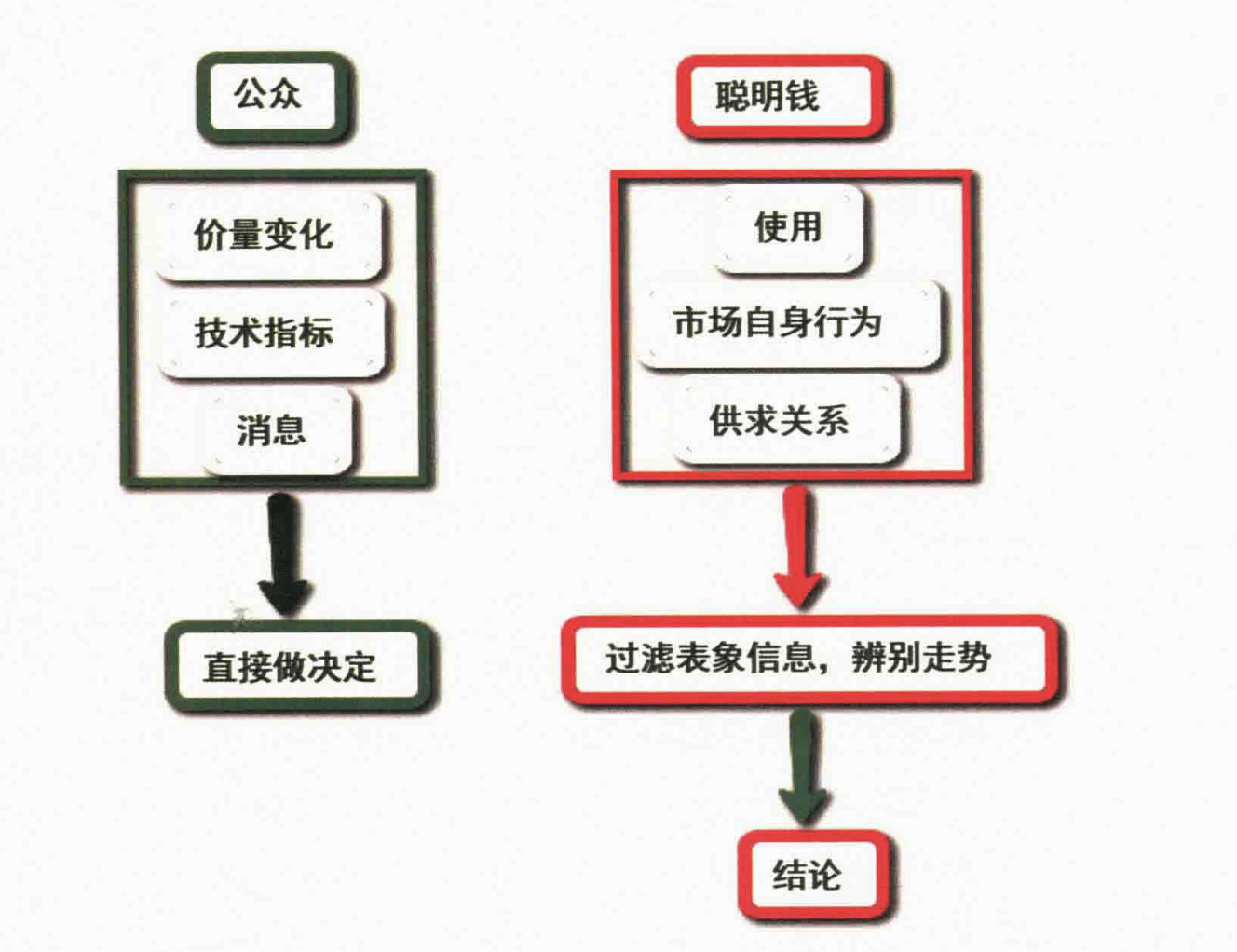
The public's analytical habit is:
Severely rely on technical indicators, news, rumors, and fundamentals.
See the signals given by technical indicators to decide on buying and selling.
Without a crisis management plan, it leads to being trapped.
The analytical logic of professionals (smart money) is:
Do not use technical indicators, do not interpret any news, only use price, trading volume, and rate of change.
For superficial information (price and volume), interpret trends through the market's own behavior and supply-demand relationships.
Make conclusions or inferences in conjunction with the current macro background.
Use crisis management to minimize risks.