
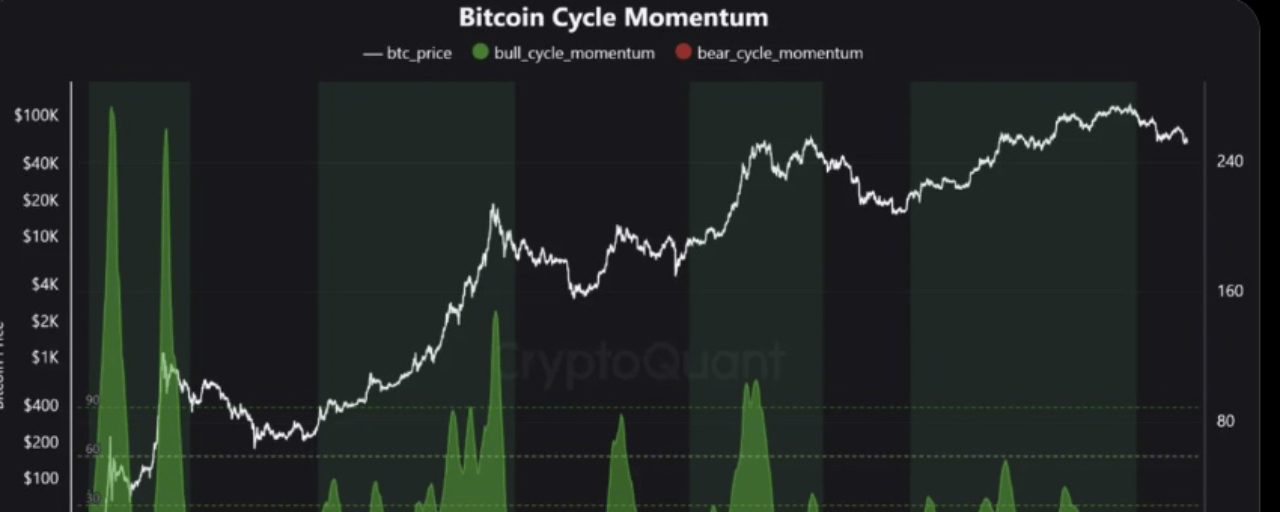

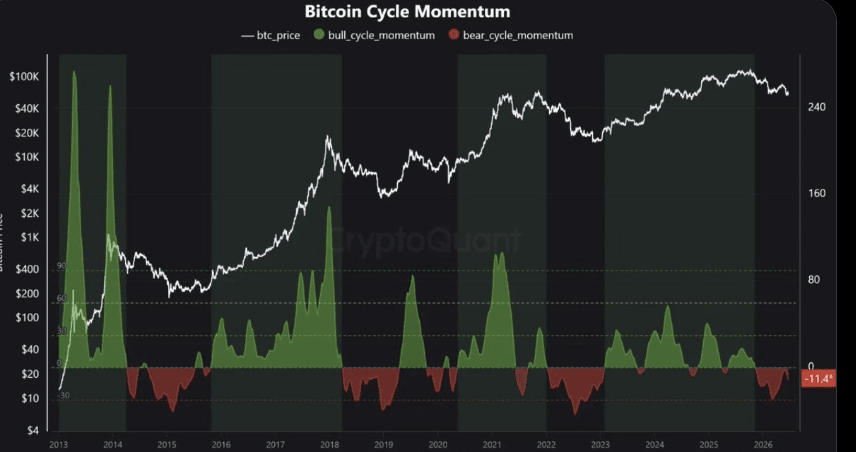
CryptoQuant's Bitcoin cycle momentum indicator has touched -30 — a reading that has appeared at every major cyclical bottom in Bitcoin's history. But analyst Gaah is clear: being in the bottom zone is not the same as confirming the bottom. The bear market continues until two specific conditions are met, and neither has been met yet.
What the -30 Reading Means
The cycle momentum indicator measures directional strength across the full Bitcoin market cycle. Readings below 0 indicate bear market conditions remain in force. Readings above 0 indicate bullish momentum has returned. The -30 level specifically represents the deepest accumulation zone in the indicator's history — the readings where prior bear markets have found their structural floor before meaningful recoveries developed.
The indicator reaching -30 in the current cycle places Bitcoin at a historically significant juncture. It is not a common reading — it requires sustained selling pressure, extended price weakness, and the kind of capitulation conditions that only develop at genuine cycle extremes. The fact that it has now touched this level is meaningful precisely because of how rarely it occurs.
Every Prior Cycle Produced a Recovery From This Zone
The -30 range has marked major support at the bottom of the 2015, 2018-19, and 2022-23 bear markets — each of which was followed by a substantial and sustained recovery. The current reading places Bitcoin in that same historically significant territory for the first time in the current cycle, adding the cycle momentum indicator to a growing list of bottom signals that have triggered throughout June.
That list now includes Bitcoin's Sharpe ratio dropping to -20 on June 11 — a level seen at each of those same three prior cycle bottoms. The RHODL Ratio has begun rolling over from its peak, matching the pattern seen at the 2015 and 2022 troughs. Glassnode's Accumulation Trend Score has held at its maximum reading of 1.0 for more than two weeks. K33 Research reports long-term holders now control a record 79% of Bitcoin's circulating supply. And 259,000 BTC have been net accumulated between $59,000 and $67,000 since June 5.
The -30 cycle momentum reading is the latest addition to this convergence — each indicator measuring a different dimension of the same underlying condition: the market is in the deep zone where bottoms form.
Why This Is Not Yet a Confirmed Buy Signal
Analyst Gaah's framing is deliberately precise, and the distinction matters. The indicator being in the -30 range creates the structural conditions for a bottom. It does not confirm one. The bear market, by this indicator's definition, continues until two conditions are met simultaneously: the price must form a recognizable bullish pattern on the chart, and the cycle momentum indicator must break above the neutral zone of 0.
Neither condition has been met as of June 22. The indicator remains below neutral. Bitcoin's price, while holding above its $59,375 cycle low, remains in a downtrend of lower highs that Standard Chartered's Geoffrey Kendrick has identified as requiring a reclaim of $83,000 to invalidate. The current range of $60,000 to $67,000 — identified by XS.com's Simon-Peter Massabni as the near-term holding zone — has produced technical bounces but not the kind of sustained directional move that would constitute a confirmed bullish pattern.
This discipline — distinguishing between bottom-zone conditions and confirmed reversals — is consistent across every credible analytical framework applied throughout this correction. CryptoQuant's "close to value, not confirmed recovery" framing from weeks ago remains accurate. The Sharpe ratio's -20 reading preceded three to five months of basing before durable recoveries in each historical case. Glassnode's maximum Accumulation Score signals the floor is forming, not that it has formed. And Galaxy Research's warning that ETF outflows are "still deepening day over day" confirms that the institutional demand signal necessary for confirmation has not yet materialized.
How This Fits the Broader Bottom Picture
The value of the cycle momentum indicator reaching -30 is not that it tells us the bottom is here — it is that it tells us we are in the zone where the bottom is likely to develop. That distinction shapes how investors should position: not as a timing signal to deploy capital immediately, but as a structural signal that the risk-reward at current levels is historically favorable for those with the time horizon to wait for confirmation.
Every prior instance of the -30 reading rewarded those who began accumulating at that level, even if they endured further volatility before the trend reversal was confirmed. The 2015 bottom required five months of basing after similar signals appeared. The 2018-19 bottom required approximately three months. The 2022-23 bottom similarly required roughly three months before a durable uptrend established itself.
If those historical timelines apply to the current cycle — which began deteriorating from the October 2025 peak near $126,000 — the base formation period is likely still underway rather than complete, and the confirmation signals Gaah identifies as necessary prerequisites may still be weeks or months away from materializing.
The Catalyst That Could Trigger Confirmation
The most proximate scheduled catalyst for the cycle momentum indicator to begin moving toward 0 is the Federal Reserve's policy trajectory — specifically whether incoming data allows the Fed to soften its hawkish stance. The June FOMC meeting's dot plot showed 9 of 18 officials projecting 2026 rate hikes, maintaining the higher-for-longer pressure that has been the primary macro headwind throughout this correction.
Core PCE — the Fed's preferred inflation measure — releases next week and represents the most immediate opportunity for that narrative to shift. A softer-than-expected reading would validate the thesis that oil's decline from $120 to $75 following the US-Iran peace deal is feeding through into measured inflation, potentially giving Warsh's Fed cover to soften its language at the next meeting. A hawkish surprise would do the opposite, extending the macro conditions that have kept institutional ETF buyers on the sidelines through six consecutive weeks of net outflows.
Until the macro backdrop shifts, the ETF flows stabilize, and Bitcoin's price forms the bullish pattern Gaah identifies as a necessary precondition, the -30 cycle momentum reading is best understood as confirmation that the current correction has reached the historical depth where major bottoms form — not as a signal that the bottom has already been reached and confirmed.