
In a landscape crowded with yield promises that evaporate as quickly as they appear, Lorenzo Protocol’s Financial Abstraction Layer (FAL) stands apart—not through spectacle, but through structure. Aish has spent months tracing the evolution of on-chain yield systems, and what distinguishes Lorenzo is not its marketing, but its mechanics. The FAL is not a peripheral feature; it is the protocol’s central nervous system, designed to orchestrate capital with the precision of a traditional asset manager—yet entirely on-chain and permissionless.
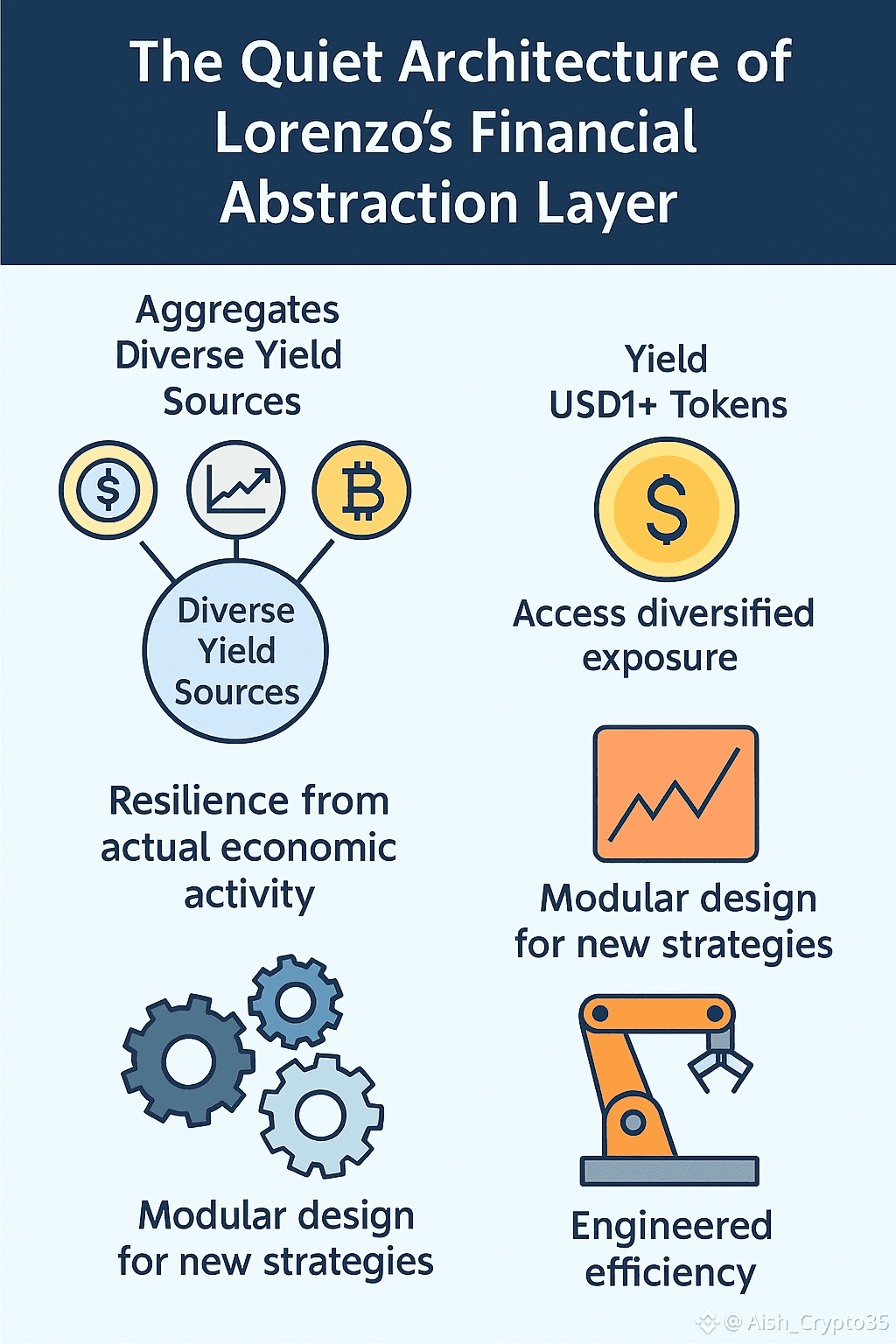
At its foundation, the FAL aggregates, normalizes, and packages diverse yield sources—ranging from stablecoin lending and quantitative trading strategies to real-world asset (RWA) cash flows and Bitcoin staking returns—into unified, tokenized instruments. The flagship example is USD1+, an On-Chain Traded Fund (OTF) that blends yields from multiple verified, low-correlation sources into a single ERC-20 token. Users hold USD1+ not to chase APR spikes, but to access consistent, diversified exposure—akin to a money-market mutual fund, but with full on-chain transparency and instant redemption.
This approach fundamentally redefines yield generation. Most DeFi protocols rely on token emissions to subsidize returns, creating artificial incentives that collapse when inflation slows. Lorenzo’s FAL, by contrast, is engineered to remain functional even in low-emission or bear-market environments, because its returns derive from actual economic activity—not synthetic rewards. That resilience is not accidental; it is architectural.
Moreover, the FAL is modular by design. New strategies—such as volatility harvesting or cross-chain liquidity routing—can be integrated without overhauling the core system. This allows Lorenzo to adapt to shifting macro conditions: leaning into RWA during stable regimes, or DeFi-native strategies during high-volatility phases. Aish notes that this flexibility without fragmentation is rare. Many protocols pivot so aggressively they lose coherence. Lorenzo evolves while staying true to its purpose: making capital work intelligently, not loudly.
The quiet power of the FAL lies in what it omits: noise, opacity, and dependency. It doesn’t promise impossible returns. It offers engineered efficiency. And in a market increasingly wary of vaporware and yield cliffs, that restraint is becoming a form of strength. As institutional participants re-enter on-chain finance, they won’t be looking for the loudest protocol—but the most reliable. Lorenzo’s FAL is building for that moment, not with fanfare, but with function.
#LorenzoProtocol @Lorenzo Protocol $BANK

