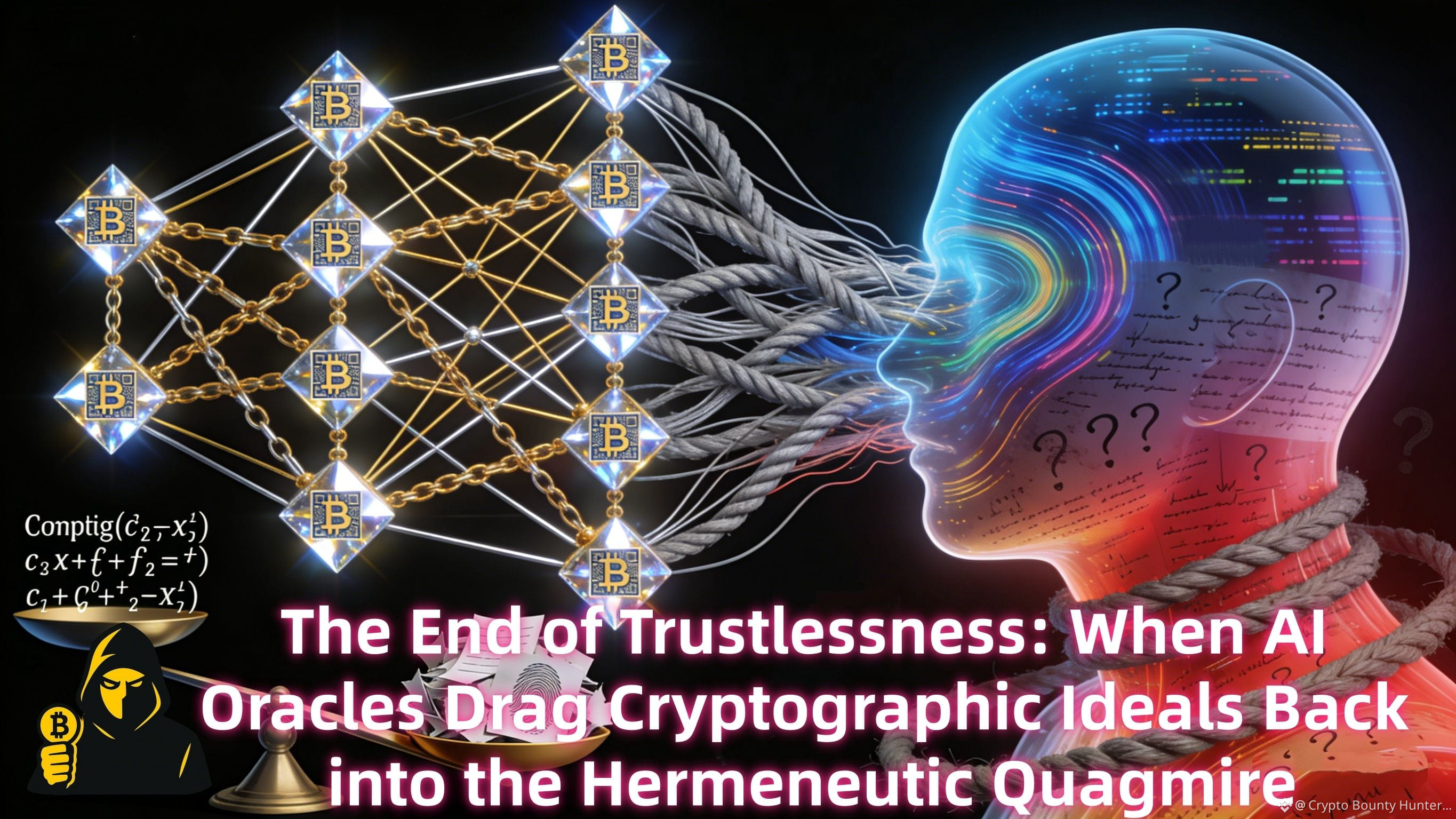
The ultimate promise of blockchain is not decentralization, but trustlessness—the elimination of reliance on any third party through cryptography and game theory. AI oracles are bankrupting this promise by replacing simple “verification” with complex demands for “understanding,” dragging us back into an old world where interpretive authority must be trusted.
Satoshi Nakamoto never used the word “decentralization” in the Bitcoin whitepaper. His core innovation was a trustless system—through Proof of Work and the longest-chain rule, participants can reach consensus on the ledger state without trusting any counterparty, intermediary, or authority. This trustlessness, rather than decentralization itself, is what fundamentally distinguishes blockchain technology from all previous distributed systems.
What APRO Oracle introduces under the banner of “AI enhancement” goes far beyond the ability to process unstructured data. It reintroduces trust requirements at the system level—trust in the AI model’s interpretive ability, trust in the representativeness of its training data, and trust in the values of its algorithm designers. When the “validity” of a legal document must be understood rather than simply verified, when the “value” of an artwork must be interpreted rather than matched, we leave the domain of cryptographic verifiability and enter the humanistic domain that depends on interpretive authority.
01 From “Verifiable” to “Understandable”: A Betrayal of the Paradigm
The core feature of trustless systems is independent verifiability: any participant with basic technical capability can verify the correctness of the system state without relying on others’ assertions. In Bitcoin, you can independently verify transaction signatures and block hashes; in Chainlink, you can compare quotes from multiple data sources. But in an AI oracle like APRO, how do you “verify” that a legal document’s validity score should be 0.87 rather than 0.85?
The answer reveals a paradigm shift:
A change in the nature of verification
Traditional oracles: mathematical verification (signatures, hashes, numerical comparison)
AI oracles: interpretive evaluation (semantic understanding, contextual inference, probabilistic judgment)
Structural differences in verification costs
Mathematical verification: fixed cost, decreasing with hardware progress
Interpretive evaluation: cost grows exponentially with complexity and requires domain expertise
A migration in the essence of consensus
Mathematical consensus: agreement on “what happened” (whether a transaction is valid)
Interpretive consensus: agreement on “what it means” (whether a document is valid)
APRO attempts to simulate trustlessness through “confidence scores” and “challenge mechanisms,” but this is a false comfort. Challenging a 0.87 validity score for a legal document requires an equally complex counter-interpretation—this becomes expert debate rather than cryptographic verification. Ordinary nodes cannot meaningfully participate, and decision-making power inevitably concentrates in a small group of “expert nodes” with AI and legal expertise.
More fundamentally, interpretation is inherently value-laden. When APRO verifies a land ownership document, its AI model implicitly endorses a particular theory of property rights—does it favor absolute individual ownership, or recognize communal traditional rights? Does it rely strictly on written registries, or accept oral transmission as evidence? These value judgments are encoded in training data and model architecture, yet presented as “objective algorithmic output.”
This covert encoding of values is a lethal poison to trustless systems. Trustlessness presupposes transparent, value-neutral rules, but interpretive AI systems cannot be value-neutral—understanding itself is a value-loaded activity. When users must trust that APRO’s AI “understands correctly,” the promise of trustlessness has already been betrayed.
02 The Recentralization of Interpretive Authority: A New Technocratic Priesthood
Blockchain redistributed power by shifting authority from institutions to code. That authority is now shifting again—to AI models that interpret code, and the ability to understand those models is highly concentrated among a small technological elite.
Power concentration within APRO’s architecture occurs on three levels:
The cognitive monopoly layer: model architecture design
Transformer attention mechanisms, convolutional hierarchies, graph neural network connections—these architectural choices determine how AI “thinks.” Choosing an architecture is choosing a mode of cognition, a power held by a small group of machine learning researchers. When APRO’s core team selects an architecture, it selects a worldview for the entire network.
The reality-definition layer: training data curation
Which legal cases are included? Which artworks are labeled “masterpieces”? Which business practices are deemed “compliant”? These curatorial decisions define “what counts as reality.” At APRO’s scale, such decisions cannot be decentralized—they require expertise and quality control, naturally leading to centralized editorial teams.
The value-encoding layer: loss function design
AI learns by minimizing “loss.” In verification tasks, the loss function defines “what is good”: is it better to misclassify genuine items as fake (high precision), or to accept some fakes to ensure genuine items pass (high recall)? This trade-off is a value judgment—conservatism vs. inclusivity, safety vs. usability.
These power layers are absent or weak in traditional oracles. Chainlink nodes can freely choose data sources, creating natural diversity. In APRO, however, the cognitive framework is unified at the source. Nodes merely execute replicas of the same framework; diversity is limited to computational redundancy, not cognitive plurality.
The danger of this cognitive centralization is not conspiratorial control, but systemic blind spots. If APRO’s interpretive framework contains an undiscovered bias or flawed assumption, the entire network shares it. When confronted with edge cases underrepresented in training data—indigenous land claims, non-Western art traditions, emerging business models—the system may fail collectively or produce systemic discrimination.
The “DAO governance” described in APRO’s documentation faces a fundamental dilemma here. How can ordinary AT holders meaningfully participate in decisions like “which attention mechanism should we use” or “should the loss function favor precision or recall”? These questions require deep machine learning expertise, inevitably pushing decision-making toward technical elites. Token voting becomes an endorsement of expert authority, not genuine decentralized governance.
03 The Loss of Auditability: When Systems Become Too Complex to Understand
Another pillar of trustless systems is auditability—any participant can, in principle, inspect the system and verify its correctness. Bitcoin’s codebase is relatively simple; a skilled developer can understand the entire system. APRO’s AI oracle may mark the end of the age of auditability.
Auditing APRO requires mastery across four domains that are nearly impossible to combine:
Domain One: Blockchain engineering
Understanding node consensus, economic game theory, and smart contract security—the traditional domain of crypto auditors.
Domain Two: Machine learning theory
Understanding Transformer architectures, gradient descent optimization, and overfitting risks—requiring PhD-level data science expertise.
Domain Three: Domain-specific expertise
For RWA: legal theory, real estate practice, environmental science. For art: art history, connoisseurship, market dynamics.
Domain Four: AI security and adversarial machine learning
Understanding how models can be deceived (adversarial examples), poisoned (data poisoning), or manipulated (backdoor triggers).
Even if one could find superhuman auditors who master all four domains, they would still face the combinatorial explosion of system complexity. Interactions between blockchain components, AI models, and domain logic can produce unexpected emergent behavior. A minor model parameter tweak may alter legal validation distributions; a blockchain upgrade may break AI inference time assumptions.
More troubling is the inherent opacity of AI models. Even with full access to architecture and training data, we cannot fully understand why a neural network makes a specific judgment. Neural networks are black boxes—we see inputs and outputs, but the intermediate representations are unintelligible to humans. When APRO outputs a “validity score of 0.87,” we cannot know which legal clause, wording feature, or contextual cue dominated the decision.
This is especially dangerous in legal disputes. If an RWA asset validated by APRO becomes contested, how does one cross-examine it in court? Chainlink’s price data can be traced to a specific source and timestamp; APRO’s legal validity score is based on complex activation patterns across hundreds of millions of neural connections—impossible to translate into coherent legal reasoning.
APRO may respond by offering “explainable outputs”—listing factors and weights influencing the score. But this is merely another simplified model, an approximation of the true decision process, not the truth itself. We are masking fundamental opacity with the illusion of explainability.
04 Rewriting the Social Contract: When Code Is No Longer Law, but Legal Philosophy
The “code is law” ethos of smart contracts rests on the assumption that code rules are explicit, deterministic, and predictable. AI oracles like APRO erode this foundation, forcing a reconsideration of the smart contract social contract.
A change in the nature of smart contracts
Traditional: deterministic automata (given input, a specific output follows)
AI-enhanced: probabilistic decision systems (given input, a distribution of possible outputs)
A paradigm shift in dispute resolution
Traditional disputes: whether code executed as written (objectively decidable)
AI disputes: whether the AI’s interpretation was reasonable (requiring explanation and debate)
The blurring of responsibility
When APRO’s validation errors cause financial loss, who is responsible?
AI model developers? They can claim “model behavior is not fully predictable.”
Training data providers? They can claim “data reflects reality and is not advice.”
Node operators? They can claim “we merely run the code.”
Token governors? They can claim “we lack the technical expertise for informed decisions.”
This ambiguity is fatal to trustless systems. Trustlessness works because responsibility is clear: malicious nodes are slashed; buggy code implicates developers. In APRO’s complex system, errors may arise from subtle interactions across components, defying attribution to a single malicious actor or obvious flaw.
APRO attempts to manage this risk through “insurance funds” and “challenge mechanisms,” but these are financial transfers, not fundamental solutions. More profoundly, we are witnessing smart contracts evolve from “law” into “legal philosophy.”
Traditional smart contracts resemble statutory codes: explicit rules, mechanical execution. AI-enhanced smart contracts resemble common law systems: requiring interpretation, precedent, and judgment by judges (or AI). But common law relies on centuries of judicial tradition, clear accountability (judges can be impeached), and appeals mechanisms. APRO’s “decentralized legal philosophy” lacks all of these foundations.
What may emerge is algorithmic common law: APRO’s AI models evolve through historical validation cases, forming de facto “precedents,” but driven by opaque training processes and governance votes rather than open debate and rational argument. This could be the first legal system in human history that humans cannot fully understand.
05 Hunter’s Simulation: The Crypto World After the End of Trustlessness
If AI oracles like APRO become mainstream, the trustless ideal must be redefined—or abandoned altogether. This would trigger a fundamental reconfiguration of the crypto world:
Reconfiguration One: The stratification of verification classes
Crypto users split into two classes:
Shallow users: accept AI oracle outputs as “facts,” reintroducing trust
Deep verifiers: possess the multidisciplinary expertise to evaluate AI outputs, forming a new technical priesthood
This stratification contradicts crypto’s egalitarian ethos, but may be an inevitable consequence of technical complexity.
Reconfiguration Two: The rise of liability markets
As systems become too complex for clear attribution, insurance and guarantee markets will flourish. Protocols will buy “APRO validation error insurance,” users will demand “AI interpretation correctness guarantees.” This manages uncertainty via financial engineering, but introduces new centralized institutions (insurers, rating agencies).
Reconfiguration Three: The inevitability of judicialized governance
APRO’s DAO may need to evolve judicial structures: expert committees (judges), case accumulation systems (precedents), and appeals processes (higher courts). Decentralized governance will no longer be simple token voting, but a complex, multi-layered deliberative system.
Reconfiguration Four: A movement to minimize AI dependence
Parts of the crypto community may strongly resist AI oracles, developing “pure cryptographic” DeFi that only handles native on-chain assets and rejects real-world complexity altogether. This could form a fundamentalist branch of crypto—smaller in scale, but ideologically pure.
From an investment perspective, APRO’s value depends less on technical superiority than on social acceptance. The market must answer:
Are we willing to abandon the trustless ideal to handle complex real-world assets?
Are we willing to accept algorithmic interpretive authority, even if it is a black box and potentially biased?
Are we prepared to manage new forms of systemic risk arising from AI decision ambiguity?
APRO’s valuation will reflect the market’s collective answers. If the market embraces complexity and relinquishes trustlessness, APRO may become critical infrastructure; if the market clings to trustless ideals, APRO may remain a niche solution.
The final philosophical dilemma:
Trustless systems are powerful precisely because they abandon the ambition to understand the world, focusing only on verifiable state transitions. Bitcoin does not try to “understand” the meaning of transactions; it only verifies signatures and balances. But real-world value exchange requires understanding—understanding contractual intent, asset nature, counterparty credibility.
APRO attempts to bridge this gap, enabling blockchains to “understand” the real world. But in doing so, it may undermine the very properties that make blockchains valuable.
The fundamental choice before us may be this: either keep systems pure but limited to simple assets, or embrace complexity and accept that systems are no longer trustless. There is no middle path.
APRO bets that a middle path exists: through clever architectural design, systems can understand complex reality while remaining sufficiently verifiable. Yet so far, all evidence points to a fundamental tension between understanding and verification—the deeper the understanding, the poorer the verifiability.
This may be the shared dilemma of all complex systems: as capability increases, transparency inevitably declines. APRO may not be the solution, but rather the first clear manifestation of this dilemma in the crypto world. Its success or failure will tell us whether the trustless ideal can be extended to human complexity—or is destined to remain a beautiful illusion confined to a digital utopia.
Existential Question: When systems must “understand” to be useful, has “trustlessness” become a luxury we can no longer afford? Are we building smarter machines—or laying the foundation for a new cognitive theocracy?
— Crypto Hunter · In the Eternal Paradox of Trust and Understanding —