
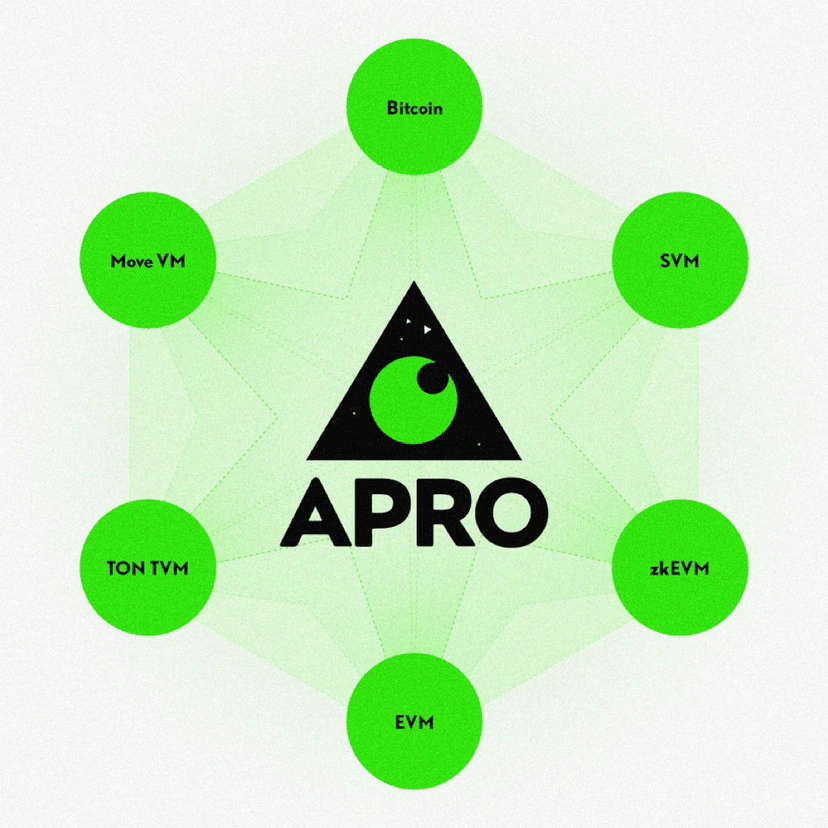
Look at the execution layer, Bitcoin, EVM, Move, they can all execute brilliantly, but they are trapped in separate linguistic silos. They can run fast, but they cannot agree on meaning. The current profound ceiling is not execution; it is the total lack of coherence across this diverse VM environment.
More and more institutions are beginning to realize that no matter how strong the cryptographic execution is, if the input layer remains fragmented, linguistically unaligned, and lacking unified semantic structure, the contract can only complete 'mechanical tasks' and will never be able to truly manage multi-chain risk.
This gap will not be solved by application-level patches, because the complexity of cross-chain capital deployment will only intensify. It must be supplemented from the foundational layer of truth.
The significance of Apro lies in that it is not reinforcing a single chain's execution, but redefining the language of truth.
Execution is Strong; Synchronization is Non-Existent
The industry has focused almost all its resources on execution capability in recent years: Faster EVMs and L2s, cheaper transaction fees, more efficient Rollup designs.
But these advancements only solve one problem: How does a chain 'act'?
While critically failing to solve the key structural issue: How does the entire ecosystem 'agree'?
Chains can see a transaction occur, but do not know the semantic meaning of that event on a different chain's ledger. They can see collateral locked in Move VM, but do not know if the derivative price feed on zkEVM is cryptographically consistent. Chains are not slow; they are 'executing but not aligning.' The stronger the execution capability, the more prominent this contradiction becomes, as the system demands accurate, simultaneous understanding across all language systems.
The emergence of Apro is to solve the problem of 'linguistic anarchy.'
From Language Barrier to Linguistic Governance
The operational requirement from institutional partners is not just speed, but a singular, unified standard. The current landscape is stuck: Bitcoin is too rigid, but the EVM cannot guarantee its finality; Move VM is too precise, but TON TVM operates on different structural logic.
Apro's logic is very clear—The system does not need to receive data from bridges; it needs to receive verifiable, harmonized semantic structures. This allows the 'language' of market value to be translated into the 'universal syntax'of all connected chains for the first time.
Each virtual machine (VM) currently operates with its own: Event logic, Behavior patterns, State models, and Risk hypotheses. But every advanced financial protocol, from cross-chain lending to RWA frameworks, demands a 'unified semantic layer.'
Without a unified governance layer, cross-chain capital deployment will forever be flying blind in a black box of unaligned data. Apro's role is to translate all these differences from a 'multilingual environment' into a 'universal, non-disputable semantic truth.' Only with this semantic unity can cross-chain financial intelligence possibly be established.
The Governance Layer: The Actual 'Control Tower'
In the past, protocols were driven by simple rules; now, high-value protocols increasingly rely on governed judgment. Without coherence, there is no cross-chain judgment. Without cross-chain judgment, there is no intelligent risk management.
Therefore, protocols are gradually shifting: From 'writing execution code' to 'writing semantic governance calls.'
Clearing is not about looking at raw prices, but about looking at unified risk structures.
Cross-chain execution is not about looking at individual events, but about looking at governed relationships between events across VMs.
All high-level financial protocols are converging towards this unified governance layer. When semantic governance becomes part of the core logic, Apro will become the actual 'Control Tower,' making the execution layer of the chains more like an 'operating system' rather than a 'simple calculator.'
The Shift from Data Consensus to Semantic Consensus
The essence of chains is consensus, but consensus is fundamentally upgrading.
The past consensus was: Is this number correct? (Data integrity)
The future consensus is: Is this interpretation reasonable and aligned across all VMs? (Semantic coherence)
What Apro provides is not unified data, but a unified way of interpreting and verifying truth across all VM languages. This allows protocols for the first time to share a 'layer of understanding,' rather than just sharing a 'layer of records.'
Conclusion
Every foundational infrastructure is born from necessity, driven by an unresolvable bottleneck. Today’s structural constraint is not one of performance, throughput, or bandwidth; it is the 'absolute ceiling of systemic coherence.' Apro does not merely occupy a space in this market; it exists precisely at the intersection of these non-negotiable demands.
It is this strategic positioning that defines Apro's ultimate value. It enables the multi-chain world to transcend its current state, moving from a fragmented execution environment to a 'singular, cognitively aligned system' with unprecedented clarity.


