
I believe many people face the issue of withdrawing funds, and there are many tutorials on how to withdraw, such as U cards, Hong Kong cards, and various other cards. Personally, I think these have little to do with ordinary people. As a retail investor, how much funds do you really need to withdraw? As a retail investor, a Binance C2C completely meets your needs. Below, I will share my experience with withdrawing funds over the past six months, based solely on my own practical experience and personal feelings, suitable for individuals with a capital range of 1 to 1 million. I don’t have large funds myself, so I won’t discuss that.
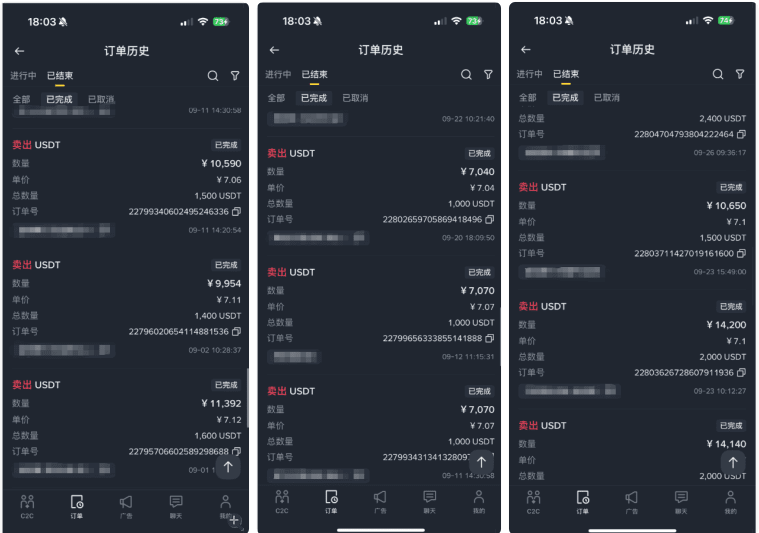
Next, I will break down how to safely withdraw funds from two dimensions: selecting merchants and accepting funds.
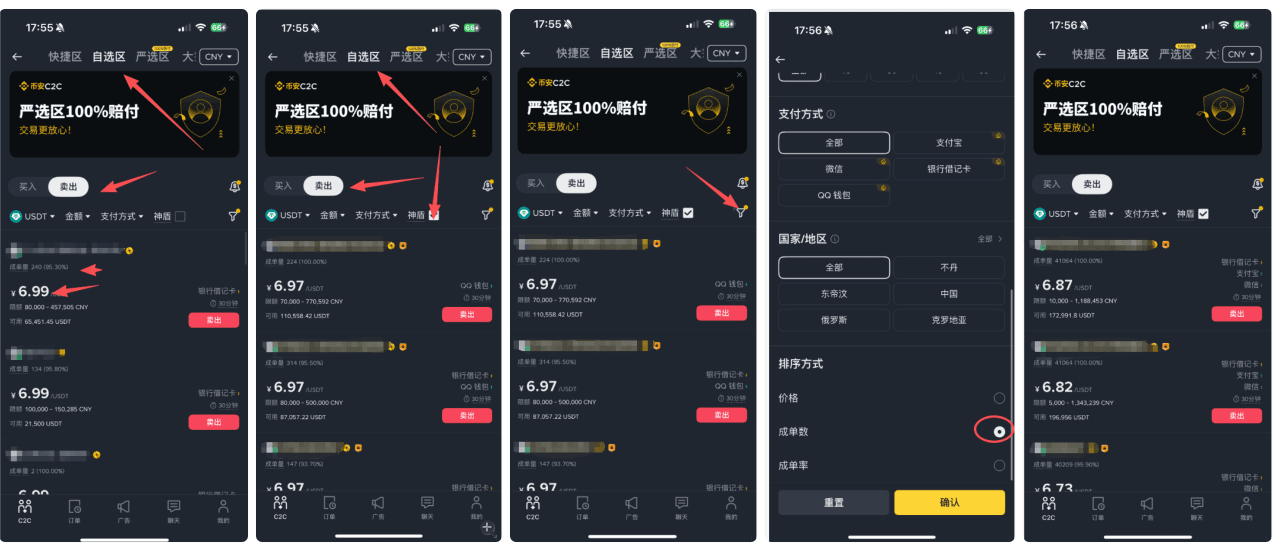
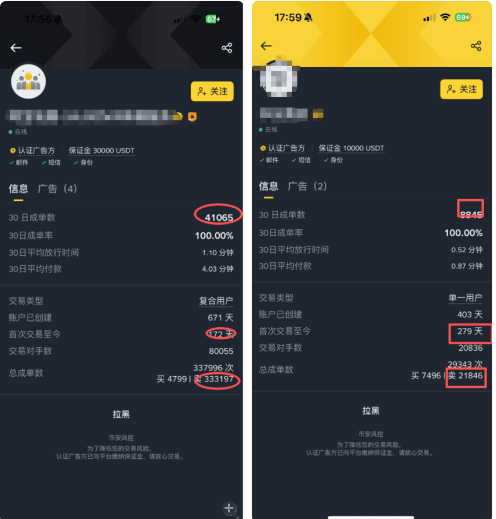
How to select effective merchants. When you open Binance C2C to prepare for fund withdrawal, you should select merchants based on three dimensions: (transaction volume, registration time, 30-day transaction volume).
Note: Do not be tempted to choose those who have just registered and have high prices. Personally, I don’t mind a little exchange rate difference, and I prefer ShenDun merchants (at least they have paid more deposit, reducing the chance of disorderly conduct).
You can see the comparison in the two images below; it is clear that the prices of ShenDun merchants are slightly lower.
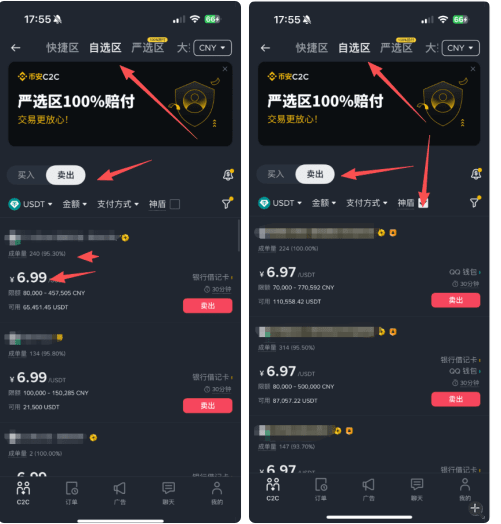
When we set a higher threshold, the price has a significant difference, so when we withdraw funds, we should prioritize: ShenDun---transaction volume. Only after filtering should we trade with merchants. Do not be tempted to sell to those with short registration times, low transaction volumes, and high prices. Cryptocurrency investment is a very high-risk activity; no one will give you an advantage for no reason.
One thing to note when selecting merchants is that you must look at the total transaction volume and the transaction volume in the last 30 days. What does this mean? For example, if a merchant has an old account registered for one year, and their transaction volume in the last 30 days is more than 80% of their total transaction volume, this could also be a deliberately maintained account. You must filter for accounts that have been registered for a long time, have a large number of transactions, and maintain a consistent transaction volume every month. Both buying and selling volumes need to be considered. See the picture below.
After selecting suitable merchants, the next thing to be aware of is how to avoid being scammed by merchants.
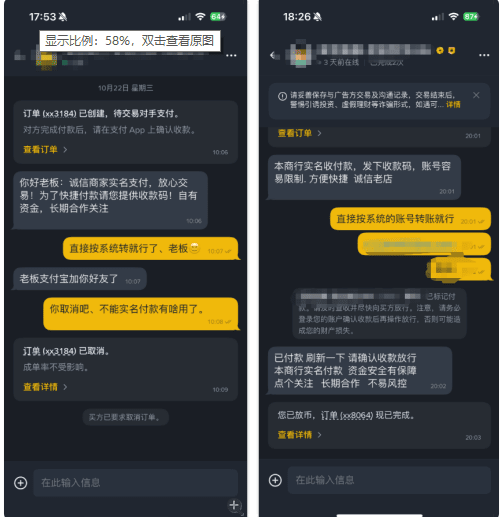
The core element must be a real-name payment bound to the platform. Never trust the merchants' sweet words (like 'My account is limited, can I use my relative's account to pay?'). The image below shows this: first, you do not transfer money to them, but they add you as a friend and then privately message you asking if they can transfer with their relative's card. This must be a NO. Always use the corresponding real-name transfer of the platform.
Another thing to note is that if you choose to receive payments via Alipay or WeChat, make sure to select the transfer option. Do not send a payment code to let the other party pay because you cannot verify their information with a payment code. With a transfer, you can check the other party's real-name information on Alipay.
Now we reach the core part, which is how to accept funds. When accepting funds, do not take the easy way out by directly using a bank card for receipt. Use Alipay or WeChat to accept withdrawn funds. Personally, I always use Alipay to accept funds because it has already filtered the funds for you (generally, illicit funds cannot enter Alipay). Another point is that, for example, if you withdraw 1000, the 1000 you receive is actually not 1000 transferred directly from the merchant.
I don’t know if you can understand this. To put it simply, if you have 1000 yuan and the numbers are from 1-10, if you receive payment now, what you receive must be a continuous series of 1000 funds from 1-10. However, if you receive money through Alipay, even though you received 1000, it does not correspond to the continuous series from 1-10. It seems a bit convoluted; I don’t know if anyone understands...
Let me share a little trick I use. I choose Alipay to accept funds, and the moment I receive the funds, I directly repay my credit card with that money in Alipay. Once it's paid off, I return to Binance to confirm the transaction is completed. When I need it, I swipe the money out through a POS machine (because the money swiped out through the POS machine to your bank card is all advanced by a third-party payment company). This is my withdrawal process:
Merchant transfers---Alipay backend----My Alipay----Credit card bank-----Third-party payment company---My bank card
Basically, after going through this process, the chances of my card being frozen are almost negligible because I have already avoided many issues from selecting merchants to accepting funds. This is my practical approach to withdrawals; I don’t know if it helps you. If it does, please give a thumbs up for support.
I don't know if I've explained it clearly. Due to my limited eloquence, I'm not sure if my expression is clear. If you don’t understand the text, feel free to ask in the group; we can chat anytime.
Follow me✅ to get the latest airdrop opportunities and practical strategies in real-time. Let’s grow, make money, and enjoy freedom together...
#BNB #币安alpha
