
3.6% of GDP in stablecoins: why Ukraine became a global leader and what lies behind this.
Ukraine 🇺🇦 topped the global ranking for Stablecoin Flow / GDP — the volume of stablecoin transactions relative to the size of the economy.
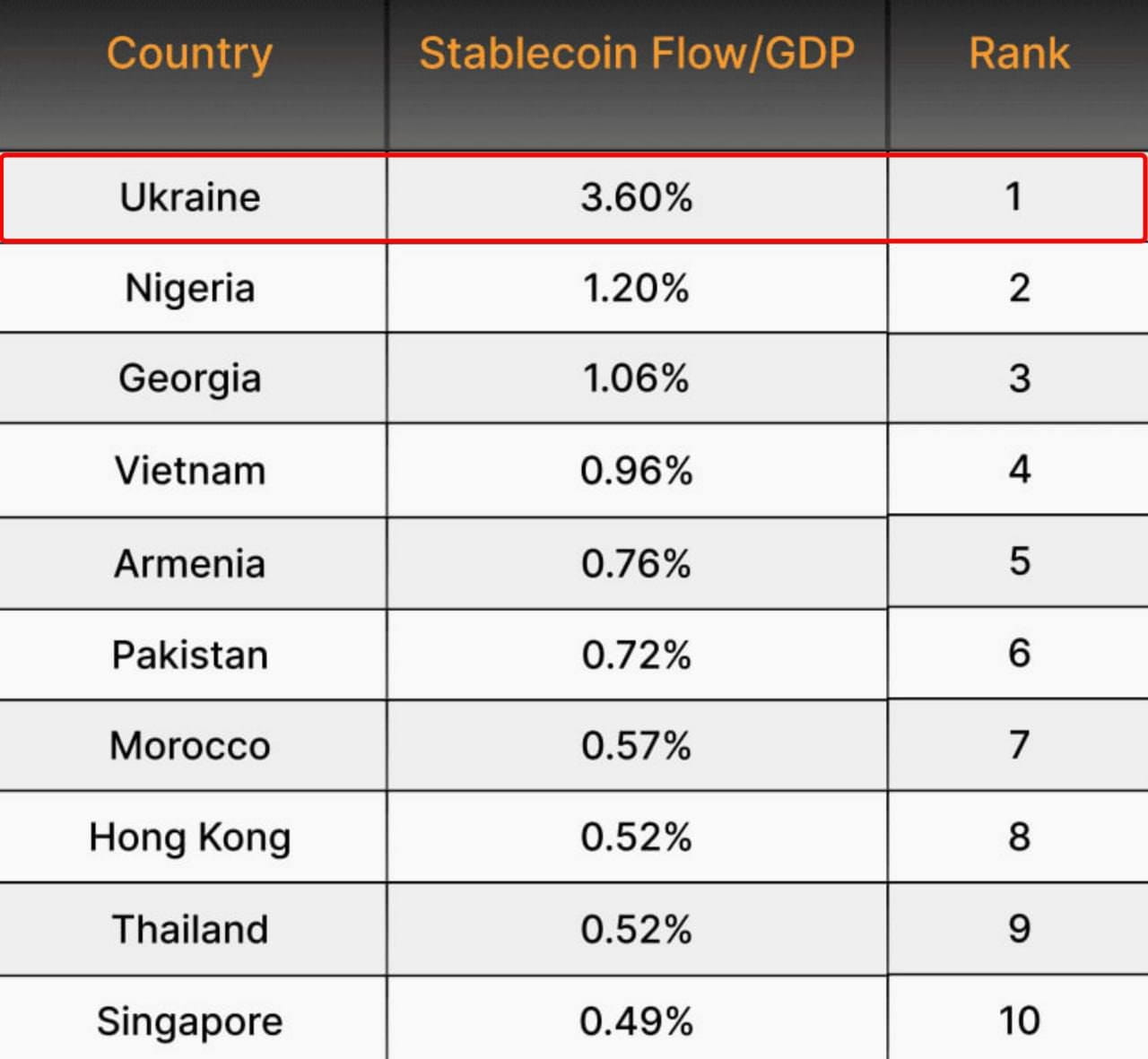
The indicator ~3.6% of GDP — the highest in the sample, surpassing Nigeria and Georgia. But this figure is not about 'crypto-wealth'. It is about the real role of stablecoins in everyday economics.
🔍 1. What exactly does Stablecoin Flow / GDP measure
This indicator shows the intensity of stablecoin usage, not the absolute volumes of the crypto market.
An important difference:
❌ not 'how much money is in stablecoins'
✅ but how often and on what scale they are used relative to the economy of the country
Therefore, countries with a smaller GDP but active digital flows can outperform large economies.
📊 2. Why 3.6% is a lot
For reference:
1% GDP is already a high level of integration of alternative payment instruments;
over 3% is a sign of systemic importance.
This means that stablecoins:
are not a marginal tool;
are used regularly;
integrated into the economic flows of businesses and households.
🧠 3. Why Ukraine 🇺🇦
🔹 Cross-border transfers as the norm
Millions of Ukrainians receive money from abroad. Stablecoins:
faster than banks;
cheaper than traditional payment systems;
do not depend on weekends, holidays, and currency restrictions.
For many, it is a practical financial tool, not an investment.
🔹 Digital business and IT sector
Freelance, IT services, e-commerce - all these are areas where:
the dollar is the basic unit of account;
crypto payments are simpler than traditional currency channels;
stablecoins are more convenient than volatile crypto assets.
🔹 Protection against currency risks
In unstable macro conditions, stablecoins perform the function:
temporary value preservation;
quick liquidity tool;
'digital dollar' without banking infrastructure.
🌍 4. Why nearby are Nigeria, Georgia, Vietnam
The rating looks reasonable:
Nigeria - inflation, currency restrictions, active P2P use.
Georgia is a transit economy, IT, financial services.
Vietnam is an export of services, digital payments, crypto adaptation.
A common feature: the need for alternative financial infrastructure, not love for speculation.
⚠️ 5. What should not be exaggerated
This rating does not mean that:
Ukraine has the largest crypto market in the world;
stablecoins have replaced banks;
this is not automatically a positive or negative trend.
This is a neutral indicator of the behavior of economic agents - people and businesses seeking effective payment tools.
🧩 6. Macroeconomic subtext
A high Stablecoin Flow / GDP ratio usually indicates:
the insufficient efficiency of traditional channels;
high demand for fast and flexible payments;
the adaptation of the economy to digital globalization.
This is not a 'crypto paradise' and not a 'grey area'. This is adaptation.
Conclusion from @MoonMan567

Ukraine has become number 1 in the world in terms of stablecoin usage intensity relative to GDP not due to speculative boom, but due to practical necessity.
Stablecoins in the Ukrainian economy are:
a payment tool,
a bridge between countries,
digital liquidity,
part of everyday financial behavior.
This rating shows not 'crypto fat', but the depth of integration of digital finance into the real economy. And in this sense, Ukraine is one of the most illustrative cases in the world.
👉 Subscribe to @MoonMan567 , to understand how the crypto economy works not in theory, but in real life - at the level of countries, businesses, and people.


