
1. Why can houses be on Airbnb, but BAYC can only 'gather dust'?
Have you ever considered a simple yet glaring question:
Your idle property can be listed on Airbnb to earn rental income,
but that valuable Bored Ape in your wallet,
often just lies silently on the NFT marketplace display page gathering dust.
In the past few years, the 'collectible attribute' of NFTs has far outweighed their 'financial attribute'.
Most guilds adopt a heavy asset self-operated model:
Buy land yourself, buy NFT yourself;
Recruit gold farmers yourself;
Handle operations and revenue sharing yourself.
It's like a chain group that only opens self-built hotels:
The model is stable, but the expansion speed is tightly bound by asset burdens.
However, in YGG's technical roadmap, the endgame (Phase 3) presents a completely different picture:
YGG proposes a blueprint called the Rental Marketplace in the white paper —
Not just about 'lending out the guild's own NFTs',
but to create a 'metaverse version of Uber / Airbnb':
Any NFT holder can lend their assets to any player,
matched and settled by a decentralized protocol.
I am meticulous analysis, and in my view, this reflects the inevitable evolution of the entire GameFi industry from 'closed gardens' to 'open financial infrastructure'.
Two, from scholarships to open lending: What difficulties is YGG solving?
Back in 2021, scholarships were one of the hottest models in the GameFi world.
This model was the first to separate 'ownership of assets' from 'rights of use' —
Assets are owned by guilds or large holders;
Rights of use are temporarily allocated to scholars;
Profits are distributed proportionally.
But at that time, YGG's scholarship system was essentially still a 'closed loop':
Only assets purchased by YGG can enter the YGG scholarship pool;
Only scholars selected by YGG can use these NFTs.
This design was very pragmatic at the time because:
The biggest problem with GameFi lending is the trust radius —
Traditional DeFi lending relies on over-collateralization;
Gold farmers often cannot provide additional collateral;
As a result: those who need assets the most find it hardest to obtain rights to use NFTs.
YGG attempts to promote a form of 'unsecured lending' (Non-collateralized Lending):
YGG serves as an intermediary, connecting external capital and gold farmers;
YGG uses the credit system, data, and risk control models established by the guild to guarantee this relationship;
External investors do not bet against individual players but connect with YGG as the 'credit intermediary'.
From this perspective, YGG is transforming from a heavy asset guild to a role of 'credit intermediary + liquidity bridge'.
Three, the industry's big background and NFTFi hotspots: What wave is YGG riding?
In the broader industry context, the platformization of the rental market hits several key trends:
NFTFi: from static collection to combinable financial assets
In the past two years, a whole set of gameplay around NFT collateral lending, NFT leasing, and NFTs as liquidity certificates has emerged.
The transaction volume of leading NFT lending agreements continues to expand, and the recognition of NFTs as 'lendable and collateralizable assets' has transitioned from concept to reality.GameFi: from a single game economy to coexistence of guilds and infrastructure
GameFi is no longer just 'earning by playing a certain game', but is evolving into a complete industrial chain:Publishers are responsible for the game itself;
Guilds are responsible for organizing players and assets;
Infrastructure projects are responsible for clearing, lending, and profit distribution.
YGG positions itself at the intersection of 'guilds + infrastructure', naturally in a key position in this industrial chain.
NFT standards and leasing agreements are maturing
In the Ethereum ecosystem, standards surrounding NFT leasing and the separation of rights of use are constantly being improved,
and the narrative of NFTs as 'rentable assets' is gradually solidifying.
YGG is strategically placing itself atop this trend:The standard layer will be resolved by universal protocols and the EVM ecosystem;
YGG will implement the 'service layer + credit layer' on the upper layer.
From a track dimension, YGG is at the intersection of popular tracks in NFTFi, GameFi, guild economy, and unsecured lending.
Four, the Rental Marketplace in YGG's white paper: the technical route to platformization
YGG's platform transformation is written into the third phase (Phase 3) of the technical roadmap.
According to the white paper description, there are three key changes for the future:
No longer just lending out self-owned assets
In the past: mainly self-owned NFTs in the YGG Treasury were allocated to scholars;
In the future: YGG's official website will add a 'lending option' (Create option for lending on website),
Any eligible NFT holder can lend assets on the YGG platform.
Introducing external lenders (External Lenders)
The white paper mentions: external lenders can lend assets to YGG through YGG token lending contracts.This means:
External NFT holders can entrust their assets to YGG through YGG's lending contracts;
YGG is responsible for asset management, scholar matching, and profit settlement;
Lenders do not need to engage in complex operations themselves and can focus more on 'collecting rent'.
YGG Scholarship System as SaaS
The complete set of 'guild backend systems' accumulated by YGG in the past —
Account monitoring
Automatic account distribution
Performance evaluation
Risk management
will be packaged into a service similar to SaaS, open to the public.
In simple terms:
YGG is no longer just a guild that plays games and issues scholarships by itself,
YGG is trying to position itself as a foundational operational platform shared by the entire industry.
Five, how does the platform operate? A diagram to understand the YGG rental market
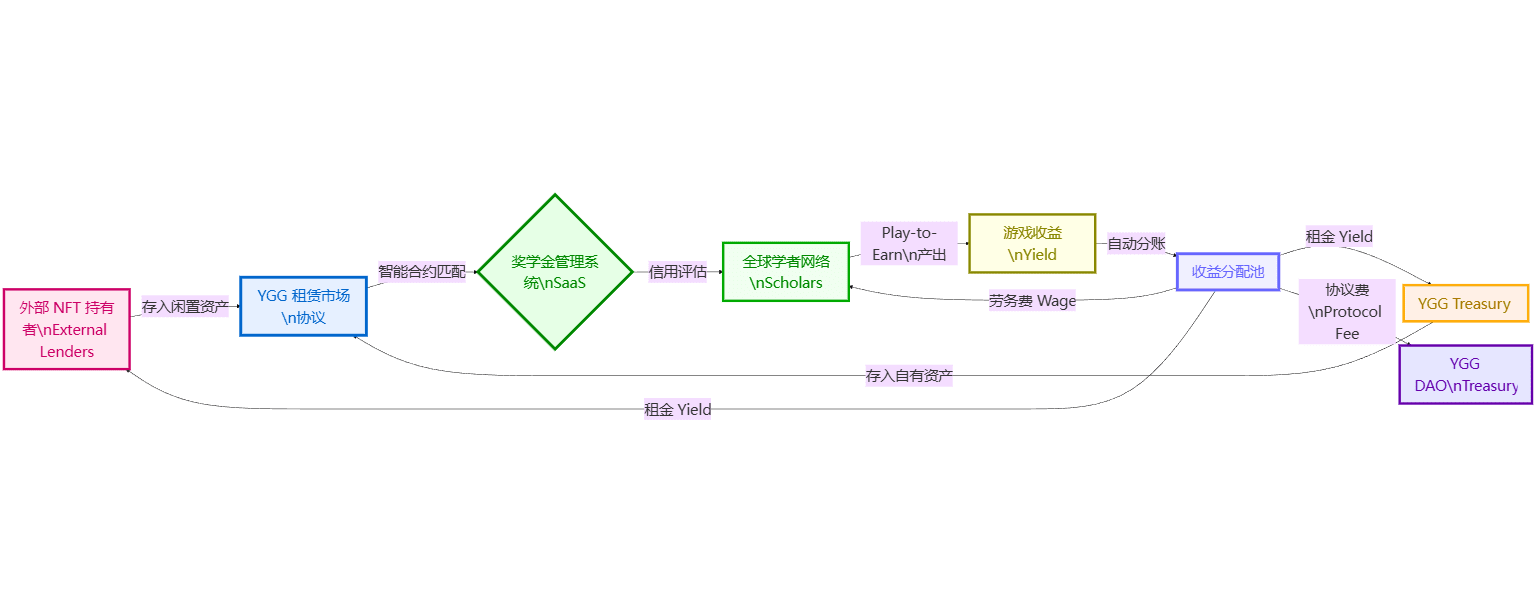
In this structure:
Asset side:
self-owned NFTs from YGG Treasury;
idle NFTs from external lenders.
Labor side:
Gold farmers and gaming guilds from around the world;
through credit assessments and performance data screening.
Protocol layer:
involves matching, tracking, settling, and fee distribution;
Extracting protocol fees into the YGG DAO Treasury.
This design allows:
Asset owners become liquidity providers;
Scholars become service providers;
YGG becomes 'platform + credit intermediary'.
Six, why is YGG's focus on the 'service layer' rather than just the 'contract layer'?
During the same period, smart contract standards for NFT leasing began to emerge in the market,
These standards focus more on 'how to split rights of use and ownership at the contract level'.
YGG's solution leans more towards 'service layer + coordination layer':
Social coordination capability prioritized
Before a fully automated smart contract lending system matures,
YGG prioritizes using the social coordination ability of DAO to fill technical gaps:If scholars default or run away,
YGG can provide a certain degree of bottom line or coordination through the Treasury or regulatory system;
In the period when on-chain credit scoring systems are still imperfect, 'reputation + system' will lead the way.
Credit intermediary role, not just a pure code market
YGG does not just provide a piece of matching code, but:
establishing multidimensional credit profiles for scholars;
continuously tracking players' performance and default records;
forming a structure akin to a 'risk control system' through rewards, punishments, and screenings.
From the DeFi perspective, what YGG is trying to do is a form of 'unsecured lending with social guarantees',
Before pure DeFi credit protocols are widely implemented, this may be the most realistic bridge connecting capital and labor.
Seven, the leap from asset management companies to 'metaverse platforms'
If viewed from the perspective of long-term industry evolution, the platformization of the Rental Marketplace represents a leap in YGG's business model:
Role transformation
In the past:
YGG was more like an asset management company,
with revenue mainly coming from the appreciation and operational efficiency of self-owned assets.
In the future:
YGG will be more like an internet platform,
Assets will come from holders across the network, labor will come from players across the network,
YGG will primarily earn network service fees and protocol fees.
AUM and network effects
When the source of assets is no longer limited to the YGG Treasury, two changes will naturally occur:
The potential manageability of assets by YGG (AUM) will no longer be constrained by self-owned funds;
Each new asset provider and player will enhance the platform's network effect.
NFTFi narrative and the potential utility of YGG tokens
In the white paper, 'Non-collateralized lending' is included in the roadmap,
and is linked with YGG token lending contracts, which at least conveys two signals:Lending agreements may be deeply bound to YGG tokens;
If the Rental Marketplace runs smoothly, the use cases for YGG tokens will expand from 'governance + incentives' to 'participation in platform profits / collateral / fee discounts', etc.
Eight, practical advice and risk control: a few tips for different roles
1. If you are an NFT lender
The focus is not just on 'how high the yield is', but on:
Whether the underlying games still have real players and cash flow;
Whether YGG's default handling mechanism is transparent (whether there are risk controls, insurance pools, blacklists);
Whether the protocol provides clear parameters for leasing contracts (duration, profit-sharing ratio, default rules).
Be wary of any claims of 'guaranteed profits' or 'high base returns'.
2. If you are a gold farmer / scholar (Scholar)
Understand clearly:
Profit-sharing ratio, whether there are hidden costs (extra tasks, mandatory online hours, etc.);
Account management methods, whether they involve account sharing, giving passwords to third parties, and other high-risk behaviors.
Maintain a reserved attitude towards commitments of 'guaranteed fixed income', as the game economy itself is a high-volatility system.
3. If you are an NFT lender
Do not treat all future revenues in the white paper as 'already fulfilled',
A more reasonable approach is:Pay attention to whether the Rental Marketplace is truly online;
See whether the protocol has real leasing transaction volume and protocol revenue;
Observe how the DAO allocates these revenues, rather than just looking at short-term sentiment.
Remember DYOR (Do Your Own Research), and do not treat any single article as a basis for trading.
Nine, the conclusion of meticulous analysis and risk warning
For me, YGG's Rental Marketplace feels more like a high-uncertainty but highly aligned long-term experiment with the NFTFi narrative,
rather than a fully priced 'cash flow machine'.
If YGG were just a farmer who buys land and grows crops by itself,
the growth ceiling of YGG would definitely be tightly constrained by the volume of funds;
But if YGG truly becomes a 'metaverse rental platform that everyone can access',
YGG will face not just the profit and loss statement of a single guild,
but the incremental space of the entire GameFi and NFTFi ecosystem.
Disclaimer:
The above content is a personal study and opinion of meticulous analysis based on public information and on-chain data, intended for communication and learning only, and does not constitute any investment or financial advice.
Cryptographic assets and related derivatives are highly volatile, with the risk of total loss of principal.
Please be sure to conduct your own research (DYOR), considering your own risk tolerance and cautiously participating in any tokens or protocols.
I am a meticulous analyst who focuses on essence and ignores noise.
