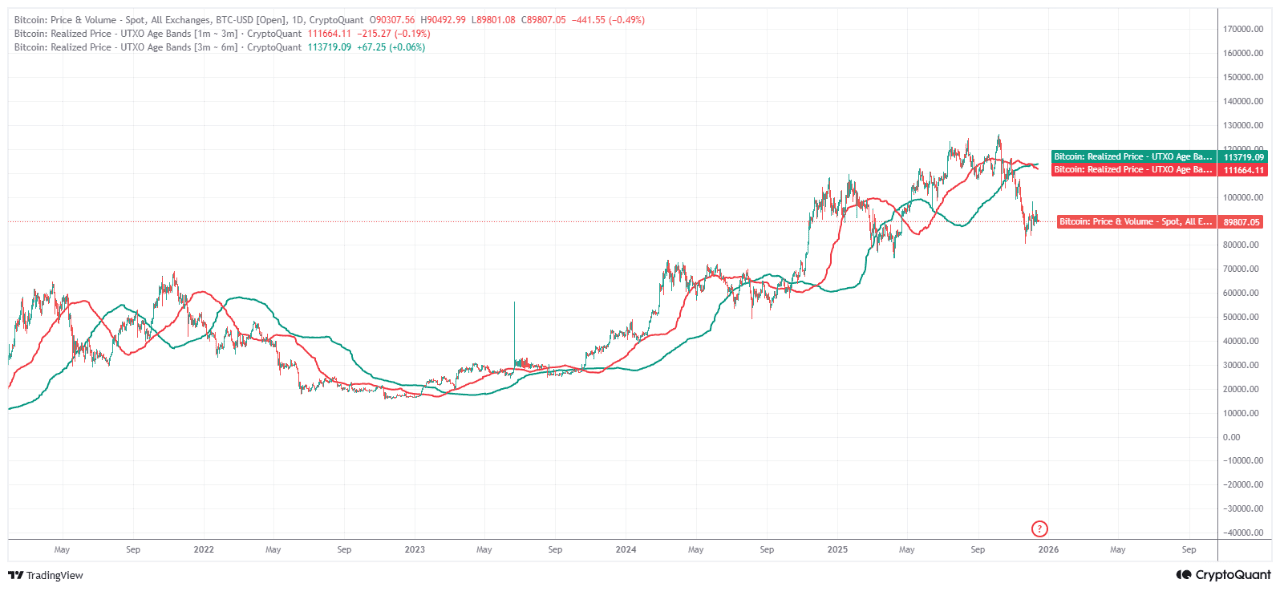
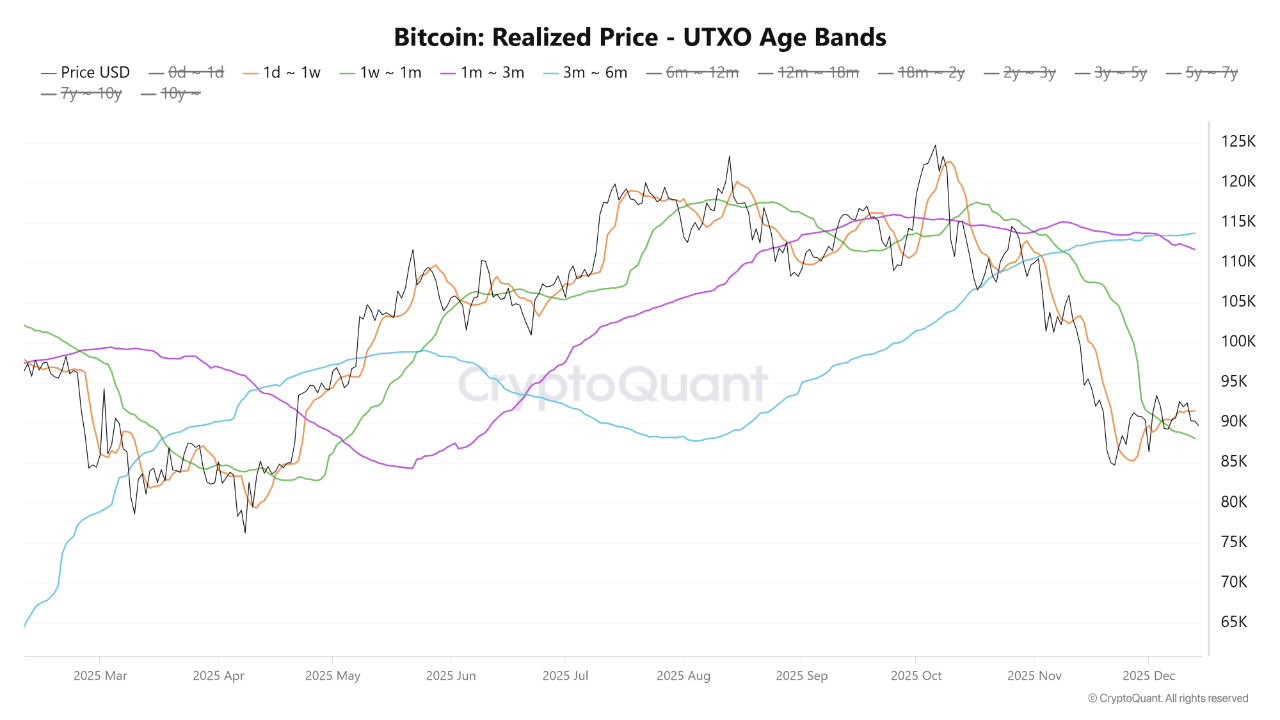
One of the most significant signals in the Bitcoin chain today comes from realized price data rather than actions on the spot price. Analyzing more than 3,200 daily observations of the realized price of Bitcoin in UTXO age groups reveals a consistent pattern where the realized price of the 1–3 month group falls below that of the 3–6 month group. Under normal market conditions, new buyers pay more than medium-term holders. In fact, the average gap between these two groups is approximately +$2,500. When this ratio inverts, it indicates a statistically unusual regime.
Throughout the entire dataset, this inversion has occurred only nine times and is generally temporary. On average, these phases last about 145 days, compared to more than 210 days when the 1–3 month group remains above the 3–6 month group. These periods are also sharper and more volatile, with negative spreads reaching depths of up to -$19,500. This tells us that such inversions are not slow structural declines, but rather brief moments of market stress and reloading.
From a behavioral standpoint, this shift indicates that new buyers are entering the market at lower prices than mid-term holders. Instead of signaling mass distribution, it reflects a redistribution of supply to stronger, low-cost hands. Short-term capital is absorbing coins at reduced prices, while mid-term holders remain closer to their cost basis, creating compression rather than collapse.
In the current market context, this pattern indicates that Bitcoin is undergoing consolidation rather than structural weakness. Price volatility may dominate the headlines, but beneath the surface, ownership is becoming more efficient. As long as this cost basis inversion remains limited to younger age groups of UTXO, it indicates a market that is in the process of redistribution and supply absorption, rather than one that is losing confidence.
News is for reference, not investment advice. Please read carefully before making decisions.