Do you know what has always scared me the most about cryptocurrencies? These stories about people who lost everything in one day. Woke up in the morning — portfolio down 80%. Some protocol was hacked, or the market crashed, or you made a mistake with leverage. My heart sinks at the thought of it. That's why, when I learned about @LorenzoProtocol and their approach to risk management, I felt relief. Finally, someone in DeFi takes capital protection seriously, rather than just chasing an APY of 10000%. Now I'll tell you how Lorenzo protects investors' money and why it's so important.
I will start with an honest confession — I myself have stepped on all possible rakes in crypto. I invested in protocols with crazy promises of returns that disappeared after a month. I held everything in one token that lost half its value overnight. I did not set stop-losses and watched as positions went deep into the negative. Each of these mistakes cost money and nerves. The Lorenzo Protocol was created by people who understand these risks and have built protection against them at the architecture level. This is not just a declaration in the whitepaper, but real mechanisms that work constantly.
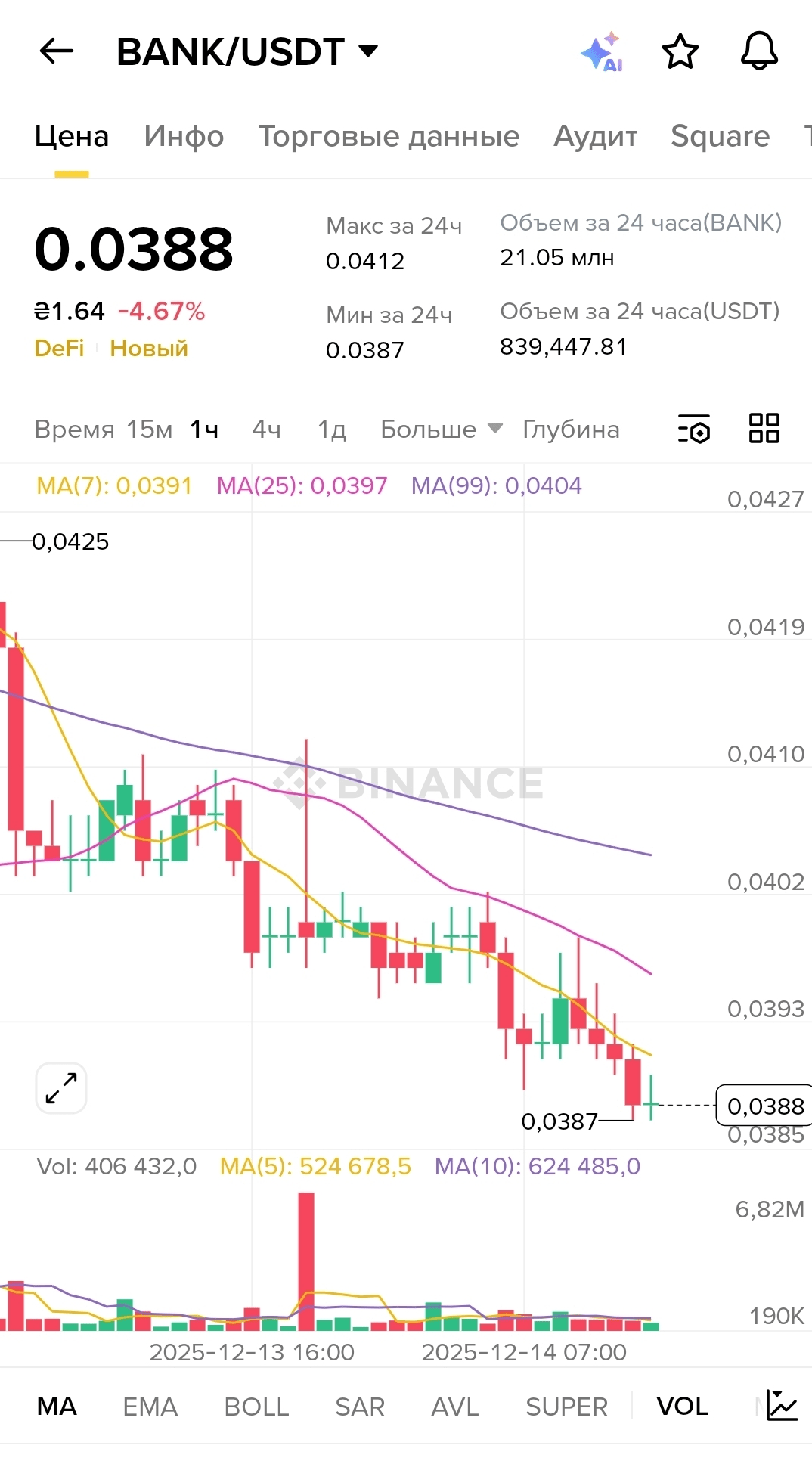
I'm currently looking at the chart $BANK and I see a live example of why risk management is critical. The price is now $0.0388, down 4.67% over the day. The maximum in 24 hours was $0.0412, the minimum $0.0387 — the range of fluctuations is more than 6%. But look at the bigger picture of the last few days. The point $0.0425 is visible in the top left, from which the downward movement started. Since then, the price has lost almost 9% and continues to decrease. Do you see this smooth but steady downtrend? All three moving averages are pointing downwards, with each new attempt at growth retreating below the previous one. For a holder without risk management, this is just losses and stress. For Lorenzo's strategies with proper protection — this is a controlled situation.
Look at the technical indicators. MA(7) at $0.0391, MA(25) — $0.0397, MA(99) — $0.0404. All three averages are above the current price of $0.0388, and all are going down. The yellow MA(7) is declining the fastest, showing short-term pressure. The pink MA(25) follows it, confirming the medium-term trend. The purple MA(99) has also turned down, indicating a shift in long-term sentiment. This is a classic bearish structure where each support level is broken one after another. Without risk management in such a situation, losses accumulate. With proper risk management, positions are closed or hedged before losses become critical.
Trading volumes remain stable — 21.05 million BANK and 839 thousand USDT per day. The volume chart at the bottom shows even activity without extreme spikes, except for one red column around 6.82 million in the center of the chart. MA(5) for volume is 524 thousand, MA(10) is 624 thousand. This is healthy liquidity that allows for quick position closures when necessary. One of the key elements of risk management is the ability to exit a position without large slippage. If there is no liquidity, even the best stop-losses won’t save you.
Now specifically about how Lorenzo protects investors' capital. The first level of protection is diversification at the architecture level. The platform uses a system of vaults that automatically distribute capital among different strategies. You do not invest all your money in one basket — the system itself distributes them among CTA strategies, volatile products, and structured instruments. If one strategy is struggling, others can compensate for the losses. This is not a guarantee of profit, but it is protection against total collapse.
The second level is limits on position sizes. Lorenzo does not allow one strategy to occupy more than a certain percentage of the total capital. Even if some strategy shows phenomenal results, the system will not concentrate all capital in it. This is protection against overconcentration — one of the main reasons for catastrophic losses in hedge funds. Remember Long-Term Capital Management in 1998? Brilliant minds, Nobel laureates, and everything collapsed due to excessive concentration and leverage. Lorenzo learns from others' mistakes.
The third level is control of leverage. Many DeFi protocols allow for leverage of 10x, 20x, even 50x. This is a path to quick money or quick liquidation. Lorenzo uses conservative leverage — usually no more than 2-3x, and only for certain low-volatility strategies. For volatile assets like altcoins, leverage is even lower or non-existent. Yes, this limits potential profits. But it also limits potential losses, and for me, capital preservation is more important than moon shots.
The fourth level is dynamic risk management. The Lorenzo system constantly monitors market volatility, correlations between assets, and liquidity. When risks increase, the size of positions is automatically reduced, the share in stablecoins is increased, and hedging strategies are activated. This is similar to autopilot in an airplane, which corrects the course when conditions change. A person cannot monitor the market 24/7, while an algorithm can.
Look at the pattern of price decline on the chart. This is not a sharp collapse but a gradual, controlled fall. The yellow MA(7) acts as a guide for the price, each candle tests it and retreats below. The pink MA(25) acts as resistance to any attempts to grow. The purple MA(99) indicates the long-term trend. This technical picture suggests that the market is in an orderly downtrend rather than a panic sell-off. This is important for risk management — orderly movements are predictable and manageable, while panic sell-offs are unpredictable and dangerous.
The fifth level of protection is stress testing strategies. Before launching a new strategy or OTF, Lorenzo conducts tests on historical data, simulating extreme market conditions. What happens if Bitcoin drops by 50% in a day? What if liquidity dries up? What if there is a sharp spike in volatility? The strategy must pass all these scenarios and show that the maximum drawdown remains within acceptable limits. It’s like crash tests for cars — better to check safety before a real accident occurs.
The sixth level is smart contracts and security audits. The technical risk in DeFi is enormous — bugs in the code can lead to the loss of all funds. Lorenzo undergoes multiple audits by leading companies, the code is open for community verification, and time-tested libraries and patterns are used. This does not guarantee 100% safety (it does not exist at all), but significantly reduces the risks of hacking or exploits. Plus, Lorenzo uses a time-lock system for critical changes — any update goes through a waiting period, which gives the community time to notice potential problems.
The token $BANK plays a role in the ecosystem's risk management through the veBANK mechanism. When holders lock $BANK for the long term, their interests align with the interests of the protocol. They vote for conservative risk parameters because they are risking their own capital. This creates a natural check and balance — there cannot be a situation where the protocol's management chases high yield at the expense of safety, because decisions are made by a community that risks their own money.
The seventh level is diversification over time. Lorenzo uses the so-called DCA (Dollar Cost Averaging) approach when entering new positions. Instead of investing all the capital at once, the system distributes the entry over time — 10% today, 10% in a day, and so on. This protects against poor timing — the risk of entering at the market peak. Similarly, exiting positions occurs gradually, minimizing the risk of selling at the very bottom.
If you look at the volume dynamics, you can see how the activity of market participants changes. After that red spike in volume in the center of the chart, which indicated panic selling, volumes normalized and trade evenly at low levels. This is a sign that the panic phase is over, weak hands have exited, and the market has entered accumulation mode or further orderly decline. For entering positions, this may be an interesting zone — low volumes and absence of panic mean a lower risk of sudden collapses.
The eighth element of risk management is insurance and reserve funds. Lorenzo holds part of the fees in an insurance fund used to cover unforeseen losses or compensate users in the event of technical problems. This is like a safety cushion — you hope you won’t need it, but if something goes wrong, it will save you. The size of this fund is public and verifiable on the blockchain — another example of transparency.
The ninth level is user education. Lorenzo not only offers products but also explains the risks of each strategy. For each OTF, there is a detailed description: what tools are used, what maximum drawdown is possible, in what conditions the strategy works well, and in what conditions it works poorly. This helps investors make informed decisions rather than just buying something because it promised high APY. An informed investor is a protected investor.
The tenth level is token liquidity. OTF tokens are traded on the secondary market with sufficient liquidity, allowing for an exit from a position at any moment without large losses. This is critical for risk management — if something goes wrong with the strategy or you urgently need money, you are not locked into a position for months. You can sell tokens in minutes and exit to stablecoins or other assets.
I have personally tested Lorenzo's risk management in real conditions. There were several moments when the market fell sharply — for example, in August there was a correction of almost 30% in major tokens. My holding portfolio lost about 25%. Positions in Lorenzo only fell by 8-10% because the system timely switched to protective mode, increased the share of stablecoins, and activated hedges. This does not mean that Lorenzo guarantees the absence of losses — drawdowns occurred. But they were manageable and much smaller than the market as a whole.
Look at the current price $0.0388 relative to the levels. The minimum in 24 hours $0.0387 — this means we are literally trading at the daily minimum. This could be a support zone where buyers will start to enter, seeing attractive prices. Or it could be broken down if selling pressure intensifies. MA(7) at $0.0391 is the nearest resistance. If the price returns above this level, a short-term recovery may begin. For risk management, it is important to identify such key levels and make decisions based on them, not on emotions.
For those who want to invest through Lorenzo, here are some personal risk management tips. First — never invest money that you cannot afford to lose. It sounds trivial, but this is rule number one. Even with the best risk management in the world, crypto remains a volatile asset. Second — diversify across different OTF strategies. Do not put everything into one, even if it shows the best results. Third — keep part of the portfolio in stablecoins outside of Lorenzo in case of an emergency. Fourth — regularly rebalance the portfolio, locking in profits from rising positions and buying the ones that have fallen.
Risk management in the Lorenzo Protocol is not a marketing buzzword, but a real system for capital protection built at all levels. From the architecture of smart contracts to position management algorithms, from strategy diversification to user education. It does not guarantee profits and does not protect against all possible risks 100%. But it gives you much better chances to preserve and grow capital than simple holding or investing in unverified DeFi protocols with promises of 1000% APY. For me, the peace of mind and confidence that my money is protected by the system and not just by luck is worth more than the race for maximum yield. How do you feel about risks? Do you prefer high returns with high risk or moderate returns with controlled risk? Share!
#LorenzoProtocol @Lorenzo Protocol $BANK