Do you know what has always annoyed me about crypto? When people say: "Just hold the tokens, and everything will be fine". Yes, holding is great, but why should my assets just sit there as dead weight when they can work and generate income? I searched for a long time for ways to generate passive income in DeFi that wouldn’t require me to sell my core assets or engage in complicated maneuvers with a bunch of protocols. And when I met @falcon_finance, a whole world of opportunities opened up for me that I hadn’t even thought about before.
Let's get straight to the point: passive income in crypto is not magic; it is the smart use of existing mechanisms. And the first strategy that I discovered for myself is basic collateral farming through USDf. The scheme is simple: I pledge my $FF tokens, receive USDf, add them to liquidity pools on various DEXs, and earn trading commissions plus reward tokens. Meanwhile, my main asset $FF remains pledged and can appreciate in value. A dual income stream: one from farming, the other from the potential appreciation of the collateral.
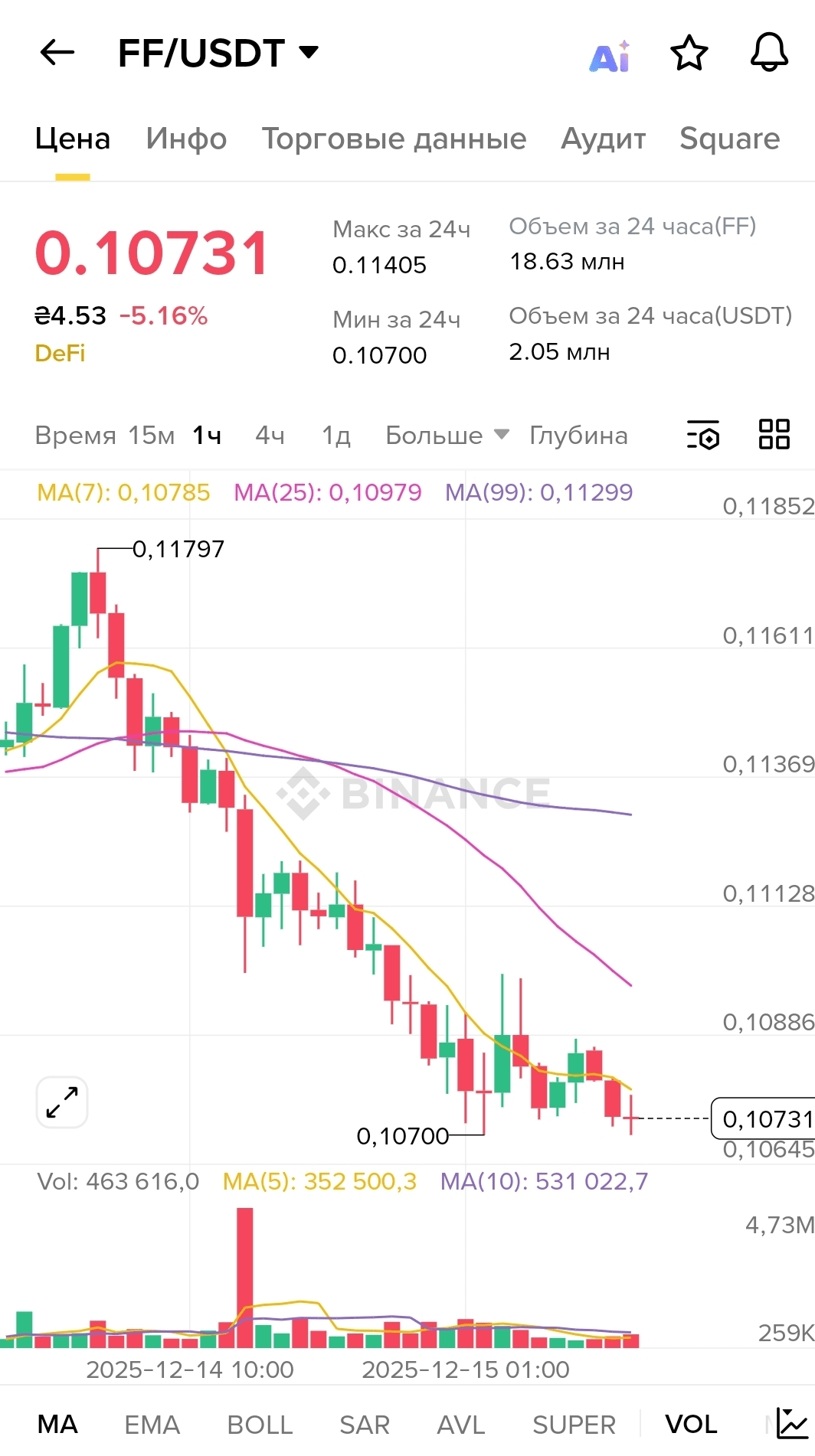
I look at the current chart $FF and see an interesting picture. The price is now 0.10731 USDT, a drop of 5.16% over the day. In the last 24 hours, the maximum was 0.11405, and the minimum was 0.10700 — a range of 6.6%. This is where the beauty of the collateral strategy shows itself: even with such a drop, if you pledged tokens earlier and received USDf at a higher price, you have already managed to secure that liquidity. And now your USDf is working in pools, earning interest, while you wait for the price of $FF to recover. When the token returns to previous levels, you will be in profit in two directions.
The second strategy that I actively use is recursive farming. It sounds complicated, but in practice, it's just a smart loop. I pledge assets, receive USDf, convert some of them back into tokens that can be pledged (if the protocol allows), receive more USDf, and repeat this several times. Each cycle increases my exposure and potential income. Of course, you need to be cautious with the collateralization ratio to avoid liquidation, but with the right calculations, it gives a significant boost to yield.
Look at the moving averages: MA(7) is at 0.10785, MA(25) is 0.10979, MA(99) is 0.11299. All three averages are above the current price, indicating a strong downtrend. But you know what the trick is? For the passive income strategy through #FalconFinance, short-term price movements are not so critical. The long-term trajectory and the stability of the protocol are important. Even if $FF is currently in correction, as long as I am earning from the farming of my USDf, time works in my favor.
The third strategy is a diversified collateral portfolio with different yields. I do not put all my eggs in one basket. Part of the USDf goes into conservative pools with low risk and stable 8-12% annual returns. Part goes into more aggressive strategies with a potential of 20-30%, but also with increased risks. Another part I simply lend through P2P platforms at a reasonable interest rate. Such diversification allows me to sleep peacefully, knowing that even if one of the income sources dries up, the others will continue to work.
I look at trading volumes — 18.63 million per day for the token and 2.05 million USDT — and understand that there is liquidity in the system. This is important because effective management of income strategies requires the ability to quickly enter and exit positions. If the market suddenly turns, I can quickly rebalance the portfolio, close some positions, and open new ones. Flexibility is key to stable passive income.
The fourth strategy that I recently discovered is participation in governance tokens through USDf. Many protocols distribute their governance tokens to users who provide liquidity. I receive USDf through @falcon_finance, add them to the relevant pools, and besides standard commissions, I also receive governance tokens. These tokens can either be sold immediately to lock in profits, held in hopes of appreciation, or staked for additional income. Another layer of yield on top of the main one.
The fifth strategy concerns working with tokenized real-world assets. This is a more advanced level, but it offers interesting opportunities. If you have access to tokenized real estate, precious metals, or other RWAs, you can pledge them in #FalconFinance just like cryptocurrency. You receive USDf, use it to generate income, and your real assets remain with you. It’s like taking a mortgage against real estate, but without banks, bureaucracy, and predatory interest rates.
I look at the volume chart: the current hourly volume is 463,616 units, MA(5) shows 352,500.3, MA(10) is 531,022.7. Do you see that huge red column in the past? That was a moment of panic when the price sharply fell from 0.11797. But pay attention: after that, the volumes normalized, and the market calmed down. For me, as someone focused on passive income, this is a good sign — it means volatility is decreasing, and I can calmly work with my strategies without the risk of sudden surprises.
The sixth strategy is automatic reinvestment of profits. I have set up a system for myself where all the income I receive from farming and staking USDf automatically goes back to work. I do not withdraw, do not spend, but reinvest. It's like compound interest in traditional finance — over time, the effect accumulates, and the yield starts to grow exponentially. The first months' results are modest, but after six months to a year, the difference becomes very noticeable.
Another important aspect that many forget is tax optimization. When you simply hold tokens and they appreciate in value, that’s passive income, but it cannot be utilized without selling and paying taxes. But when you pledge assets and receive USDf, you formally haven’t sold anything. You just took a "loan" against collateral. This can provide tax advantages in some jurisdictions (of course, you need to consult with an accountant; I'm not a lawyer). At the same time, income from farming USDf can be structured in various ways depending on your tax situation.
Look at the current price of 0.10731 and compare it with the maximum of 0.11405 — this is a drop of 5.9%. If I relied solely on the price increase of the token to generate income, I would currently be at a loss. But thanks to passive income strategies through USDf, even during a correction period, I continue to earn. My USDf in liquidity pools generates commissions, reward tokens are growing, and ultimately, the $FF drop for me is just a temporary paper loss, compensated by other sources of income.
The seventh strategy I want to talk about is arbitrage farming. Sometimes there is a difference in yields for the same pairs between different protocols. For example, a USDT-USDf pool on one platform offers 10% annually, while on another, it offers 15%. Having access to USDf through @falcon_finance, I can quickly move liquidity to where the conditions are better. This requires some monitoring and active actions, but if you are willing to dedicate an hour a week to this, an additional 5% annual yield on the overall return is quite realistic.
You know what I like most about all these strategies? That they work regardless of the market direction. The market is rising — great, my collateral $FF appreciates, plus I earn from farming. The market is falling — not a problem, USDf are stable, continue to work in pools, and I keep earning. It's like having a safety net that inflates itself while you sleep.
The eighth strategy is the use of leverage, but very carefully. I'm not talking about crazy leverage of x10 or x20; that’s a path to quick liquidation. But moderate leverage of x1.5-x2 through collateral and receiving USDf can significantly increase yield without critically raising risks. The key is to always maintain a margin of safety and never approach the liquidation threshold.
I look at MA(99) at 0.11299 and understand: if you hold a long-term perspective, the current price of 0.10731 looks like a temporary anomaly. Sooner or later, the market will return to its average values. And while this happens, my passive income through USDf continues to drip, drip, drip. Day by day, week by week, month by month. And at the end of the year, when I summarize, it turns out that I earned not only from the appreciation of assets but also from all these little streams of income that turned into a full-flowing river.
The last piece of advice I can give: do not chase crazy APYs of 1000% or 5000%. This is almost always either a scam or a very short-term opportunity that evaporates in a few days. A stable passive income of 15-25% annually in crypto is real, achievable, and sustainable. And considering the potential growth of underlying assets like $FF, the overall return can easily exceed 50-100% annually. You just need to be patient, disciplined, and not give in to greed.
#FalconFinance @Falcon Finance $FF