Do you know what has always fascinated me about technology? The ability to glimpse into the future. Not in a mystical sense, but in an analytical one — to see trends, understand where the industry is heading, to be at the forefront of change rather than at the tail end. When I think about the future of asset management, I see two opposing forces: traditional finance, which clings to its old models, and decentralized technologies that are breaking all the rules. @LorenzoProtocol stands at the intersection of these worlds, and that is why its future is so interesting. Now I will share my thoughts on where the asset management industry is heading and what role Lorenzo can play in this revolution.
I'll start with an honest admission — predicting the future in crypto is incredibly difficult. Five years ago, no one could have imagined DeFi in its current form. Three years ago, NFTs seemed like a marginal niche. A year ago, few were talking about the tokenization of real assets as mainstream. Everything changes quickly and unpredictably. But there are certain trends that are already obvious, and we can extrapolate them into the future with some degree of confidence.
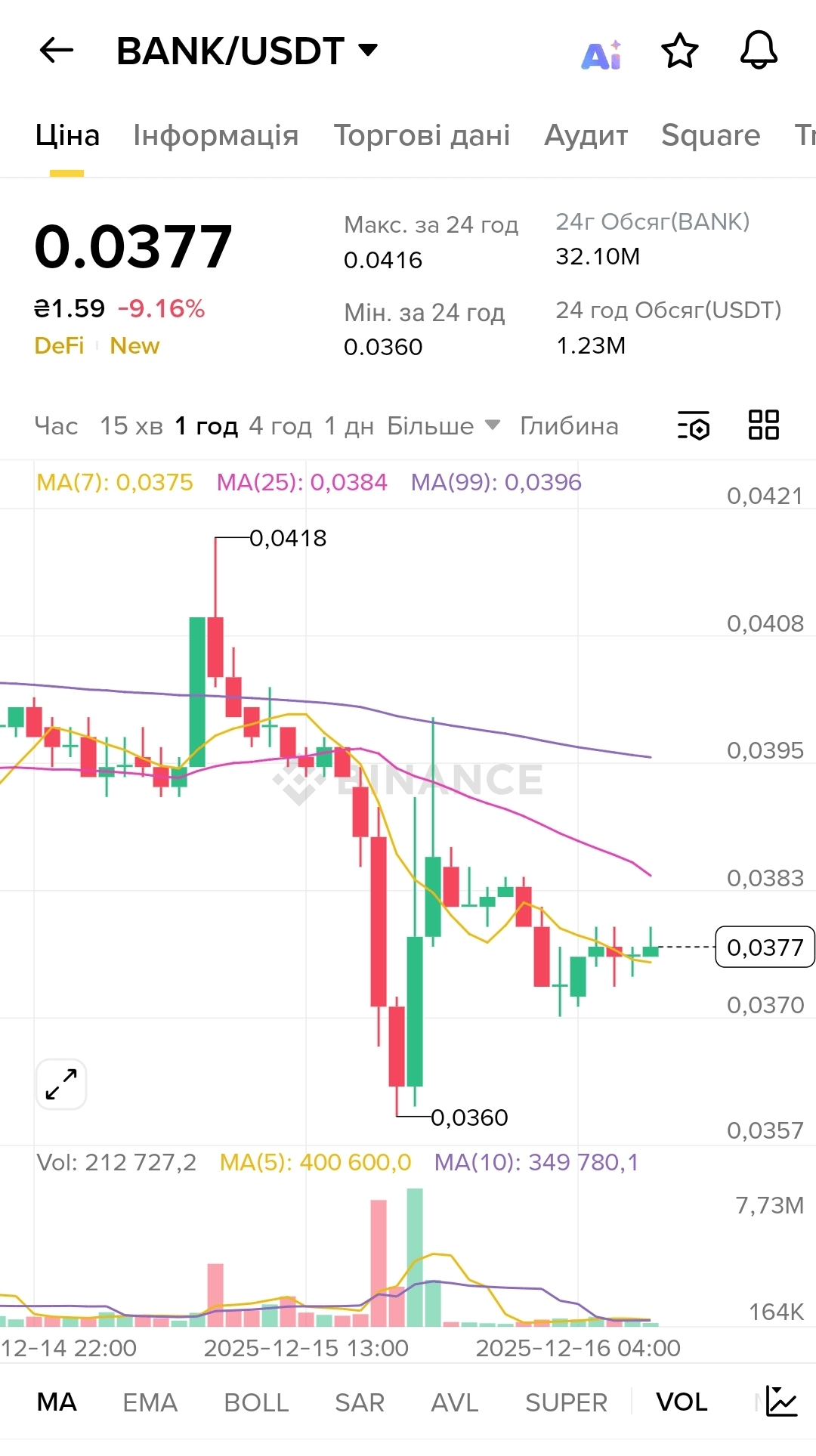
I’m looking at the chart $BANK and see a microcosm of what is happening with the entire industry — volatility, uncertainty, but also huge potential. The price is now $0.0377, down 9.16% over the day. This is a serious drawdown that shows the market is under stress. The maximum in 24 hours was $0.0416, the minimum $0.0360 — a fluctuation range of over 15%. Look at the chart — on the left, there is an attempt to rise to $0.0418, then a sharp drop due to that huge red body of the candle in the center, and now a slow consolidation around $0.0377. This is a classic picture of a market searching for a bottom after a correction.
Look at the technical indicators. MA(7) is at $0.0375, MA(25) is at $0.0384, MA(99) is at $0.0396. The current price of $0.0377 is trading slightly above the fast MA(7), but below the average and long-term. The yellow MA(7) has begun to turn upward after reaching a bottom, showing early signs of recovery. The pink MA(25) is still going down, but the angle of decline is decreasing. The purple MA(99) continues its downward trend. This technical picture symbolizes the current state of the industry — short-term recovery after panic, but the long-term direction is still undetermined. It is during such moments of uncertainty that the future is shaped.
Trading volumes remain significant — 32.10 million BANK and 1.23 million USDT per day. The volume chart below shows two major spikes: the pink bar around 7.73 million (mass sales on the decline) and the green bar (purchases on recovery). MA(5) by volume is 400 thousand, MA(10) is 349 thousand. After extreme movements, volumes have normalized but remain above average. This shows that interest in the asset has not faded; the market is simply transitioning from panic to thoughtful decisions.
Now, about the future of the industry. The first megatrend is the tokenization of everything. Right now, we are mainly tokenizing cryptocurrencies and some digital assets. But the next 5-10 years will bring the tokenization of stocks, bonds, real estate, art, intellectual property, literally everything that has value. Imagine a world where you can buy a share of an apartment in New York, a tokenized Picasso painting, and a share of an index fund in one application, from one wallet, in a matter of seconds. Lorenzo Protocol is positioning itself for this world — their OTF infrastructure can tokenize any investment strategies, not just crypto.
The second trend is the democratization of access. Traditionally, the best investment products are only available to the wealthy: hedge funds require a minimum of $1 million, private equity funds — $5 million or more. Tokenization breaks down these barriers. Lorenzo already allows investments in institutional strategies starting at $100. In the future, this threshold may drop even further, possibly to $10 or even $1. Billions of people who are currently excluded from the financial system will be able to invest in what was previously available only to the elite.
The third trend is composability and interaction of protocols. Right now, DeFi is still quite fragmented — different protocols interact weakly with each other. The future lies in full composability, where tokens from one protocol can be used in dozens of others without friction. Lorenzo's OTF tokens will become the basic building blocks for more complex financial products. You will be able to take an OTF token from a CTA strategy, use it as collateral in a lending protocol, get a loan in stablecoins, invest it in another OTF — and all this automatically, without intermediaries.
The $BANK token may evolve from a simple governance token to a central element of the entire ecosystem in the future. Perhaps $BANK will become not just a voting tool, but also a base currency for all transactions in Lorenzo, a means of incentivizing liquidity, a token for staking in secure mechanisms. The more functions and utility $BANK has, the greater the demand for it will be, and the more stable its value will become. Right now, when the price is $0.0377 after a 9% drop, it may seem like a painful moment. But for a long-term investor who believes in the future of the industry, such corrections are opportunities for accumulation.
The fourth trend is the merger of TradFi and DeFi. Right now, these worlds exist in parallel, almost not intersecting. But this will change. Traditional financial institutions are already experimenting with blockchain, tokenization, and smart contracts. Large banks are launching their own DeFi platforms. Hedge funds are buying cryptocurrency. In the future, the line between TradFi and DeFi will blur. Lorenzo can become a bridge — offering products that are comfortable for both worlds. For DeFi native users — complete decentralization and control. For traditional investors — compliance, KYC, regulatory adherence.
The fifth trend is artificial intelligence in asset management. Currently, Lorenzo's strategies are based on mathematical models and algorithms developed by humans. But AI is already showing impressive results in processing vast amounts of data, detecting patterns that humans do not see. In the future, OTF strategies may be fully managed by AI, which analyzes not only prices and volumes but also news, social media, macroeconomic data, and geopolitical events. Imagine a strategy that reads all tweets about crypto in real-time, analyzes sentiment, and trades based on that. This is no longer fiction, but a reality in the next 2-3 years.
Look at the recovery pattern after the drop. The price fell to a minimum of $0.0360 (and that long red candle in the center), then a series of green candles gradually raised the price to the current $0.0377. This is not a vertical recovery, but a gradual one, which often indicates healthy accumulation rather than speculative pump. The yellow MA(7) follows the price upward, providing dynamic support. If this pattern holds, the next target is to break MA(25) at $0.0384, then MA(99) at $0.0396. For the long-term future, Lorenzo's important factors are not daily fluctuations but the ability to recover after drops and form higher lows.
The sixth trend is regulatory clarity. Right now, the crypto industry exists in a regulatory gray area, which deters many institutional investors. But governments around the world are working on clear rules. The next few years will bring more clarity — what is allowed, what is prohibited, how to report, what licenses are needed. Protocols that are ready for compliance (like Lorenzo) will survive and thrive. Those that ignore regulators may be shut down or blocked. The future belongs to protocols that find a balance between decentralization and compliance with laws.
The seventh trend is the cross-chain future. Currently, most DeFi protocols live on one blockchain — Ethereum, BSC, Solana, etc. The future lies in full interoperability, where assets move freely between chains. Lorenzo can deploy its OTFs on all major blockchains simultaneously, and users will be able to choose where it is more convenient for them to invest. The same OTF token will exist on Ethereum with its security, on Solana with its speed, on Arbitrum with low fees — and all this will be one asset, one strategy.
The eighth trend is social investing and collective intelligence. Imagine a platform where thousands of investors create and share their strategies, and you can copy the best with one click. Lorenzo could evolve into such a platform — anyone can create their OTF with a unique strategy, others can invest in it. The strategy author receives a percentage of the profit. This is like YouTube for investing — democratization not just of access to capital, but also of the opportunity to become a fund manager.
Volumes after those dramatic movements are returning to normal levels. The current hourly volume of 212 thousand is below MA(5) of 400 thousand and MA(10) of 349 thousand. This shows that the hype has subsided, and the market is transitioning to a calmer mode. For the long-term development of the protocol, such stabilization is beneficial — less speculation, more focus on the product and users. The future of Lorenzo is built not on hype, but on real utility and innovation.
The ninth trend is personalization. In the future, investment products will be maximally personalized for each investor. AI will analyze your risk profile, goals, investment horizon, tax situation, and will suggest the optimal OTF strategy portfolio just for you. Not universal products for everyone, but individual solutions for each. Lorenzo, with its modular storage architecture, is perfectly suited for such personalization.
The tenth trend is new types of assets. Right now, we invest in tokens, stocks, real estate. The future will bring investments in data, attention, reputation, time. Imagine an OTF that invests in tokenized health data (anonymized and consented) that is sold to pharmaceutical companies for research. Or an OTF that invests in social media user attention, monetizing it through advertising. This sounds fantastic, but the technology already exists; we just need the right infrastructure. Lorenzo can become that infrastructure.
I see Lorenzo not as a short-term investment tool, but as a bet on the future of the entire industry. Yes, right now the price of $BANK has fallen by 9%, and that is unpleasant. Yes, the market is volatile and unpredictable. But when I look at where the world of finance is heading — tokenization, democratization, automation, personalization — I realize that protocols like Lorenzo will be at the center of this transformation. The question is not whether this revolution will happen, but which protocols will survive and thrive. Lorenzo, with its serious approach to product, technology, and compliance, has every chance.
Of course, there are risks. Competition is fierce — dozens of protocols are fighting for the same niche. Regulators can strike so hard that half the industry could vanish overnight. Technological progress could render current solutions obsolete. A crypto winter could last for years, draining project resources. But it is during such times of uncertainty that the leaders of the future are formed. Those who survive the crypto winter will emerge stronger and ready for the next bull market.
The future of asset management will be radically different from today. It will be tokenized, decentralized, automated, personalized, and accessible to anyone with a smartphone. Lorenzo Protocol is building the infrastructure for this future right now. As an investor, I am willing to endure short-term volatility for the opportunity to be part of this transformation. Do you believe in a tokenized future for finance? Do you think traditional structures will survive and adapt? Share your predictions — I’m curious to hear different opinions!
#LorenzoProtocol @Lorenzo Protocol $BANK