You know, lately I've been thinking a lot about how software and digital services are monetized. Over the past few years, we've become accustomed to the subscription model — Netflix at $15 per month, Spotify at $10, Adobe Creative Cloud at $50, GitHub at $7, and so on. Add to this a dozen professional tools, API services, cloud storage, and suddenly it turns out that you are paying hundreds of dollars every month for things you only use partially. Maybe you watch Netflix once a week, but you pay as if you watch it daily. Maybe you use that API only for one project, but you have to pay for the basic pricing plan. And when I learned about @GoKiteA and their concept of microtransactions through AI agents, it clicked in my head: this could completely change the economy of digital services.
Let's start with why the subscription model exists at all. Historically, it was the easiest way for companies to predict revenue and for users to avoid complicated calculations for each usage. Before the internet era, subscriptions were the norm — you paid for a newspaper every month, for cable television, for a gym. When all of this moved to digital, the model simply migrated online. Plus for companies — predictable recurring revenue, which investors love. Plus for users — simplicity, no need to think about each payment.
But there's a huge downside — inefficiency. Most people overpay for what they don't fully use. Studies show that the average user only utilizes 20-30% of the capabilities of their subscriptions. It's like a gym membership where you go once a month, but you pay as if you train every day. For consumers, it's a waste of money. For the industry as a whole, it's a misallocation of resources, where money goes to places that don't create real value.
And this is where AI agents on the KITE platform can change everything. Imagine a world where instead of subscribing to an API service, you just pay for each request. Your AI agent needs to translate text — it calls the translation API, pays a few cents in $KITE, and gets the result. The next day, the agent doesn't use that service — you don't pay anything. Used it a thousand times — paid for a thousand. This is the ideal pay-per-use model that was technically impossible before due to the high transaction costs of traditional payment systems.
Think about it from the API provider's perspective. Right now, if you want to monetize your API, you create pricing plans — a free tier with limitations, a basic one for $29/month, a professional one for $99, an enterprise one for $500+. It works, but it creates friction. Someone wants to use your API for a small project, but they're not willing to pay $29 for something they'll use twice. Someone else needs a bit more than the basic tier but not enough to pay for professional. You lose customers due to inflexible pricing.
Now imagine the same API in the KITE ecosystem. You set a price per request — say, $0.001. AI agents from all over the world can use your service, paying micro amounts in $KITE for each request. No pricing plans, no minimum payments, no complex terms. Just pure monetization based on actual usage. For small users, it's cheaper than the cheapest subscription. For large ones — fair payment for volume.
I also think about how this will change competition in the API and SaaS market. Right now, large companies have an advantage because they can afford complex sales processes, multi-tiered pricing, and enterprise client support. A small indie developer with a cool API cannot compete because it's hard for them to monetize at the level of big players. But in the world of microtransactions through KITE, company size becomes less important. If you have the best API for a given task, AI agents will find you and use you, whether you are Google or a solo developer from Kyiv.
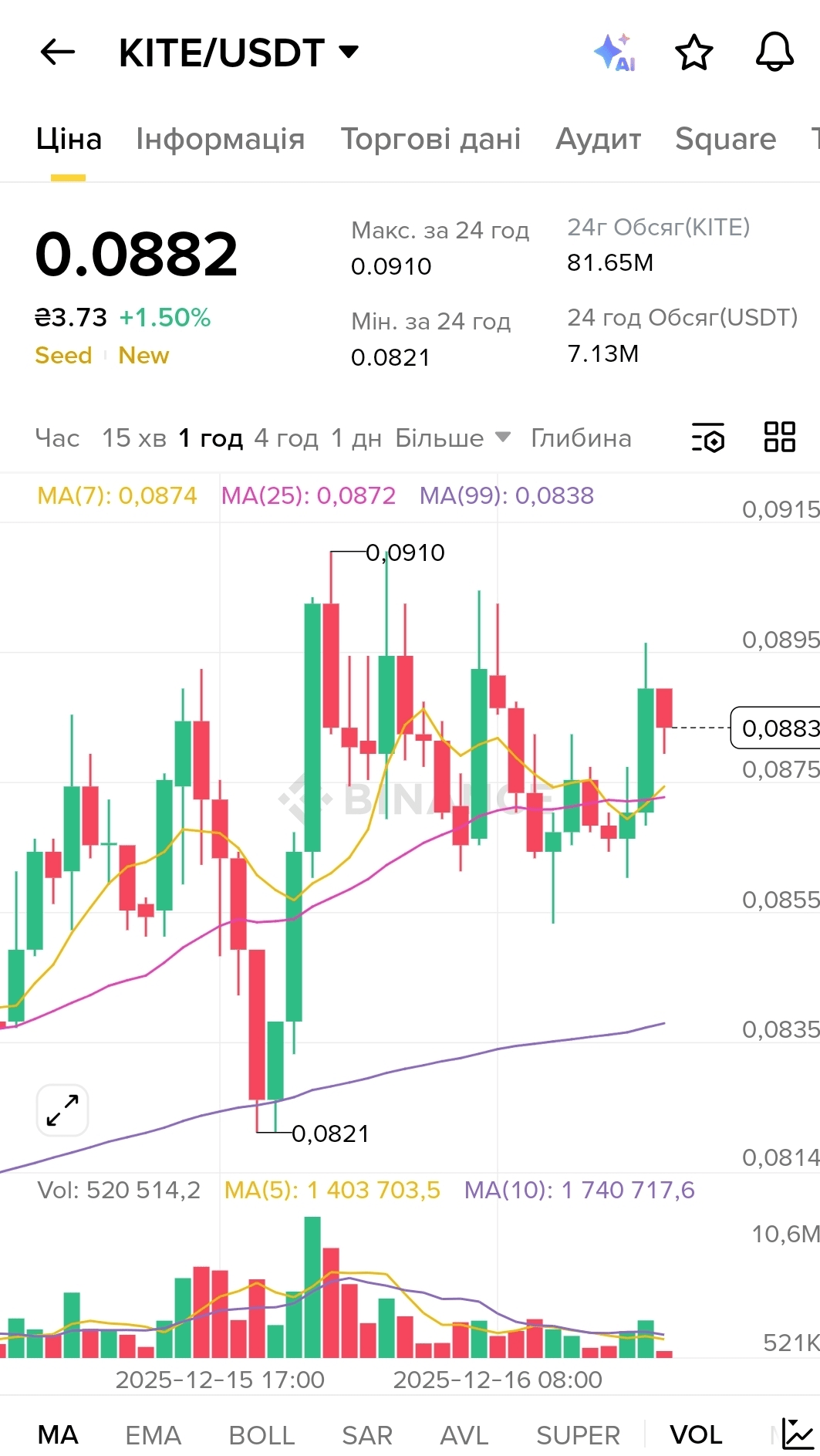
I'm looking at the $KITE chart at 0.0882 and imagining the economy of scale that could arise. If millions of AI agents make billions of microtransactions daily, paying for API calls, data, and computing resources, it creates enormous, continuous demand for the token. Not speculative demand from traders, but organic utility demand from real usage.
But of course, there are challenges. The first is the psychology of pricing. People are used to subscriptions because it's simple — one amount every month, and you don't think about it. The pay-per-use model requires more awareness of costs. However, if it's managed by an AI agent with set limits, perhaps it's not a problem. You tell the agent: "you have a budget of $100 per month for API services," and it optimizes expenses within that limit.
The second challenge is pricing discovery. What is a fair price for an API request? For a gigabyte of data? For a minute of computation? In the subscription world, companies set prices based on perceived value and competition. In the world of microtransactions, more dynamic pricing may emerge — surge pricing when demand is high, discounts when demand is low. It's more complex but more effective.
The third challenge is trust and quality. When you pay a subscription, there are certain guarantees — SLA, support, reliability. When you pay for each request, how do you ensure you receive quality service? Again, a reputation system on KITE is crucial, which I thought about earlier. API providers with high ratings, a history of reliability, and good reviews will receive more requests and can charge higher prices.
I also see potential for new business models that are impossible in the subscription world. For example, API aggregators — services that integrate dozens of different APIs and allow AI agents to find the best option for each task. Or dynamic pricing platforms that analyze the market and automatically adjust prices to maximize revenue. Or insurance for API calls — you pay a small premium, and if the service fails during a critical operation, you get compensation.
Another interesting aspect is bundling and unbundling. Right now, many services sell bundles — a package of tools for one price. This is convenient, but again inefficient if you only use part of the package. In the world of microtransactions, there will be unbundling — each service is sold separately, and AI agents combine them as needed for their specific tasks. This creates a more flexible, modular ecosystem.
When I think about the timeline for implementing this model, I realize it won't happen overnight. Companies won't abandon subscriptions quickly — it's working too well for their revenue. But gradually, as more AI agents emerge that need flexible access to APIs, as @GoKiteA proves the life ability of its platform, and as the first success stories show that pay-per-use can be more profitable, the industry will start to change.
Perhaps initially it will be small indie developers and startups experimenting with new models. Then mid-sized companies that see opportunities for differentiation. And eventually even giants like Amazon Web Services, Google Cloud, Microsoft Azure will add options for microtransactions through blockchain platforms like KITE because they don't want to lose market share.
I also think about the social aspect of this change. The shift from subscriptions to microtransactions is not just a technical change; it's a shift in how we perceive value. Instead of "I pay for access," it becomes "I pay for usage." It's fairer, more transparent, more aligned with the real value we receive. And in the long term, it could create a healthier digital economy, where resources are allocated more efficiently, where creators are fairly rewarded, and where consumers pay only for what they actually use.
So when I see the price $KITE at 0.0882 and trading volume over 81 million, I see not just another token. I see the infrastructure for a fundamental change in how the digital world is monetized. The shift from subscriptions to microtransactions is not just optimization; it's a revolution. And KITE positions itself as a platform that will make this revolution possible. Time will tell if they can realize this vision, but the potential is enormous.