

Do you know what has always annoyed me in all these conversations about Web3 and decentralization? Everyone talks about decentralized finance, decentralized applications, decentralized future — but then it turns out that this entire "decentralized" world relies on a bunch of centralized services. AWS hosts most of the Ethereum nodes. Infura processes most RPC requests. And the data? Data almost always comes from centralized sources.
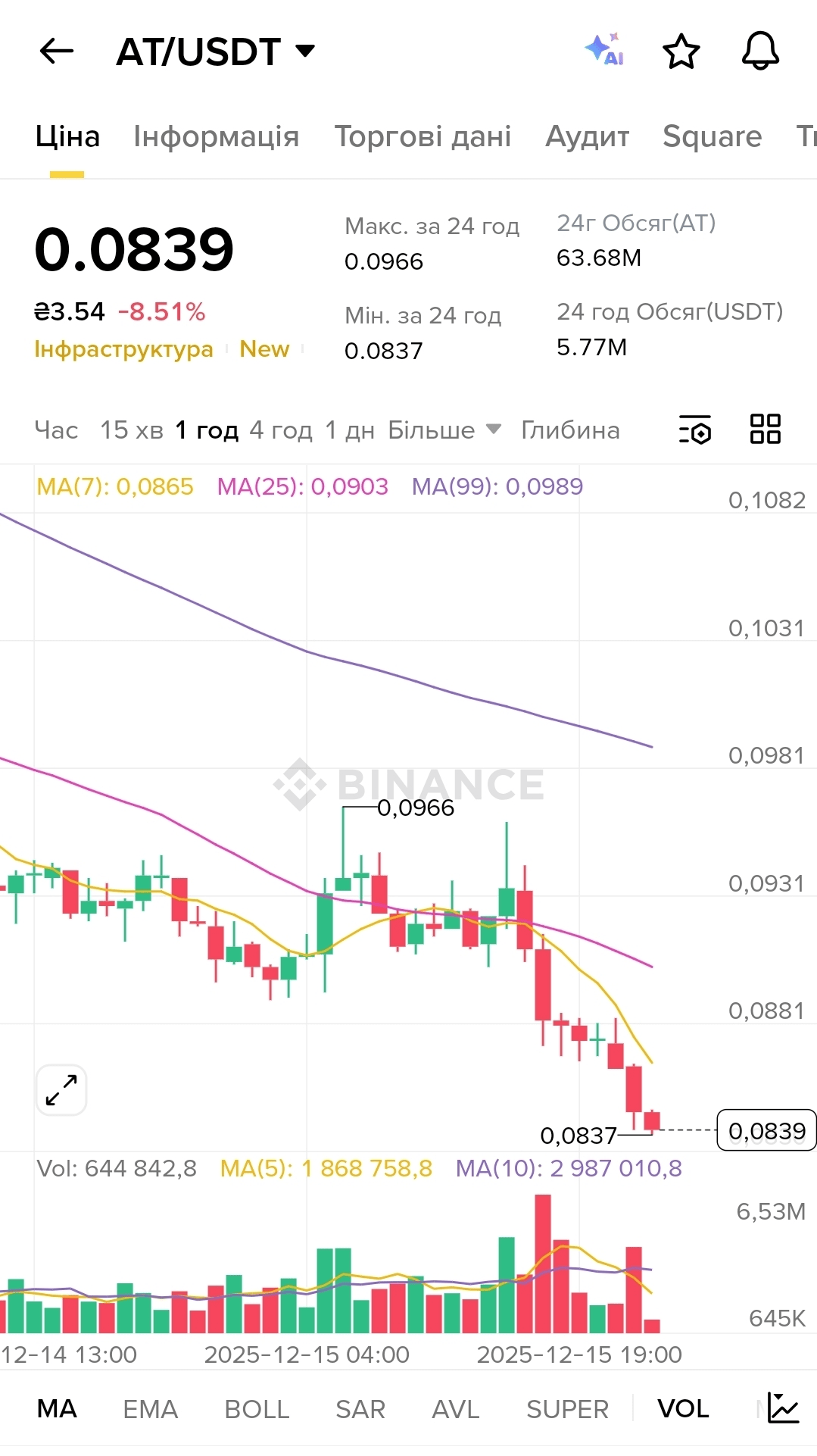
I'm looking at the chart for $AT, which is trading at 0.0910 with a drop of 2.47%, and I'm thinking: the market is red, panic is standard. But behind these numbers lies something more than just another token. @APRO-Oracle positions itself not just as another oracle for transmitting cryptocurrency prices into smart contracts. It's an attempt to build a truly decentralized data infrastructure. And if they really are doing this (and not just marketing talk), it could change the entire paradigm of how Web3 works.
Let's break down what data decentralization really is, why it's critically important, and why #APRO might be something more than just another technical project with a nice whitepaper.
I'll start with the basics. What is decentralization in general? It's when control is distributed among many participants, rather than concentrated in one person's hands. Bitcoin is decentralized because there is no central bank that controls its issuance. Ethereum is decentralized because there is no company that controls which transactions are valid and which are not. But the data? Data on the blockchain is almost always centralized.
Imagine a DeFi protocol for lending. You collateralize ETH and take a loan in stablecoins. The protocol needs to know the current price of ETH to calculate when to liquidate your position. Where does it get the price? From an oracle. And where does the oracle get the price? Usually from centralized exchanges like Binance or Coinbase through their APIs.
Wait. Did we just build a "decentralized" financial system that completely depends on Binance honestly transmitting prices and not manipulating them? Do you see the irony? All this beautiful decentralization crumbles at the point of data retrieval from the real world.
The trading volume of $AT 5.02 million USDT shows active trading, but that's just the surface. The question is not how much the token is traded, but how decentralized the infrastructure it supports is. Because if the infrastructure is centralized, the token merely represents a centralized service with a blockchain wrapper. And that's not a revolution; it's cosmetics.
@APRO-Oracle approaches this differently. They don't just take data from one source and feed it into the blockchain. They build a network of independent data providers who compete with each other for quality and reliability. This is a data market, not a monopoly. And it's fundamentally a different approach to the problem.
Let's consider how this works. There are many data sources for the price of BTC: Binance, Coinbase, Kraken, Huobi, local exchanges, P2P platforms, even data from DEX. Instead of trusting one source, #APRO aggregates data from dozens of sources simultaneously. If one source is lying or mistaken, most others will show the truth. This is data consensus, similar to consensus in blockchain.
But there's a nuance here that many don’t think about. What if all these sources are actually controlled by one actor? For example, if 10 out of 15 data sources are APIs from one company, just under different names? Then all this "decentralized" consensus is a fiction.
Therefore, true decentralization of data requires not just multiple sources but multiple independent sources. And this is where the economics comes in. You need to create incentives for different actors to become data providers. If you provide quality, accurate data — you earn. If you provide fake data or make mistakes — you get penalized or excluded. Simple and effective.
I spoke with a security researcher who specializes in oracle attacks. He told me: "The biggest vulnerability of most oracles is the centralization of data providers. Even if you have 100 nodes, if they all get data from one API, you have a single point of failure. Hack that API or bribe the one who controls it, and the whole oracle is compromised."
#APRO is trying to solve this by allowing anyone to become a data provider. Do you have a weather station? Sell your weather data. Monitoring prices in the local real estate market? Sell that data. Have access to a unique source of information? Monetize it through APRO. This creates a truly decentralized data market where there is no single controller.
The maximum in the last 24 hours was 0.0966, currently 0.0910 — low volatility. But you know what? The token price is short-term speculation. And building decentralized data infrastructure is a long-term game that may take years, but could potentially change the entire industry.
Another important aspect of data decentralization is censorship resistance. Imagine you are building a platform for prediction markets where people bet on election outcomes or political events. If you rely on a centralized oracle, the government can simply order that oracle to stop working or to transmit false data. And your platform is dead.
With a decentralized oracle, where data comes from dozens of independent sources worldwide, censorship becomes virtually impossible. Even if one government blocks some sources on its territory, others will continue to operate. Data will keep flowing. The system will keep functioning. This is true resilience.
@APRO-Oracle builds such a system. It's not just a technical solution for transmitting prices in DeFi. It's infrastructure for censorship-resistant transmission of any real-world data to the blockchain. From financial data to political events, from sports results to scientific measurements.
I often think about what Web3 promised us: freedom from corporate control, from censorship, from monopolies. But honestly — most Web3 applications still rely on Web2 infrastructure. Your NFT is stored on IPFS, but the metadata is often on a regular server. Your DeFi protocol is decentralized, but the data comes from the Coinbase API. Your DAO votes on the blockchain, but discussions happen in Discord on someone else's servers.
True decentralization requires decentralization at all levels of the stack. And data is a critical level that has mostly remained centralized until now. Projects like #APRO are trying to change that. And if they succeed, it will be a significant step toward a truly decentralized Web3.
The minimum in the last 24 hours was 0.0890, and the chart shows typical consolidation. The market is searching for a balance between bullish and bearish sentiment. But technological progress does not stop due to market fluctuations. When Bitcoin fell 80% in 2018, it didn't stop the development of the Lightning Network. When Ethereum fell 90% after the ICO boom, it didn't stop the development of DeFi. Price and technology are different things.
Another aspect I want to talk about is transparency. Decentralization without transparency is an empty promise. If a system is decentralized but you can't verify how it works, can you trust the results? Blockchain is transparent — anyone can look at the transactions. But oracles often are a black box.
@APRO-Oracle, according to their documentation, emphasizes transparency. Each data source has a reputation score that is publicly available. The history of the data is stored and can be verified. AI verification doesn't just say "data is correct" or "incorrect," but provides reasoning — why the algorithm considers the data valid or suspicious.
This is important because trust cannot be built on words. Trust is built on verification. "Don't trust, verify" is the mantra of Bitcoin, and it should apply to everything in crypto, including oracles. If I cannot independently verify that the data is correct and the system operates fairly, why do I need decentralization?
A volume of 54.47 million $AT in 24 hours is the liquidity that allows the system to function. But behind these figures must stand real value. And the real value of a decentralized oracle lies in the fact that it enables applications that otherwise could not exist.
Platforms for betting on political events that no government can shut down. Insurance systems that automatically pay out claims based on objective data, with no possibility for the insurance company to refuse. Prediction markets that aggregate collective wisdom without a centralized controller. Tokenization of real assets with transparent data verification. All this is only possible with decentralized data infrastructure.
I'm not romanticizing decentralization. It doesn't solve all problems. Sometimes centralized solutions are more efficient, faster, cheaper. But there is a class of problems where decentralization is critically important. Where trust in a centralized actor is impossible or undesirable. Where censorship resistance is more important than efficiency. And it's for these cases that projects like #APRO are needed.
Another thing that distinguishes true decentralization from pseudo-decentralization is the ability to exit. If you are unhappy with how the system works, can you just leave and use an alternative? In a centralized system — no, you are tied to the provider. In a decentralized one — yes, there is always a choice.
@APRO-Oracle, being a multi-chain solution with open access for data providers, creates just such an environment. Don't like one data provider — use another. Don't like how an oracle works on one blockchain — switch to another among the 40+ that are supported. This is the freedom of choice that is the essence of decentralization.
Honestly, I am skeptical about most crypto projects. Too much hype, too little substance. Too many promises to "change the world," too little real work on complex technical problems. But the idea of a truly decentralized data infrastructure is what excites me. Because if done right, it can unlock new opportunities we haven't even thought of.
The chart shows stable trading without sharp spikes. This is good. Wild pumps and dumps are a sign of manipulation and speculation. Organic growth based on real adoption is what leads to long-term success. And if #APRO is really building what it promises — a decentralized, transparent, censorship-resistant data infrastructure — they have a chance to become a critical layer in the Web3 stack.
Because ultimately, Web3 is not about tokens and quick enrichment. It's about returning control of data and infrastructure to users. About building systems that do not rely on trust in corporations or governments. About creating an alternative that is truly resilient, truly open, and truly decentralized.
And the oracles are a key part of this puzzle. Without decentralized oracles, all other components of Web3 remain vulnerable to centralized control at the data level. @APRO-Oracle and similar projects are trying to close this gap. Will they succeed? Time will tell. But the very attempt is worth attention and support.
So when someone tells me "APRO is just another oracle," I disagree. If they are doing what they claim — building a truly decentralized data infrastructure with open access, multiple independent sources, economic incentives for honesty, and transparency of verification — this is much more than "just an oracle."
This is an attempt to solve one of the fundamental problems of Web3: how to obtain reliable data from the real world without a centralized intermediary. And if this problem is solved, we will see an explosion of new applications and use cases that are currently impossible. From global decentralized insurance networks to censorship-resistant platforms for journalism and freedom of speech.
This is a future worth fighting for. And projects like #APRO that work on decentralizing data are doing important work toward that future. Regardless of what the token price does today or tomorrow.


