

Most automation systems begin with optimism.
Kite begins with restraint.
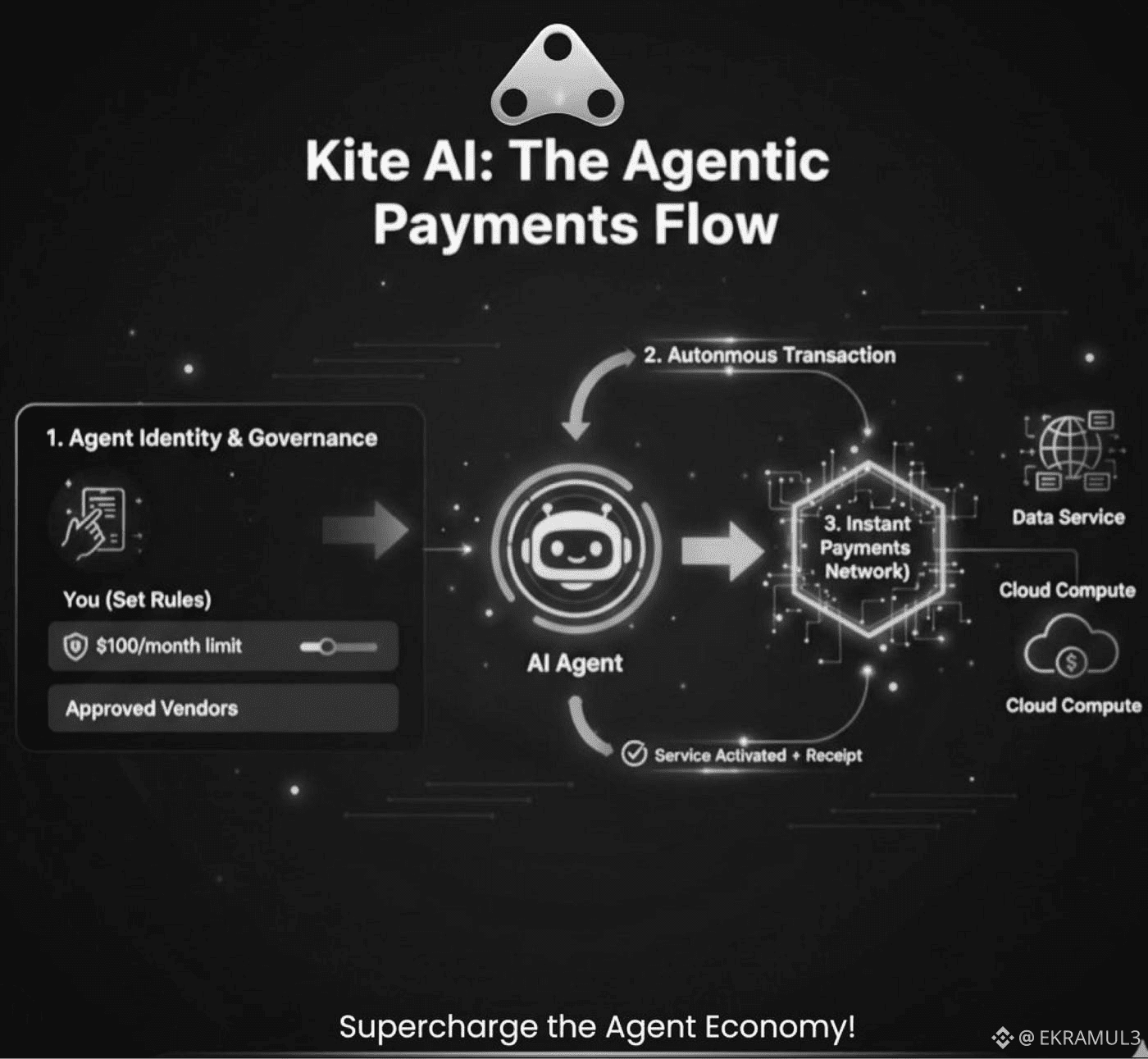
Kite doesn’t just wonder how much freedom AI agents can handle. It goes further and asks the tougher question: how much freedom should these agents actually keep once they’re dealing with real cash, strict rules, and actual consequences? That single question drives every part of the network’s design, from how it handles identity to the way things actually get done.
Kite is not racing to prove that agents can do more.
It is proving that agents can do enough safely, repeatably, and without eroding human control.
Automation That Starts With Authority, Not Permission
In most AI systems, automation is granted broadly and constrained later, often after something breaks.
Kite reverses that logic.
Every automated action on Kite begins with explicit authority, not implicit permission.
An agent does not simply “exist” on the network. It is instantiated with a scope:
what it can touch, how long it can act, how much value it can move, and who it is allowed to interact with.
These boundaries are not advisory.
They are enforced at execution time.
If an agent attempts to exceed its mandate by amount, counterparty, duration, or context the system does not warn, throttle, or degrade.
It stops.
And it records why.
Automation on Kite is not optimistic execution.
It is conditional execution.
Why Boundaries Are the Real Innovation
Speed is easy to market.
Boundaries are hard to defend.
Most high-throughput systems optimize for continuous execution, assuming errors can be fixed downstream. That assumption collapses in environments where agents control capital, compliance obligations, or operational workflows.
Kite treats containment as a first-class feature.
Every agent session is isolated.
Every task is scoped.
Every failure is localized.
If an agent misfires during an automated payment cycle, it does not propagate through a treasury.
If a logic error occurs, it does not unlock broader permissions.
If an instruction is malformed, it does not degrade system trust.
Failures stay small by design.
This makes Kite less flashy and significantly more reliable.
Structured Delegation Instead of Blind Autonomy
Kite does not sell “full autonomy.”
It sells structured delegation.
Human owners define the framework.
Agents operate inside it.
That distinction matters.
A treasury team can delegate invoice settlement to an agent without exposing the full wallet.
A platform can allow agents to execute recurring payments without granting open-ended authority.
A business can automate reconciliation while preserving auditability.
Autonomy exists but only where responsibility is clearly assigned.
This is why early interest is coming less from retail automation experiments and more from payment infrastructure teams, compliance-aware startups, and operational finance groups. These users don’t want impressive demos. They want systems that don’t surprise them.
Compliance Is Not an Add-On It’s Embedded
Kite’s architecture assumes oversight from day one.
Instead of layering compliance tools after the fact, Kite embeds verification logic directly into the session model.
Rules around jurisdiction, identity validation, counterparty eligibility, and logging are enforced before execution, not audited after.
This changes the role of automation entirely.
Agents don’t “bypass” controls.
They execute controls.
For institutions, this matters more than decentralization narratives.
They are not looking to remove oversight they are looking to make it programmable.
Kite is speaking that language fluently.
Quiet Infrastructure, Serious Intent
There is very little surface-level noise around Kite right now.
That is intentional.
Most development effort is focused on internal mechanics:
message validation, proof lineage, identity resolution, and interoperability with existing settlement tooling.
This is not consumer-facing work.
It is infrastructure work.
And infrastructure does not reward shortcuts.
Kite is building the kind of system that only becomes visible once it is trusted not when it is announced.
Why This Approach Matters Long-Term
Automation without limits eventually collapses under its own weight.
Either it becomes unsafe, or it becomes unusable.
Kite is trying to avoid both outcomes by treating boundaries as the enabler of scale, not the enemy of it.
By proving that agents can operate independently without escaping accountability, Kite positions itself as a credible settlement layer for the next phase of automation one where AI systems interact with real businesses, regulated capital, and institutional workflows.
Not fast.
Not loud.
But built to last.


