
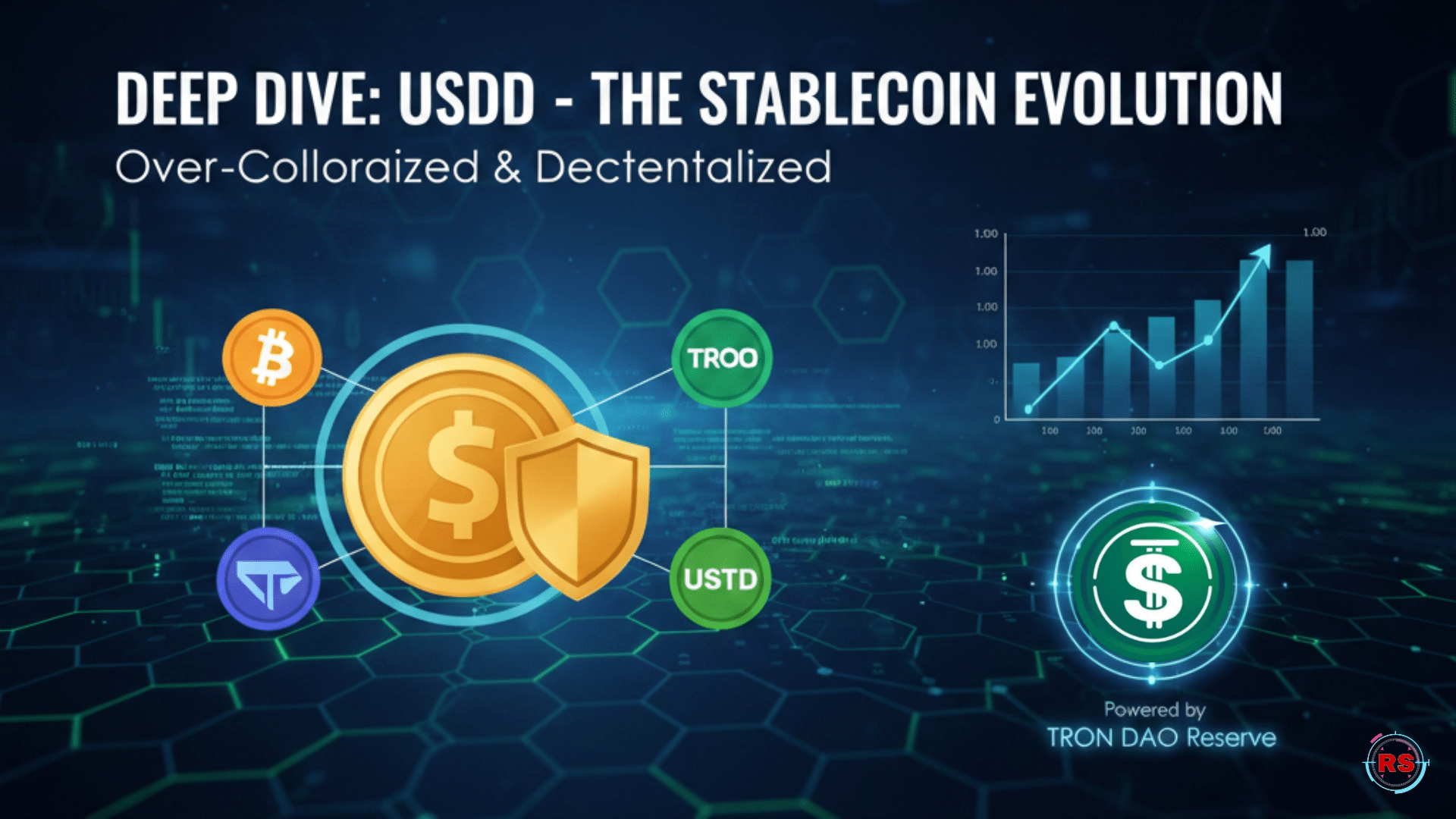
The stablecoin space is continuously evolving, with numerous projects striving to achieve fiat-equivalent stability based on the decentralization and transparency of blockchain technology. USDD (Decentralized USD), launched on the TRON network, positions itself as an over-collateralized decentralized stablecoin pegged 1:1 to the US dollar. This article will analyze its core characteristics, stability mechanisms, and role within the broader crypto ecosystem.
🔑 Core Features and Value Proposition
USDD aims to overcome the vulnerabilities of early algorithmic stablecoins by adopting a robust collateral model.
Decentralized architecture: The USDD protocol is primarily managed through smart contracts and community governance, aiming to reduce reliance on centralized issuers.
Overcollateralized reserves: Unlike early purely algorithmic stablecoins, USDD is supported by a diversified basket of crypto assets, including TRX, Bitcoin (BTC), and USDT. These assets are held and managed by the TRON DAO Reserve (TDR), with its collateral pool designed to far exceed the circulating supply of USDD, providing a strong buffer against market fluctuations.
On-chain transparency: The project's core philosophy is transparency, with collateral ratios and reserve wallet addresses publicly auditable on the blockchain, allowing users to verify their asset backing in real-time.
Multi-chain interoperability: USDD is natively based on the TRON blockchain but is also integrated with other mainstream public chains like Ethereum and BNB Chain, enhancing its accessibility and application scenarios in decentralized finance (DeFi).
🛡️ Dual Stability Mechanism
USDD maintains its dollar peg through the combination of over-collateralization and algorithmic stability mechanisms.
Overcollateralization model:
The TRON DAO Reserve (TDR) plays a stabilizing role similar to that of a central bank, actively managing a basket of collateral that includes high-quality digital assets.
By holding reserve assets worth far exceeding the circulating total of USDD (usually maintaining assets worth over 1.30 dollars for each USDD), TDR builds a safety cushion. Even if some collateral asset values decline, a high collateralization rate can effectively prevent the risk of the stablecoin becoming under-collateralized and losing its peg.
Algorithmic Peg Stability Module (PSM :
The system adjusts supply and demand through the algorithmic minting and burning mechanism between USDD and the native TRON token TRX.
If the price of USDD exceeds 1 dollar, users can mint new USDD by exchanging collateral assets (or native tokens) worth 1 dollar for 1 USDD, increasing supply to drive the price back down.
If the price of USDD drops below 1 dollar, users can reduce supply to push the price back up by destroying 1 USDD in exchange for collateral assets (or native tokens) worth 1 dollar.
The Peg Stability Module (PSM) further supports the anchoring mechanism, allowing for near-zero slippage seamless exchanges between USDD and other dollar-pegged assets like USDC and USDT, thereby enhancing market confidence and liquidity.
⚖️ Comparison and Conclusion
USDD occupies a unique ecological niche, blending the characteristics of crypto-collateralized stablecoins (like DAI) with its own algorithmic supply adjustment mechanism. The project emphasizes over-collateralization with diversified, highly liquid assets, aiming to learn from the failures of purely algorithmic stablecoins (such as Terra's UST) to build a more sustainable stability system.
These three categories of stablecoins represent three different design philosophies and trust models:
USDD (Hybrid/Ecological): It seeks to find a balance between the decentralization ideals of DAI and the user-friendly stability of USDT. Its core relies on over-collateralization to provide a safety cushion while using algorithms and its native ecosystem (TRX) mechanisms to adjust supply and demand and maintain its peg. Its success is highly dependent on the prosperity of the TRON ecosystem and the prudence of TDR reserve management.
DAI (Decentralized Native): This is the paradigm of a 'crypto-native' stablecoin. It does not rely on any centralized entity or real-world assets, operating entirely through on-chain over-collateralization and smart contract rules, pursuing maximum decentralization and censorship resistance. Its value is ultimately supported by the value of the basket of accepted crypto assets.
USDT/USDC (Centralized Fiat): This is the current market leader, with the simplest and most direct model: '1 token = 1 dollar deposit.' They offer the highest liquidity and stability, but their fundamental premise is that users trust the issuing company to transparently hold sufficient fiat reserves. This is an extension of the traditional financial trust model onto the blockchain.
The choice of which stablecoin to use depends on the specific needs of the user:
Pursuing maximum security and decentralization, able to accept complex operations → DAI
Pursuing extreme liquidity and widespread acceptance, trusting centralized issuers → USDT/USDC
Deeply engage in the TRON ecosystem, recognizing its hybrid model and governance → USDD
🛑 Potential Risks
Although the over-collateralization model significantly reduces risks compared to uncollateralized algorithmic stablecoins, its reliance on volatile crypto assets as support still brings inherent risks:
Concentration risk of collateral: The collateral often includes a large amount of TRX. If the price of TRX experiences a sharp, rapid, and sustained decline, it will severely erode the overall collateralization rate, potentially jeopardizing the system's ability to maintain its peg during extreme market events.
Reserve management risk: Whether the TRON DAO Reserve (TDR) can professionally and transparently manage and liquidate collateral assets during market pressure is key to its long-term stability. Its operational ability and credibility will directly determine the system's capability to respond to crises.
Systemic risk: The stability of USDD is highly tied to the overall market health and liquidity depth of its collateral assets (such as BTC, TRX, etc.). In a comprehensive, long-term bear market for cryptocurrencies, the value of all collateral could shrink simultaneously, potentially triggering a chain liquidation or collapse of confidence, testing its ultimate resilience under pressure.
💡 Final Analysis and Positioning
USDD represents the second-generation attempt to create a decentralized, transparent, and stable on-chain value storage tool. Its emphasis on over-collateralization is a key improvement addressing the core vulnerabilities of its predecessors, providing a more solid security foundation.
For DeFi users, USDD offers an attractive asset choice with its cross-chain compatibility and high on-chain verifiability. It provides a decentralized alternative outside of traditional centralized stablecoins in ecosystems like TRON.
However, the positioning of USDD can be seen as a trade-off within the 'trust triangle':
Between 'decentralization' and 'stability,' it sacrifices some capital efficiency (compared to uncollateralized algorithmic coins) for greater stability through over-collateralization.
Between 'decentralization' and 'efficiency/liquidity,' it may not match the depth and ubiquity of USDT/USDC but offers more transparent on-chain verification.
Its ultimate resilience, like all crypto-collateralized assets, depends on the ongoing health, diversity, and liquidity of its collateral reserves, especially during severe market downturns.
Conclusion: USDD is an important financial engineering experiment that seeks to find a better balance between decentralized ideals and real-world financial stability. Its success will be a long-term test of its collateral structure design, governance capabilities, and the effectiveness of its mechanisms under extreme pressure. Users should view it as an innovative asset accompanied by native crypto risks, rather than a risk-free tool fully equivalent to fiat currency deposits.
#USDD #OverCollateralized #DecentralizedFinance #TRONNetwork #DeFi

