Honestly, when I first received USDf through @falcon_finance, I had a question: okay, now I have a synthetic stablecoin, and what next? Just hold it in my balance? It's like getting a tool and not knowing what it's for. That's when I started digging deeper and realized that USDf is not just another stablecoin for storage; it's a universal key to dozens of opportunities in the crypto space. Let's explore five main use cases that I have personally tested and that actually work.
The first and most obvious scenario is trading and speculation without liquidating the underlying assets. Here’s what it looks like in reality. I have $FF, I believe in the long-term potential of the token, but I see an interesting opportunity in the market right now. For example, another token has significantly dropped and looks undervalued. Previously, I would have to sell part of my $FF, buy this token, then sell it for a profit, buy back $FF — a bunch of transactions, a bunch of fees, plus the risk that during this time $FF itself would rise in price. But now? I collateralize my tokens, receive USDf, buy what interests me, trade, return USDf, and take back my collateral. My main assets remain with me, and I catch the market movement.
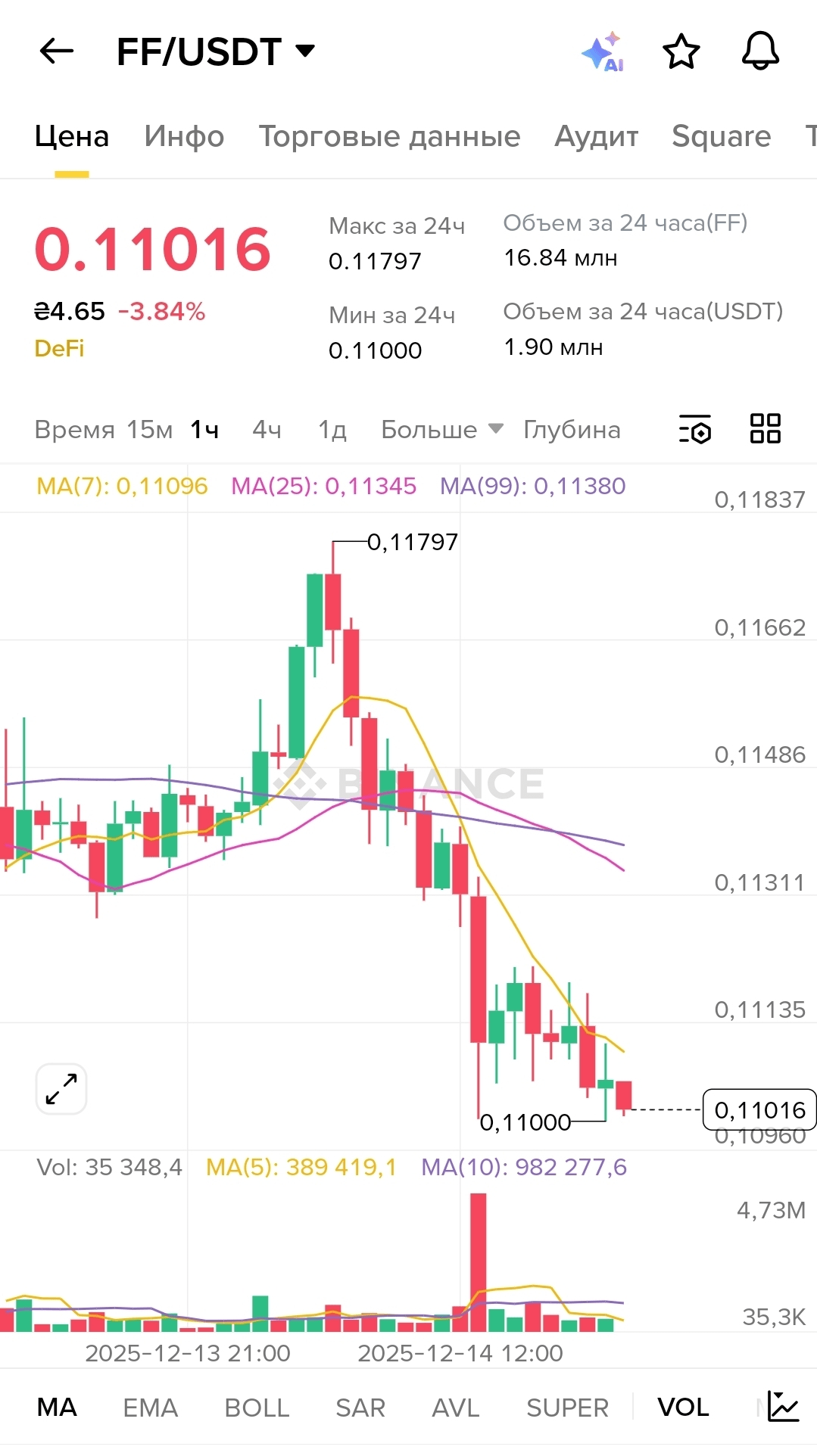
Look at the current chart $FF — price 0.11016 USDT, a drop of 3.84% over the day. Over the last 24 hours, the maximum was 0.11797, the minimum 0.11000 — this is a fluctuation of 7.2%. Here is the perfect example for trading: if you collateralized $FF at the peak around 0.11797, received USDf, and waited for a drop to 0.11000, you could have bought additional $FF tokens at a discount. When the price recovers, you will return USDf, take your original collateral plus the additional tokens — pure profit without needing to sell your position initially.
The second scenario is participating in yield farming and staking with borrowed capital. This is my favorite way to use USDf because here the math works particularly beautifully. Suppose I see a liquidity pool with a yield of 15% per annum. I have $FF worth $10,000, but I don’t want to sell them. I collateralize the tokens, receive USDf worth $6,000-7,000, and add them to the pool. Now I earn 15% on the borrowed funds, while my main asset $FF can also increase in price. If the price of $FF increases by 20% over the year and farming brings me 15% on borrowed capital, my overall yield will be much higher than if I simply held the tokens.
Of course, it is important to consider the cost of using USDf — there may be fees or an interest rate for issuing a synthetic asset. But in #FalconFinance, these conditions are transparent, and if calculated correctly, arbitrage between the cost of borrowed funds and farming yield can be very profitable. I look at the trading volumes — 16.84 million per day for the token and 1.90 million USDT — this is a sign of healthy liquidity, which means that if necessary, I can always quickly enter or exit a position.
The third scenario that opened up for me just recently is using USDf for a DCA strategy (dollar-cost averaging) without selling main assets. This is especially relevant for those who want to accumulate a specific asset gradually but do not have a regular inflow of fiat money. Here’s how it works: I collateralize my cryptocurrency portfolio, receive USDf, and now every week or month I buy a portion of these funds into the token I am interested in, regardless of its current price. A classic DCA strategy, but without the need to introduce new money from my pocket.
Look at the chart — MA(7) at 0.11096, MA(25) — 0.11345, MA(99) — 0.11380. The short-term average is significantly below the long-term ones, indicating a downtrend. If you practice DCA and buy the asset regularly, such dips are a gift because you are averaging the entry price. And thanks to USDf, you can do this without touching your main savings in crypto.
The fourth scenario is using USDf as a liquidity buffer for everyday expenses. You know, one of the main downsides of living in crypto is the need to convert assets to fiat every time you need money. It’s especially painful to do this during market dips. I solved this problem for myself like this: I collateralize part of my portfolio, receive USDf, and keep them as a safety cushion. When I need money — I exchange USDf for fiat or spend directly (if the merchant accepts stablecoins). My main portfolio remains untouched; I don’t lock in losses during dips, and I don’t miss potential growth.
Look at the current dip: $FF dropped from 0.11797 to 0.11016 — that’s minus 6.6%. If I needed money right now and had to sell tokens, I would have locked in that loss. But with USDf? I obtained liquidity in advance when the price was higher, and now I am calmly waiting for the market to recover. My $FF is in collateral, but when the price returns to previous levels, I will be able to return USDf and reclaim my tokens without losses.
The fifth scenario that I discovered literally a couple of months ago is using USDf for lending and P2P loans. This is a more advanced option, but it works wonderfully if you have the right connections in the community. Suppose someone I know needs urgent liquidity but doesn’t want to go to a bank or a centralized platform. I can lend them USDf at a reasonable interest rate. For me, this is a source of passive income; for them, it’s quick access to funds without bureaucracy. And all of this works on the blockchain, transparently and without intermediaries.
I look at the volumes and see an interesting picture: the current hourly volume is 35,348.4 units, while MA(5) shows 389,419.1, and MA(10) — 982,277.6. This means that activity has decreased compared to a recent spike — do you see that huge red column on the volume chart? That was a mass sell-off, panic. But here’s what’s interesting: during such moments, the demand for stable liquidity increases. People want to move into stablecoins to weather the storm. And USDf in such situations becomes a life raft — you don’t have to sell assets at the market bottom; you can just collateralize them and gain stability.
Another bonus scenario I want to mention is arbitrage between different protocols and exchanges. There are moments when there is a price difference for the same asset on different platforms. With USDf, you can quickly take advantage of this opportunity: obtain liquidity, buy where it is cheaper, sell where it is more expensive, and lock in profits. All of this without the need to hold large amounts in stablecoins in advance or sell your main portfolio.
Do you know what I like most about all these scenarios? Flexibility. Previously, I had to choose: either I hold assets and miss opportunities, or I sell assets and lose growth potential. Now with @falcon_finance and USDf, I can do both simultaneously. My tokens in collateral remain mine; they increase in price (or decrease, it’s crypto), but I also obtain liquidity to seize current opportunities.
Look at the current price 0.11016 and compare it with MA(99) at 0.11380 — this indicates that the token is trading below its long-term average. For a long-term holder, this is not a cause for panic; it’s just a temporary correction. And thanks to the ability to obtain USDf against collateral, you can weather this correction comfortably, having access to liquidity for other purposes.
I am sure that as the #FalconFinance ecosystem develops, dozens more scenarios for using USDf will emerge that we are not even aware of right now. Perhaps integration with payment systems for direct payment for goods and services. Maybe usage in cross-chain bridges for transferring value between blockchains. Perhaps something completely unexpected. But even now, with these five main scenarios, USDf provides a level of flexibility that simply did not exist in DeFi before. And this is just the beginning.
#FalconFinance @Falcon Finance $FF