You know what has always annoyed me about DeFi? This illusion of democracy. Everyone talks about decentralization, about community power, about how everyone has a voice. But in reality? Whales control everything, decisions are made in closed chats, and ordinary users only find out about the results after the fact. I am tired of this falsehood. So when I got acquainted with the veBANK system at @LorenzoProtocol, I realized — here it is, real decentralized governance, where power is truly in the hands of the holders. Now I will explain how it works and why it changes everything.
Let me start with what veBANK actually is. It is a model of vote-escrowed tokens that emerged thanks to Curve Finance and has proven effective in aligning interests between the protocol and its users. The essence is simple: you lock your tokens $BANK for a certain period — from several months to several years. In exchange, you receive veBANK tokens, which give you the right to vote in governance and a larger share of the income. The longer you lock, the more veBANK you receive, and the greater your weight in voting. This is like the difference between a tourist who is here for a day and a local resident who has lived here for decades. Who is more interested in the city's development?
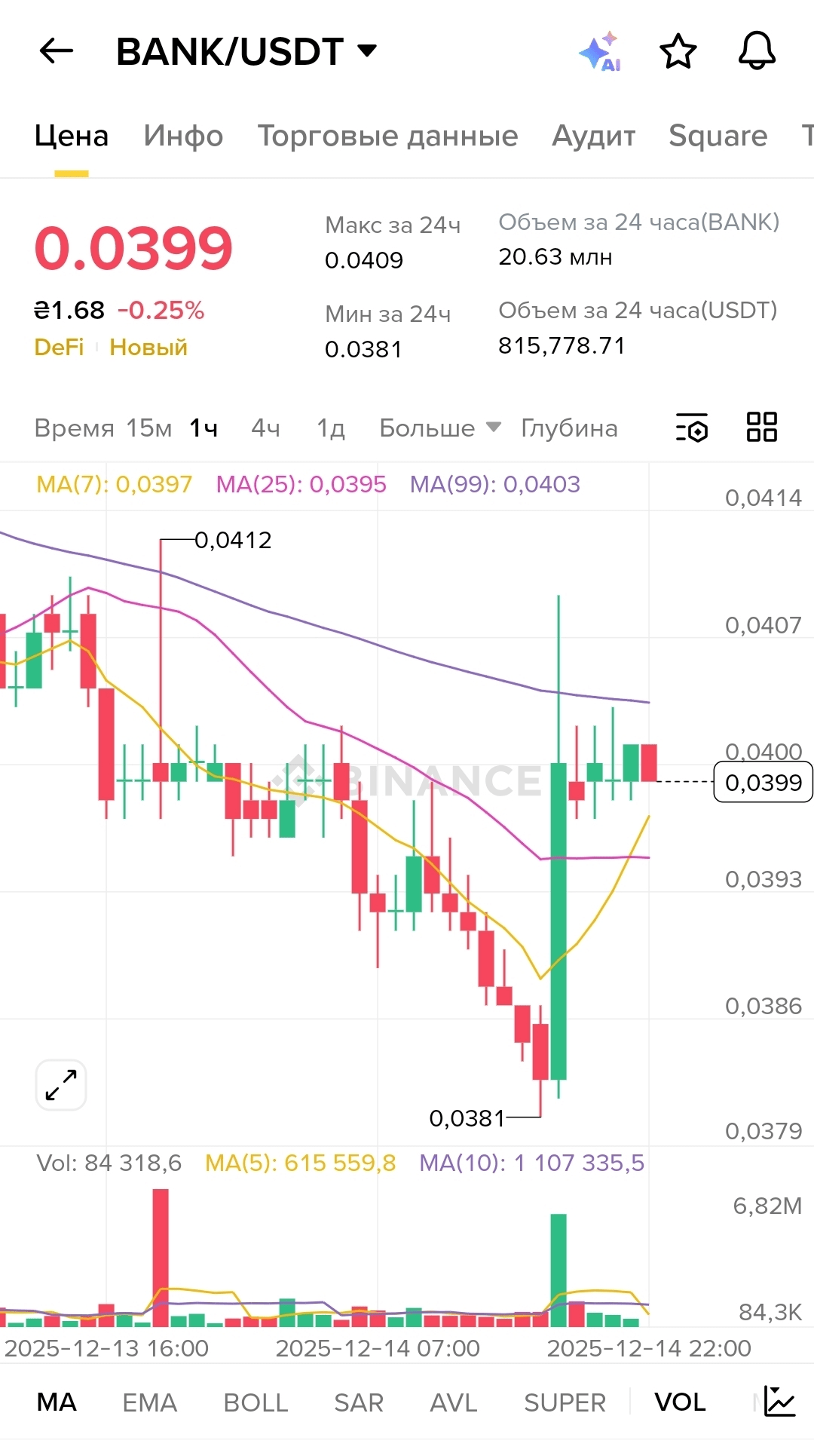
I am currently looking at the $BANK chart and see an interesting picture that shows why long-term interest is so important. The price is currently $0.0399, having fallen only 0.25% over the day — minimal change. The maximum in 24 hours was $0.0409, the minimum $0.0381 — a range of more than 7%. But look at the overall picture. After a sharp drop to the minimum of $0.0381 (do you see that long red candle in the center of the chart?), the price made a powerful recovery — a huge green candle rose almost to $0.0407. This is an increase of more than 6% from the minimum in a short time. Now consolidation is taking place around $0.0400 with slight fluctuations. For a short-term trader, this is stress and uncertainty. For a veBANK holder who has locked tokens for a year or two, this is just noise — the long-term growth of the protocol is what matters, not daily fluctuations.
Look at the technical indicators. MA(7) is at $0.0397, MA(25) — $0.0395, MA(99) — $0.0403. Interestingly, the current price of $0.0399 trades above the fast MA(7) and the average MA(25), but below the long-term MA(99). This is a transitional zone where the market is determining direction. The yellow MA(7) has turned upwards after hitting the bottom, indicating a short-term bullish impulse. The pink MA(25) has also begun to turn upward after a long decline — this is a potential signal for a trend change. The purple MA(99) is still pointed downwards but is beginning to flatten. For the veBANK system, this technical picture shows the importance of a long-term outlook — there may be volatility in the short term, but a foundation for growth is being formed in the long term.
Volumes tell their own story. In one day, 20.63 million BANK and 815 thousand USDT. Look at the volume chart — two huge spikes stand out in the background. The red bar on the left shows mass sales during the decline, while the huge green bar on the right shows aggressive purchases during the recovery. This green bar is even higher than the red one — about 6.82 million against approximately 6 million. This means that buyers came in stronger than sellers exited. MA(5) by volume — 615 thousand, MA(10) — 1.1 million. After these spikes, volumes returned to normal levels. For veBANK holders, token liquidity is important — if they want to exit a position early (although this is unprofitable), they need the ability to sell veBANK or unlock $BANK.
How does the voting system work in Lorenzo? veBANK holders vote on key issues for the development of the protocol. Which new strategies to add to the platform? A high-risk, high-return CTA fund or a conservative structured product? How to distribute fees among different OTFs? What percentage to reserve in the insurance fund? What risk parameters to use for leverage? All these decisions are made by voting, where the weight of each vote is proportional to the amount of veBANK. One veBANK token — one vote. If you have 1000 veBANK — you have 1000 votes. Someone with 100,000 veBANK has more influence, but that’s fair because they are taking more risk and have been locked in the protocol longer.
The coolest thing about the veBANK model is the alignment of interests. In traditional companies, management can make decisions that benefit them personally but not shareholders. They pay themselves bonuses, take excessive risks for short-term profits, and think about the next quarter instead of a decade ahead. In Lorenzo, veBANK holders are the management. They make decisions and live with the consequences of those decisions. Voted for a risky strategy, it failed — your veBANK is worth less. Voted for a conservative approach, the protocol grows slowly but steadily — your veBANK increases in value. Perfect alignment of incentives.
Another important aspect is income distribution. veBANK holders receive a share of all the fees generated by the protocol. The more people use Lorenzo, the more assets under management, the more OTF strategies are working, the more fees accumulate, and the more veBANK holders receive. This is like being a shareholder in a company that pays dividends, but with one difference — dividends are automatically reinvested in veBANK, creating a compounding effect. Your share in the protocol grows by itself, without additional actions.
The $BANK token plays a central role in this system. To obtain veBANK, one must lock up $BANK. The more people want to participate in governance and receive a share of the revenue, the higher the demand for $BANK to be locked. This creates a scarcity of $BANK in the market — tokens are locked for months and years and do not participate in trading. With constant or growing demand and decreasing supply, the price rises. This is not a guarantee, but it is a healthy economic model that encourages long-term holding.
Look at the price recovery pattern. From the minimum of $0.0381 to almost $0.0407 — this is a V-shaped recovery, a classic pattern of capitulation and subsequent bounce. Do you see how after that long red candle, a powerful green one followed immediately? This indicates that aggressive buyers found value at the bottom who believe in the asset's long-term value. For short-term traders, such movements are an opportunity to profit from volatility. For veBANK holders, this confirms their long-term thesis — even in moments of panic, there are buyers who see value.
I locked a part of my $BANK in veBANK a few months ago. I chose a one-year lockup period — not too long to feel like a hostage, but long enough to gain a decent weight in voting. At first, it was unusual — seeing the price of $BANK fluctuate and not having the ability to sell. But then I got used to it and even loved that feeling. I no longer look at the chart every hour, nor make impulsive decisions based on emotions. I am an investor, not a trader. My focus is on the development of the protocol, not on short-term price movements.
Through veBANK, I participated in several votes. The most interesting was the vote on adding a new CTA strategy focused on altcoins. Part of the community was in favor — high potential returns, growing interest in altcoins. The other part was against — high risk, volatility, complexity of management. I voted in favor, but with the condition of limiting the size — no more than 15% of the total capital in this strategy. In the end, the proposal passed with similar conditions. This is real participation in governance, not a theater where decisions are made in advance.
Another aspect of veBANK is gauge voting. veBANK holders vote on the distribution of rewards among different OTF strategies. Which strategies will receive more incentives in the form of $BANK tokens, which will receive less. This affects the attractiveness of each strategy for new investors. A strategy with large incentives attracts more capital, grows faster, and generates more fees. This is a mechanism of self-regulation — the community directs capital where it sees the greatest potential. It is not a centralized team making decisions for everyone, but the collective intelligence of thousands of holders.
Looking at the current price position relative to moving averages, an interesting configuration is visible. The price broke above MA(7) and MA(25), which is technically a bullish signal. But it remains below MA(99) at $0.0403 — this is the nearest resistance. If the price breaks and holds above this level, it will confirm a trend change from descending to ascending. For long-term holders of veBANK, this is an important psychological moment — confirmation that the worst is behind us and recovery begins.
Another advantage of veBANK is protection against hostile takeovers. In regular DeFi protocols with simple token voting, a large player can buy a substantial amount of tokens on the market and take control of the protocol, making decisions in their favor. With veBANK, this is much more difficult because a large portion of tokens is locked for a long time and is not for sale. Even if someone buys a lot of $BANK, they will have to lock it up for years to gain significant voting weight. During this time, the community will notice the concentration of power and may take protective measures. This makes Lorenzo more resilient to governance attacks.
Of course, the veBANK system is not perfect. The main risk is the illusion of decentralization while power is actually concentrated. If a few large holders control the majority of veBANK, they can make decisions in their own interest, ignoring the opinions of smaller holders. This is a problem with any voting system where weight is proportional to capital. But Lorenzo tries to mitigate this through quadratic voting for some issues, where influence grows not linearly but as the square root of the number of veBANK. This gives more weight to smaller holders relative to whales.
Another risk is low voter turnout. If only 10-20% of veBANK holders participate in voting, decisions are made by an active minority rather than the community as a whole. Lorenzo addresses this through incentives — additional rewards in $BANK are given for participating in votes. The more actively you vote, the more you earn. This motivates people not just to hold veBANK, but also to actively participate in governance.
Look at the volumes after the price recovery. After that huge green bar indicating aggressive buying, the volumes returned to low levels. This indicates that the market has accepted the new price level and is consolidating here. There are no mass sell-offs, no panic buying — the market is in equilibrium. For veBANK holders, such stability after volatility is a good sign. It means the worst is behind us, and we can calmly focus on long-term development.
For those considering locking $BANK in veBANK, here are a few tips from personal experience. First — start with a short lockup period. Don’t lock for 4 years right away if you are not sure. Lock for 3-6 months, feel the mechanics, participate in the votes. Then you can extend. Second — only lock up the portion of your portfolio that you definitely won’t need in the near future. veBANK is a long-term game; early exit is usually unprofitable and comes with penalties. Third — actively participate in governance. Read proposals, ask questions in the community, vote consciously. Otherwise, the purpose of locking is only for additional rewards, not for real influence on the protocol.
Fourth — diversify by locking time. You can split your $BANK into several parts and lock them for different periods — part for 6 months, part for a year, part for two years. This will give you a more even distribution of liquidity over time. When one part is unlocked, you can decide what to do next, while the other parts continue to work. Fifth — keep an eye on the governance forum of Lorenzo. There, proposals are discussed before voting, and you can learn the arguments from different sides and understand the nuances. Voting without understanding the context is a lottery, not governance.
veBANK and decentralized governance in the Lorenzo Protocol are not just a trendy feature; they are a fundamental shift in how investment platforms work. Power shifts from a closed team of managers to an open community of holders who risk their own capital. This aligns interests, creates long-term thinking, and protects against short-term speculation and manipulation. It is not a perfect system — problems of power concentration, low turnout, and complexity for newcomers remain. But this is the best we have in DeFi in terms of true decentralization. For me, participating in veBANK is not only a way to earn more but also an opportunity to truly influence the development of the protocol I believe in. Are you ready to lock tokens for a long time for influence and greater rewards? Or do you prefer the liquidity and flexibility of short-term holding? Share!
#LorenzoProtocol @Lorenzo Protocol $BANK