
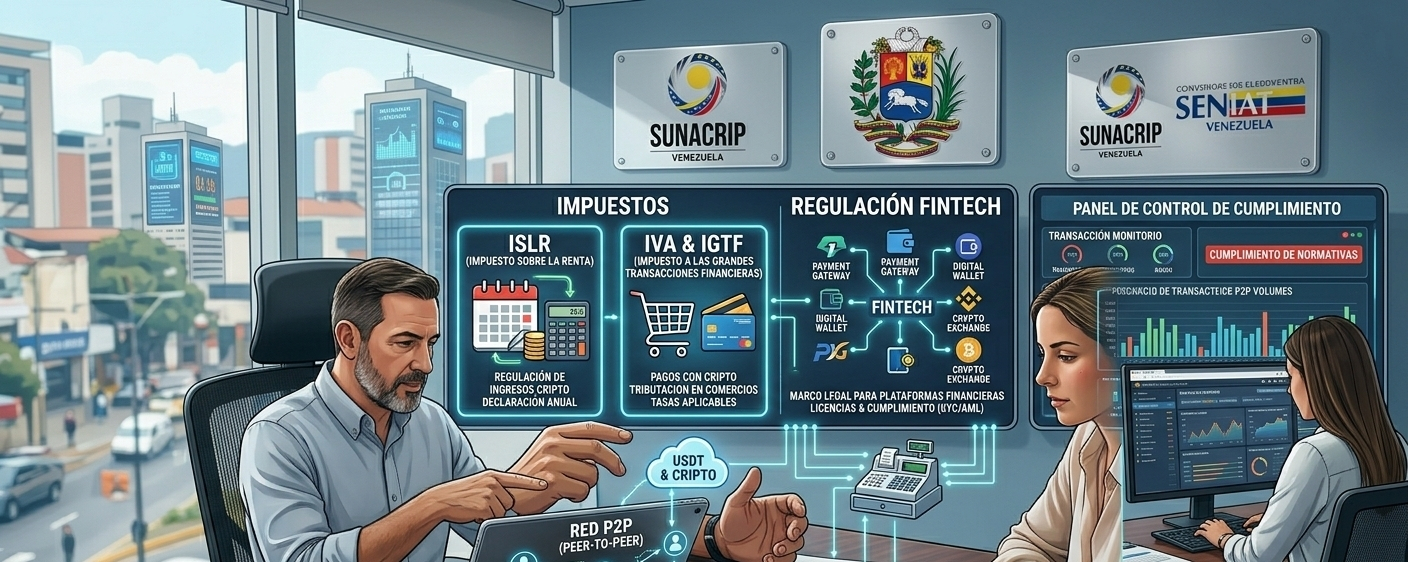
Is USDT legal in Venezuela? SUNACRIP, SENIAT, ISLR, IGTF, and VAT explained. Declaration thresholds and everything you need to trade legally in 2026.
Venezuela doesn't have a specific tax regime for cryptocurrencies — the general rules of ISLR and the VAT Law apply, treating crypto assets as intangible goods. The result: three different taxes that may apply depending on the type of trade. Trading with USDT is completely legal under the SUNACRIP framework. If you want to get started, check out the guide on how to buy USDT in Venezuela. The threshold for declaring is lower than most think: anyone who generated more than 30-40 USDT on average monthly in 2025 is required to declare ISLR. On USDT TODAY, you can find the real-time price of USDT in Venezuela, or in the USDT price guide for today in Venezuela.
SUNACRIP and SENIAT — two distinct entities
SUNACRIP (National Superintendence of Crypto Assets): regulates the ecosystem — exchanges, mining, crypto services. Issues licenses to CrixtoPay and Kontigo. Does not collect taxes.
SENIAT (National Integrated Customs Administration Service): collects taxes on profits from cryptocurrencies. Applies the general rules of the tax system. The legal basis: Constituent Decree of 2018, Application Bulletin No. 12, and Presidential Decree No. 4,025 (2019).
💡 SENIAT does not receive cryptocurrencies directly. When declaring, all operations must be expressed in bolívares using the official BCV rate — not the P2P market rate.
The three taxes that apply to USDT
1. ISLR — on profits from selling or exchanging USDT. Rates from 6% to 34%.
2. IGTF — 3% on currency transactions. Mainly applies to special taxpayers and businesses.
3. VAT — 16% only on commission for intermediary services (exchanges). Does not apply to the sale of crypto directly.
ISLR — the main tax for individuals
Who is obliged to declare? Any individual who meets both conditions: more than 183 days in Venezuela during 2025 and average income exceeding 30-40 USDT monthly during 2025. This amounts to only $360-480 USD a year — practically any Venezuelan who regularly trades crypto is obliged.
ISLR rates for individuals: progressive from 6% to 34% depending on total annual income expressed in Tax Units (UT, valued at Bs. 9 since 2023).
Profit calculation: selling price in Bs. (BCV rate) − acquisition cost in Bs. (BCV rate on purchase day) = net taxable profit.
Generates ISLR: selling USDT for Bs. with profit, exchanging USDT for another crypto, receiving USDT for services or staking, using USDT as a payment method.
Does not generate ISLR: buying USDT, transferring between own wallets, holding.
⚠️ ISLR deadline 2025: expired on March 31, 2026. The next period (2026) expires on March 31, 2027. Don't leave the declaration until the last moment.
IGTF — the tax on currency transactions
IGTF is 3% on transactions in currencies or cryptocurrencies other than Petro. It mainly applies to special taxpayers and businesses receiving payments in USDT or USD. Ordinary taxpayers (individuals selling on P2P and receiving bolívares via Pago Móvil) generally are not subject to IGTF directly.
Formula for businesses accepting USDT:
Base = USD × BCV Rate → + VAT 16% → + IGTF 3% = Total to charge
Example: business receives $100 USD in USDT, BCV rate Bs. 62.10
Base: $100 × 62.10 = Bs. 6,210 → VAT 16%: Bs. 993.60 → IGTF 3%: Bs. 216.11
Total tax: approx. Bs. 7,419.71
The unique context of Venezuela
Currency duality: the official BCV exchange rate (approx. Bs. 62.10) and the parallel P2P market rate (approx. Bs. 76.94) are significantly different. For SENIAT, all operations are expressed in bolívares using the official BCV rate — even if you operated at the parallel rate. This can create distortions between actual profit and declared tax profit.
The Tax Unit (UT): its current value is Bs. 9 — significantly lagging behind real inflation. This means that practically any income in USDT exceeds the declaration thresholds expressed in UT.
Unauthorized platforms: if you operate through exchanges without SUNACRIP licenses (like Binance P2P), operations still generate tax obligations. Ignorance does not exempt. Tools like Cointable help provide tax traceability for these operations to comply with SENIAT.
Remittances in USDT — special treatment
Remittances in USDT from family abroad are generally classified as donations — not as income from economic activity — and donations between direct family members are not taxed by ISLR. However, if you gain a favorable exchange difference when converting them to bolívares, that exchange gain may be interpreted as taxable income. The line is not always clear — consult a specialized Venezuelan accountant.
Step by step: declare USDT to SENIAT
Step 1: Gather complete operation history — date, amount of USDT, price in Bs. at the BCV exchange rate for each day.
Step 2: Calculate net profit in bolívares always using the official BCV rate.
Step 3: Log into the SENIAT portal with your RIF and password.
Step 4: Complete Form DPN-25 for individuals. Profits from crypto assets go in "global enrichment" or "other income" — there is no specific box for crypto.
Step 5: Pay in bolívares through authorized banks. SENIAT does not accept direct payment in USDT.
Frequently asked questions
Is it legal to operate with USDT in Venezuela?
Yes. SUNACRIP regulates the ecosystem and has issued licenses to platforms like CrixtoPay and Kontigo. Holding and operating with USDT is permitted. The obligation is to declare profits to SENIAT when you exceed the threshold of 30-40 USDT average monthly.
At what exchange rate do I declare my USDT?
At the official BCV exchange rate in effect on the day of each operation — not at the P2P market rate. The BCV publishes the official exchange rate daily at bcv.org.ve. This distinction is critical as the two rates are significantly different.
Can SENIAT see my operations on Binance?
Currently, international exchanges do not report directly to SENIAT. Exchanges licensed by SUNACRIP do have reporting obligations. The OECD's CARF is closing this gap globally. The obligation to declare exists regardless of whether SENIAT has access to those data.
Do I have to pay IGTF if I sell on P2P and receive via Pago Móvil in bolívares?
For individuals selling on P2P and receiving bolívares via Pago Móvil, IGTF generally does not apply directly — IGTF mainly applies to special taxpayers and businesses. However, check your specific situation with a Venezuelan tax advisor.
What happens if I didn't declare in previous years?
SENIAT can review past years. The statute of limitations is 4 years (6 years in cases of fraud). A voluntary regularization significantly reduces penalties — consult a specialized Venezuelan accountant to assess your situation.
⚠️ This guide is for general informational purposes. Crypto regulation in Venezuela is constantly evolving. Consult a specialized Venezuelan public accountant in digital assets for your specific tax situation.
#venezuela #Caracas #caracasvenezuela #P2P #regulacion $BTC @Binance Academy @Binance Announcement @Binance Customer Support @Binance LATAM Official @Binance News @Ton Network @CoinMarketCap @Cointelegraph @CoinDesk