
The market is at a critical directional choice point.
The current market has reached a critically important stage, and the market is about to make a directional choice. Will it continue to rise in a new round of growth, or will there be a significant pullback at a high level? The answer will come in the next few days. Fluctuating markets can easily confuse people, but truly significant market movements often emerge from such hesitation and divergence.
Macro environment: Known negative factors have been fully priced in.
From a macro perspective, this week is a typical 'super market week'. Japan is about to start its interest rate hike process, and the overall interest rate reduction cycle of developed countries' central banks is coming to an end. Next year, only the Federal Reserve may still have room for rate cuts. Previously, the market was generally concerned that the Federal Reserve's 'hawkish rate cuts' and the positive impact of rate cuts in December would instead turn into negative factors.
However, it needs to be clarified that this information is not a sudden event but rather a consensus that has long been public and repeatedly discussed. Any information known by retail investors has already been priced in by institutions and large funds. Therefore, even if short-term volatility increases, such 'known information' is not sufficient to truly determine the market's major direction.
Real variable: U.S. core economic data
What the market truly needs to focus on is the upcoming unknown data. First is the U.S. unemployment rate and non-farm employment data for November, followed by the CPI inflation data to be released on Thursday evening.

If employment data shows significant weakness, it indicates increased economic pressure, and the previously considered low probability of a rate cut in January will be significantly elevated, constituting a clear benefit for risk assets like Bitcoin. Conversely, if employment remains strong and the unemployment rate stays low, expectations for rate cuts will cool again, creating short-term bearish effects on digital assets.
Regarding CPI, the Federal Reserve has clearly stated that it will continue to suppress inflation and firmly anchor the target at 2%. From some leading data and internal signs, there is a possibility of continued decline in inflation. Once the data verifies this judgment, the market will reassess liquidity expectations.

The 'fundamentals' of Bitcoin are actually liquidity.
At this stage, Bitcoin hardly has any traditional fundamentals; the only true core driving force is global liquidity expectations. Whether to cut interest rates or restart quantitative easing directly determines how high the market is willing to give Bitcoin a valuation premium. As long as liquidity improves marginally, Bitcoin has the basis for upward elasticity in the short term.
Capital observation: The tug-of-war between bulls and bears is still ongoing.
From a capital perspective, some large players in the derivatives market who went long at high levels are still in a trapped state, with a concentrated range around $91,000–$92,000. This means that once the price returns to this area, there will be significant unwinding and speculative behavior.
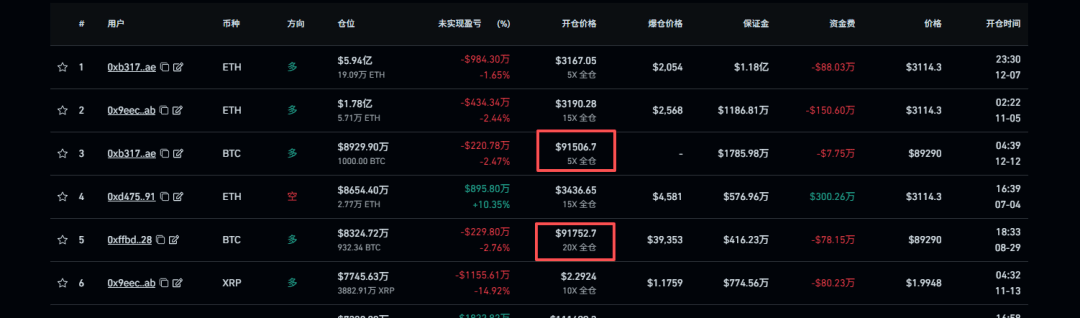
From the perspective of liquidity distribution, $91,000 is currently a high liquidity area in the market. In the absence of a clear direction, prices often test such positions repeatedly. However, the spot CVD is still declining, indicating that there has not yet been a sustained buying signal from institutional levels in the spot market, and the overall state remains one of wait-and-see.
It is important to note that there is not a lack of short-selling power in the current market, which also means there are potential conditions for a 'short squeeze' in the short term.
Technical structure: Bitcoin is in an extremely delicate position.
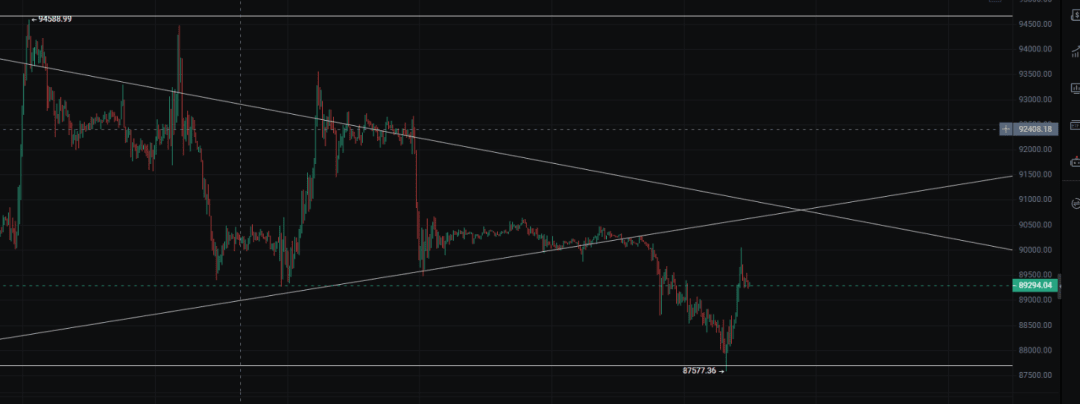
On the weekly level, Bitcoin previously formed a long lower shadow candlestick, theoretically providing conditions for another assault on $94,000. However, $94,000 has repeatedly become a clear resistance, and its importance has been continuously enhanced as it has failed to break through effectively.
From a daily perspective, $88,000 is the current key defense level for bulls. As long as this position is not effectively broken, the market remains in a consolidation structure. Once it is breached, it will open up downward space approaching the 'ten thousand point level.'
Short cycles (4 hours and below) show that a clear bullish engulfing and divergence structure has emerged at the bottom, indicating that there is a short-term defensive willingness from bulls around $88,000–$89,000. Under this premise, a more reasonable strategy in smaller timeframes is to buy on dips rather than to short.
Key price range and trading ideas
Looking upward, $94,000 is the decisive resistance. If it is effectively broken with the support of macro data, the next target range will point to $97,000–$98,000, and the probability of a breakout is gradually accumulating.
However, if the price breaks below $88,000 after significant data is released, the bullish logic will be completely destroyed, and one should decisively cut losses on long positions and consider switching to bearish positions, targeting deeper levels.
Weekly perspective: Not yet in a real bear market
Although market sentiment is cautious, the weekly structure shows that Bitcoin has not truly entered a bear market. The key is that the long-term structural level of $74,000 has not been broken. Before that, all declines are more inclined toward medium-term adjustments rather than trend reversals.
Historical experience shows that the Federal Reserve has frequently found itself in situations where it 'originally did not lower interest rates but ultimately did,' leading the market to maintain expectations for renewed liquidity easing. This is why prices in the current area have gradually stabilized, without showing panic-induced sell-offs.
Ethereum's structure is clearly stronger than Bitcoin's.
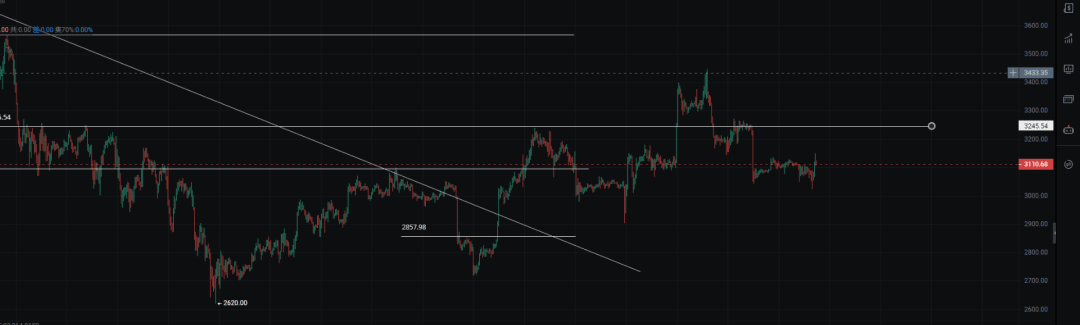
In contrast, Ethereum's technical structure is clearly stronger. The daily chart maintains a bullish pattern of 'higher lows and higher highs,' and the upward trend line has not been broken. After a false breakdown in the short term, it quickly recovered and formed a bullish divergence, creating conditions for continued rebounds.
Short-term targets can focus around $3,200, which corresponds to the starting area of previous downward momentum.
Summary: The direction is about to become clear, controlling positions is key.
Considering macro, capital, and technical structures, the market is waiting for this week's key data to provide final guidance. The weekly chart still maintains a bullish structure, while the daily chart is more viewed as a rebound phase after a decline.
Before the direction is completely confirmed, it is advisable to appropriately reduce positions and control risks. Once a breakout is confirmed, one can add positions in the trend; if key support is lost, one should quickly switch strategies.
The market is not lacking in opportunities; what is lacking is the ability to remain clear-headed at critical junctures. True major trends often unfold amid hesitation.

