
Falcon Finance (FF)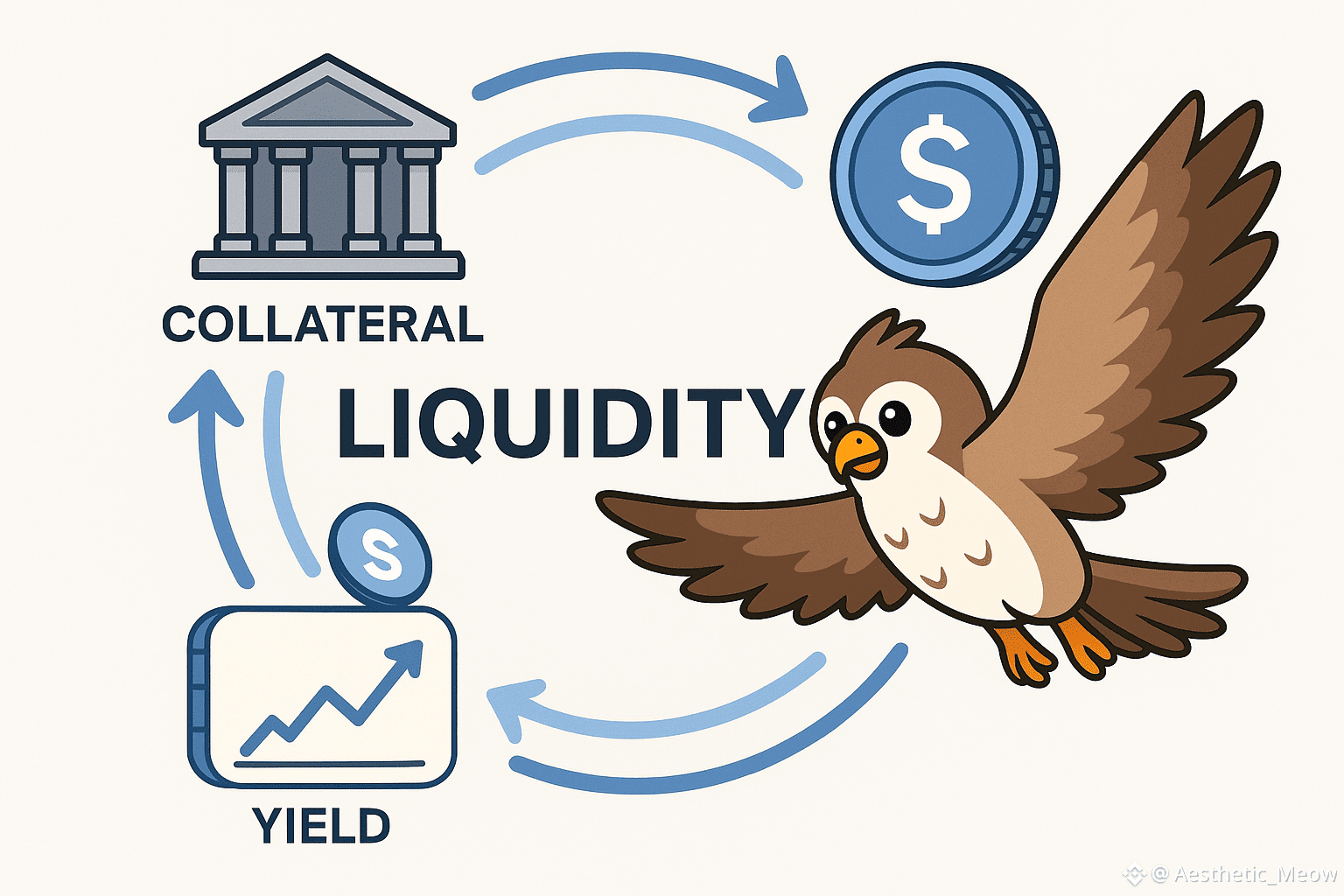
Most people discuss liquidity as if it's simply money ready to be used. In reality, liquidity is more like a commitment: when someone needs to transfer, exchange, or settle value, the system should not fail. The difficult truth is that promises are easiest to make during stable markets and hardest to uphold during times of stress. Falcon Finance's central idea addresses this directly designing collateral so liquidity functions reliably, not just when conditions are favorable.
If you view liquidity as a basic building block, you shift from thinking about features to thinking about limitations. What must hold true for on-chain liquidity to remain usable when prices become erratic, when the difference between buying and selling prices widens, when everyone tries to exit at once? Falcon's framework attempts to answer this by starting where many systems stop: with strict collateral management.
Managing collateral effectively at scale is an economic challenge, not a user interface issue.
Small operations can afford to be informal. At a large scale, informality becomes weakness. A system that accepts more assets and more users isn't just growing; it's accumulating different types of risks that don't behave similarly. Risks related to price, liquidity, and correlation. There are also operational and settlement risks when tokenized real-world assets are included. Expanding collateral means building a structure that can handle diversity without assuming all assets are the same.
Falcon's "universal collateralization" concept appears to be an effort to establish a common set of rules for various asset types. This isn't about treating them all as identical risks, but about translating them into a standard framework: determining how much can be issued against an asset, under what conditions, with what safeguards, and what happens if circumstances worsen.
This translation process is where the actual engineering work lies. The system for issuing new units is what users see. The collateral model is the foundational structure.
Why "overcollateralized" is a strategic choice, not just jargon.
Overcollateralization is often seen as inefficient. This is true in a limited sense: you tie up more value than you receive as available funds. However, when viewed more broadly, it begins to look like the cost of building something durable. In finance, the systems that endure are seldom the most efficient during ideal times; they are the ones that remain functional during difficult times.
Falcon's design suggests a preference for caution over boldness. For users, this means you're not being offered a scenario where liquidity is free. You're being brought into a system where liquidity is obtained by providing actual backing and respecting risk limits. While this might not sound exciting, it's often the approach taken by systems that withstand market downturns.
A "liquidity primitive" actually functions as a way to guide behavior.
Here's what people often overlook: the most resilient systems don't just move money; they shape how users act. A fragile system encourages risky behavior taking on too much debt, seeking quick profits, ignoring potential losses until the system forces a reckoning. A well-managed system does something more subtle: it trains users to think in terms of potential outcomes, to manage their positions, and to see liquidity as something that needs constant attention rather than a quick gain.
Falcon's collateral structure, at least in its intent, encourages users to adopt this discipline. If you can create a stable currency without selling your primary investments, you gain flexibility but you also accept responsibility. Your asset transforms from a passive holding into an active position that must be maintained.
This exchange is the true offering: flexibility in return for adherence to rules.
The link between "owning value" and "being able to use value."
There's a psychological gap in on-chain finance that isn't reflected in financial data. People can possess significant assets but struggle to make decisions about them. They "own" value but can't "use" it without turning a long-term investment strategy into a permanent sale. Collateralized liquidity aims to bridge this gap.
Falcon's approach presents USDf as a way to convert assets: collateral is deposited, a stable currency is issued, and the user can act without immediately losing their investment exposure. If you've ever sold an asset simply to access cash, only to see the market rebound later, you understand why this is important. The goal isn't to eliminate risk. The goal is to avoid forced, premature actions.
A liquidity primitive, in this context, is a mechanism to prevent circumstances from dictating the worst possible timing.
Scaling collateral means scaling risk management, not just total value locked.
A system doesn't simply grow larger because more collateral is added. It expands when more obligations are created against that collateral, and when more users begin treating those obligations as if they were money. That's when managing risk moves from a secondary concern to the primary focus.
At this scale, three questions become unavoidable.
First, how does the system assess the value of collateral during difficult times, not just under normal conditions? The availability of buyers matters. Price swings matter. How assets move relative to each other matters. A system that values assets as if liquidity were unlimited is setting a trap for future crises.
Second, how does the system enforce limits without hesitation? In stressful moments, making individual decisions takes too long. Clear rules are swift. Forced sales are unpleasant, but the alternative hidden financial distress typically results in worse outcomes for everyone. A system that cannot enforce risk limits becomes one that asks users to subsidize denial.
Third, how does the system communicate its stability in a way that discourages runs fueled by speculation? In complex financial systems, confidence can erode faster than the underlying mathematics. Transparency isn't an optional feature; it's a component of stability.
If Falcon intends to manage collateral "at scale," these are the critical challenges: valuing assets under pressure, enforcing rules promptly, and providing clear information without ambiguity.
Yield is not the main point; it's a result.
One clear way to understand Falcon's approach is to distinguish between liquidity and yield. USDf focuses on usable stability. sUSDf is about making that stability generate returns. This distinction is important because stability and yield are often mentally conflated. People may believe they want stability but act as if they seek the highest possible return. Then, when difficulties arise, the system reveals their true priorities.
A more sound design keeps the choice clear. Creating a stable currency is backed by collateral rules. Placing that currency into a system to earn a return introduces strategic and execution risk. Making yield a secondary step is not just a product feature; it provides ethical clarity. It prevents the stable currency from becoming a speculative instrument by default.
If the yield component is managed responsibly, it can feel less like a promotional effort and more like straightforward accounting: your balance grows because the underlying operations generated profits, not because funds were arbitrarily created.
Tokenized real-world assets make the collateral discussion more practical and more demanding.
When tokenized real-world assets are incorporated into a collateral framework, the system becomes both more compelling and more complex. More compelling because collateral now reflects different economic cycles: not all assets behave like major cryptocurrencies. More complex because real-world exposures involve assumptions about settlement times, periods of market access, and reactions to stress that don't always align with continuous on-chain markets.
If Falcon expands the stablecoin model using real-world assets, the responsibility increases. Discounts must reflect actual market conditions, not wishful thinking. The system must be transparent about what can be converted to cash quickly and what cannot. And information must be readily available so users can understand what supports liquidity without having to guess.
When managed with discipline, diversified collateral can make a synthetic dollar less reliant on a single market trend. When managed carelessly, it can create hidden problems that only surface too late. This is why "at scale" is the crucial factor. Large-scale operations require realism.
The core idea, in simple terms:
Falcon's central principle can be stated as follows: on-chain finance requires a foundational element for liquidity that operates like essential infrastructure built from diverse collateral using cautious rules, capable of remaining trustworthy under pressure, and flexible enough that users don't need to sell their long-term holdings simply to manage short-term needs.
If this sounds more like a design philosophy than a sales pitch, that's intentional. The most significant financial systems are often stable in the right way. They reduce impulsive decisions. They make difficult choices evident. They don't need to draw attention because their reliability is their message.
And when you're trying to establish collateral at a large scale, being unremarkable is not a drawback. It's often the strongest indicator that the creators understand what markets ultimately demand.
@Falcon Finance #FalconFinance $FF

