@Yield Guild Games #YGGPlay $YGG

Have you ever calculated this kind of account?
In a well-known metaverse, you gritted your teeth and spent dozens of ETH to buy a piece of "prime real estate" digital land, eagerly anticipating it to become your cash cow. The reality, however, is that you find yourself every day like a frazzled landlord: searching global forums for reliable "gold farming" players while keeping an eye on your wallet, calculating whether the meager rental income can cover your initial investment. What makes you even more anxious is that when market trends change, this territory where you invested real money, aside from the occasionally boastful NFT avatar, has an intrinsic value as thin as a cicada's wing. This is the heart-wrenching reality that the vast majority of "metaverse landlords" are experiencing—you have merely acquired an expensive yet silent coordinate, rather than an economic entity that can generate its own revenue.
However, within the same virtual world, a silent revolution is taking place. Yield Guild Games' holdings in Gotchiverse are no longer just a few parcels of land waiting for a price; they are numerous economic engines that operate day and night, precisely. While others are still anxious about land speculation, YGG has completed a thrilling leap from 'asset manager' to 'ecological sovereign,' turning cold pixel coordinates into a Web3 ecological hub that connects players, assets, and enormous profits.
01 Dimensionality Reduction Strike: The strategic gap from 'rent collection' to 'nation-building'
There exists an insurmountable gap between the traditional model and the YGG model, with the core being the fundamentally different 'roles' assigned to the land.
Traditional model: The 'toolification' fate of land
In traditional thinking, virtual land is a tool. Its value logic is simple and fragile: purchase → hold (wait for appreciation) → rent (generate cash flow). This is essentially a rough imitation of the logic of real estate in the real world. Land is isolated, and its value entirely depends on external market speculation sentiment and rental demand. Once the market cools, it turns into a 'digital wasteland' that generates no vitality. You own the property rights, but you do not own the ecology.
YGG Model: The 'sovereignization' of land
YGG's practice in Gotchiverse has completely subverted this logic. Here, land is the cornerstone of sovereignty. YGG deeply binds land with trained players (scholars), optimized production devices (like harvesters and mines), and guild brands through its vast scholarship system. Land is no longer the end, but the starting point—a 'sovereign enclave' that integrates resource production, community governance, brand display, and strategic defense.
Simply put, while others manage a piece of land, YGG is managing a 'nation.' The 'GDP' (gold coin output), 'population' (scholar community), and 'national defense' (resisting in-game 'liquidators') of this micro-nation are all built upon its land. This ability to transform land into productive capital and social hubs forms a moat that cannot be easily replicated.
02 Four-layer Alchemy: Dissecting the composite value of a 'sovereign enclave'
How does YGG extract value from a piece of virtual land that exceeds tenfold or a hundredfold rent? The answer lies in a sophisticated four-layer alchemy model.
To help you better understand this composite yield engine, please refer to the table below for an analysis of the four value layers:
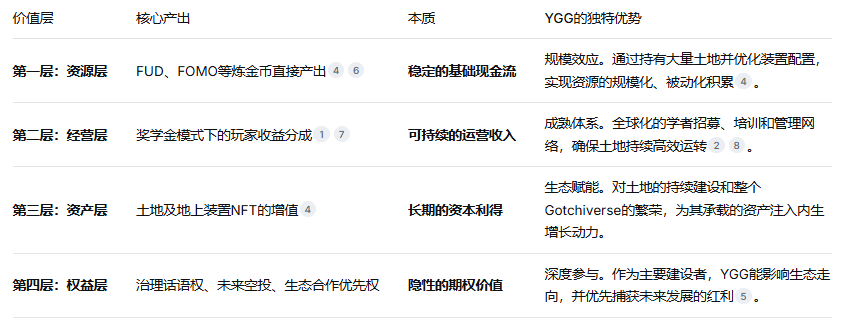
These four layers of value do not exist in isolation but form a powerful enhancement loop. Resource output attracts more scholars to join the operation, operational data and community activity drive land asset appreciation, while strong assets and community status reinforce governance rights within the ecology, thus paving the way for further acquisition of quality resources and cooperation opportunities.
03 Life and Death Speed: Why must we understand YGG's gameplay now?
The sense of urgency comes from two simultaneous, irreversible trends.
First, the 'land grab movement' in the metaverse is transitioning from brutal growth to meticulous cultivation.
The early wave of land speculation has receded. The market no longer pays for the simple 'land NFT concept,' but chases virtual assets that truly have economic activity and can generate stable income. YGG's model just happens to validate the feasibility of virtual land as 'productive capital.' If you are still stuck in the old thinking of 'buying land and waiting for the wind to come,' you will find that when the next cycle starts, the most valuable 'core assets' have already been built into unshakable fortresses by institutions like YGG with deep operational capabilities.
Second, the competitive dimension of guilds has undergone a fundamental leap.
The competition between guilds has long surpassed the primary stage of 'who has the more expensive NFTs.' The current core competitiveness is: who can turn assets into the greatest ecological value. YGG has built a replicable template through its sub-DAO (Decentralized Autonomous Organization) network. This means that its successful experience in Gotchiverse can be quickly migrated to other metaverse projects with land economies. It is evolving from 'a strong guild' into 'a set of protocols and infrastructure that empower all guilds.'
Time is running out for players of the old model. When giants like YGG begin to refine their land into 'sovereign enclaves' and attempt to standardize this infrastructure, the pure speculators and small landlords only have an old ticket that may expire at any time due to 'liquidity exhaustion.'
04 Your Choice: Become part of the 'enclave' or be isolated outside the new continent?
In the face of this silent revolution, as an investor or participant, you are not powerless. The key is to upgrade from 'land thinking' to 'ecosystem thinking.'
Examine your 'digital assets': Are they living 'economies' or lifeless 'collectibles'?
Reassess any metaverse assets you hold. Ask yourself several sharp questions: Do they generate continuous, measurable income? Do they have active communities and use cases? Are they embedded in a larger value network, or are they just an isolated symbol? If the answers are all negative, then you need to be wary of their long-term value.
Understanding the future's value capture points: from 'ownership' to 'governance rights' and 'revenue rights.'
In the picture YGG presents, the greatest value may no longer come from directly owning a piece of prime land (which is extremely costly), but from participating in an economically driven ecosystem powered by quality land. This can be achieved by holding governance tokens like $YGG to share the entire guild treasury's profits or by participating in its scholarship program to become a builder within the 'enclave' to earn shares. The flow of value is shifting from static ownership to dynamic participation and contribution.
When the area symbolizing YGG's 'sovereign enclave' on the Gotchiverse map is brightly lit and resources flow endlessly, those scattered, silent private lands are fading. This is not only a scene in the game but also a metaphor for the entire evolution of Web3 assets.
YGG, with its land economics, announces a new era's rules: in this world, real power does not belong to those who own the map, but to those who can inject life into the map, set rules, and ensure value continues to circulate—'alchemists.' Do you want to continue guarding a piece of land that may soon become a digital desert, or seek a ticket to the next vibrant 'sovereign enclave'? This choice will determine your coordinates in the next crypto wave.