
Azu has been in the cryptocurrency space for a long time, and what he fears most is not market fluctuations but information pollution. You will find that regarding Falcon's 'collateral damage', many times it is not the mechanism that has a problem, but rather you are being driven by second-hand interpretations: a certain screenshot captured a 'highest APY' without telling you the time window; a certain tweet said 'the returns are not good anymore' without indicating which strategy leg it was referring to; a wave of panic in the community, everyone is forwarding the emotions, yet no one goes back to take a look at the most basic structure and parameters. In the end, your decision-making is not based on Falcon's balance sheet, but rather on the emotional fluctuations of others — this easily turns a tool that should be observed long-term into a gambling machine that changes opinions daily.

I crudely divide Falcon's information sources into three layers. The first layer is the hardest and the one you must trust first: official documents, transparency panels, official channel mechanism explanations and data disclosures. You don’t need to memorize every term, but you must understand 'what this system is saying, what data it is using to communicate, and what the key parameters are'. The second layer consists of research institutions or long-form analyses, which are valuable for helping you build frameworks, provide background, and make comparisons, but only if they are citing primary data, not layers of paraphrasing. The third layer consists of short content from X and communities; they are not completely useless, serving as 'early warning radars' — letting you know what the market is buzzing about and what everyone is worried about, but they inherently carry emotions, fragments, and positions. If you treat the third layer as the first layer, you will eventually be led astray.
The typical path of being led astray is actually quite fixed: you first come across a screenshot claiming 'high returns', and thus assume this is the norm; then you see a short post stating 'returns have collapsed', leading you to assume there is a major problem with the system; you swing back and forth between these two extremes without ever really understanding 'where its returns come from, where the risks are stated, and how parameters are constrained'. More commonly, people only look at APY without considering the structure, only focus on conclusions without examining assumptions, only pay attention to the excitement without noting the timing. Many screenshots don't even have dates, yet you treat them as today's facts; many viewpoints are discussing a specific scenario or strategy leg, but you apply them to the entire system. In the end, you think you have a lot of information, but in reality, your understanding is just a collage of noise.

Therefore, Azu's principle for himself is very simple and effective: when it comes to information about Falcon, always consume it in the order of 'first What, then Why, finally Noise'. First look at What — what exactly are the mechanisms and data, what is the role of USDf/sUSDf, what is the overarching framework of collateral and parameters, and what key indicators can be seen on the transparency panel, and what state are they discussing. Then look at Why — how others are analyzing, what frameworks they are using to explain, and what assumptions their conclusions are based on. Only then look at Noise — what the market is buzzing about, what KOL emotions are fluctuating, treating this as directional hints rather than evidence. You will find that as long as this order is not disrupted, you will hardly be hijacked by 'the loudest voices', because you always stand on primary structures first before listening to others' interpretations.
Here's a very practical 'filter': any evaluation of Falcon that doesn't fall back to the 'balance sheet + risk parameters' framework is likely just noise. You don't need to require everyone to write an audit report, but at least they should be able to answer a few hard questions: which side are they talking about, the asset side or the liability side? Are the risks mentioned related to collateral volatility, parameter changes, or performance at the strategy level? Where do the cited data come from, and what is the time window? If none of these are present, and it just boils down to 'great' or 'must run', then treat it as emotional entertainment, not operational instructions.
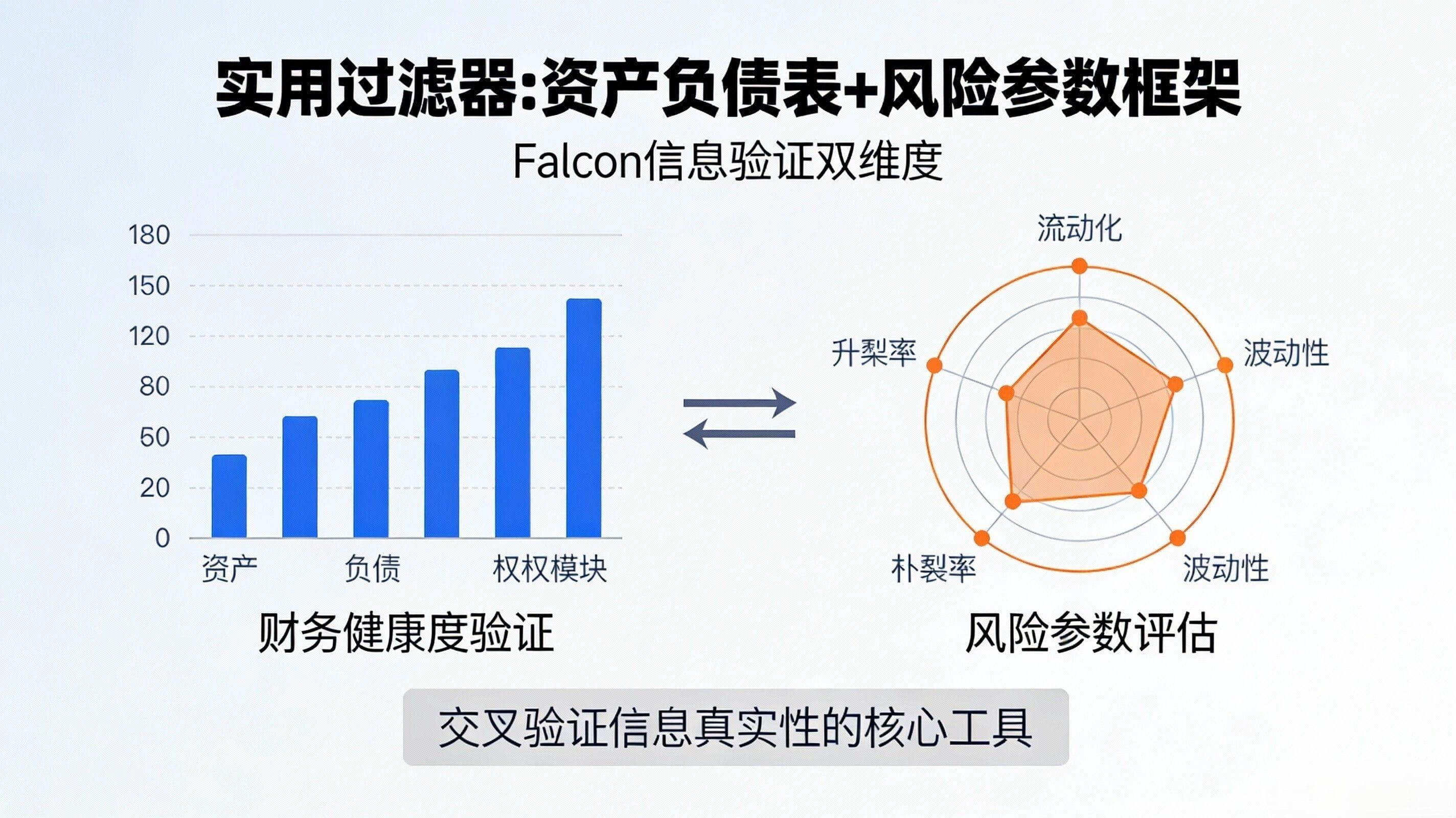
This kind of information hygiene will directly change your decision-making approach. You will shift from 'listening to whoever speaks the loudest' to 'looking at whoever provides primary structure and data first'. You will also slowly form your own cognitive framework regarding Falcon: when you see secondary viewpoints, you will no longer immediately choose sides, but will instinctively check back against the original structure before deciding whether to believe it. In the long run, this will help you avoid many 'pseudo-information traps', and more importantly, your emotions will stabilize, because you will no longer be swayed by external fluctuations; you will know you are making judgments based on a verifiable logic.

Today's action suggestions shouldn't be complicated: create a 'bookmark organization' for yourself, saving at least three primary access points — the Falcon official website, the official docs, and the transparency panel (as well as any official announcement channels you often use). In the future, whenever you see secondary viewpoints, whether bullish or bearish, first check back against the original sources: can you find corresponding structures or data in the primary information? If not, just hold off for now. You'll be surprised to find that this small action can prevent most impulses of being 'led by the rhythm', transforming you from someone who chases trends into someone who truly knows how to use tools.
@Falcon Finance $FF #FalconFinance



