You know, when I first started to understand DeFi, one thing really annoyed me: all the protocols seemed similar to each other. MakerDAO, Aave, Compound — everywhere you deposit assets, take a loan, pay interest. But the more I delved into @falcon_finance, the more I understood that there was something different here. This is not just another lending protocol with copied code — there is a completely different philosophy, a different approach to how collateral and liquidity should work in the blockchain. Let me tell you what exactly distinguishes $FF from other players in the market.
Let’s start with MakerDAO because it’s a classic. Maker allows you to collateralize ETH and other approved assets to issue DAI—a decentralized stablecoin. I have used Maker myself, and the system works, that’s a fact. But there are nuances. First, the list of assets that can be collateralized is quite limited and strictly controlled by governance. It takes months of voting to add a new asset. Second, risk parameters are set separately for each asset, creating fragmentation—you cannot just collateralize a diversified portfolio; you have to work with each asset separately.
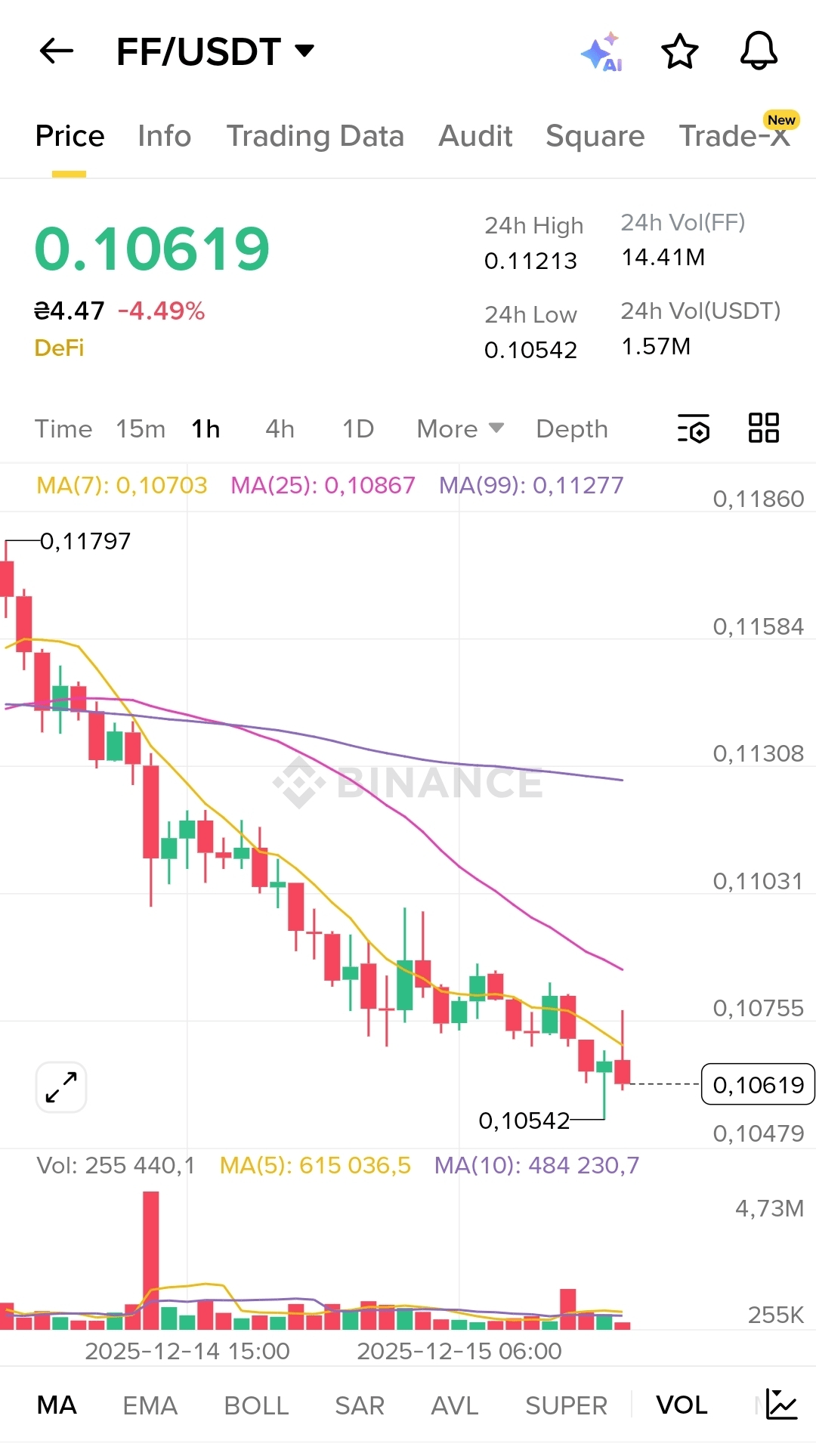
And now look at the current chart for $FF: price 0.10619 USDT, down 4.49% over the day. In the last 24 hours, the high was 0.11213, the low was 0.10542—this is a fluctuation of 6.4%. This kind of volatility shows why a universal collateral infrastructure is needed, which #FalconFinance is building. Instead of each asset living its own life with separate rules, the system looks at the entire portfolio holistically, considering correlations between assets and the overall risk profile.
Now about Aave. This is one of the most popular protocols, and I respect their work. Aave allows for both borrowing and lending at interest rates. They even have flash loans—instant loans without collateral that need to be repaid within a single transaction. This is great for arbitrageurs and developers. But when it comes to regular users who just want to get liquidity for their assets, Aave has its limitations. Interest rates change dynamically depending on supply and demand, and sometimes they can spike to unpleasantly high values.
Look at the moving averages: MA(7) at 0.10703, MA(25) at 0.10867, MA(99) at 0.11277. All three averages are above the current price, indicating a strong downward trend. But here’s the kicker: when you work with @falcon_finance and get USDf, you’re less concerned about these short-term movements because you’re not selling your assets. In Aave, if the borrowing rate suddenly jumps from 5% to 15%, you’re forced to either endure higher costs or close your position at an unfavorable moment.
Compound is another giant in the industry. Their model is very similar to Aave: you deposit assets into a pool, receive cTokens (like cDAI or cETH), which generate interest, and you can take out loans against collateral. I like the simplicity of the Compound interface, but there is a capital efficiency issue that I've mentioned earlier. The collateral ratios are quite conservative, and you often end up collateralizing much more than you borrow. This is safe for the protocol, but not very efficient for the user.
Look at the trading volumes $FF —14.41 million for the token over a day and 1.57 million USDT. This is a sign of healthy liquidity, which is critically important. Because another problem I encountered in smaller lending protocols is low liquidity. You collateralize assets, want to take out a loan, and then find out that there aren’t enough free funds in the pool. Or when you want to exit a position, you discover that your asset cannot be sold quickly without significant slippage.
Another interesting player is Liquity with their LUSD. This is a governance-free protocol that operates with zero percent interest on loans. Sounds cool, right? You only pay a one-time fee when opening a position, and then you can hold your LUSD for as long as you want without interest. But there’s a catch: Liquity only works with ETH. If you have a diversified portfolio of various tokens, you'll first have to convert everything to ETH before you can collateralize it. Plus, the liquidation risks there are quite harsh due to the lack of flexible parameter management.
You know what impresses me most about the #FalconFinance approach? It’s the focus on universality. Not just ETH, not just top-10 tokens, but a wide range of assets, including tokenized real-world assets. Imagine: you have tokenized real estate, precious metals, company stocks in token form—and you can collateralize all of this together in one protocol. In MakerDAO, Aave, or Compound, such flexibility is simply impossible due to their architecture.
The current hourly trading volume is 255,440.1 units, while MA(5) shows 615,036.5, and MA(10) is 484,230.7. This means that activity has decreased compared to the recent spike—do you see that huge red bar on the volume chart? That was panic when the price fell from 0.11797. In traditional protocols, such volatility often leads to cascading liquidations, where the price drop of one asset forces the system to liquidate positions, pushing the price down even further.
Synthetix is another protocol worth mentioning. They allow for the creation of synthetic assets (synths) that track the price of real assets: stocks, commodities, currencies. It’s a powerful system, but extremely complicated for the average user. You need to understand the debt ratio, stake SNX, manage the C-ratio, and if you do something wrong, you can quickly get into trouble. I tried Synthetix a year ago and felt like I was taking a quantum physics exam.
What I like about @falcon_finance is that the complexity is hidden under the hood. The system does all the heavy lifting for risk management, collateral ratio calculations, and liquidity monitoring. As a user, I just collateralize my assets and get USDf. You don’t need to be a math whiz to understand this.
Another aspect often overlooked is tokenomics and governance. MakerDAO has MKR tokens, whose owners vote on system parameters. This is great for decentralization, but in practice, most users don’t participate in voting, and real power is concentrated in the hands of large holders. Aave has AAVE tokens with a similar mechanism. In Compound, there are COMP tokens. And each protocol has its own unique incentive system that needs to be understood for effective use.
Look at the current price of 0.10619 and compare it with MA(99) at 0.11277—this indicates that the token is trading below its long-term average. For a long-term holder, this is not a reason to panic; it’s just a temporary correction. And thanks to the ability to get USDf against the $FF collateral, you can weather this correction comfortably, having access to liquidity for other purposes.
Instadapp and DefiSaver are not protocols per se but rather aggregators and management tools. They allow you to manage positions across several protocols through a single interface. I have used both, and it’s really convenient. But again, it’s another layer of complexity. You need to understand how each underlying protocol works, plus how the aggregator itself operates.
Another thing I've noticed: most lending protocols are focused on Ethereum. Yes, there are versions on other chains—Polygon, Arbitrum, Avalanche—but these are often separate deployments with separate liquidity. If your assets are spread across different chains, you’ll have to use bridges, pay additional fees, and risk security when transferring assets.
You know what finally convinced me of the advantages of the #FalconFinance approach? It’s the focus on user experience and real needs of people. Most protocols are built by engineers for engineers. They’re technically sophisticated, but not always user-friendly for the average person. And $FF aims to make DeFi accessible, understandable, and efficient for everyone who wants to manage their finances without intermediaries.
Another important point is security. MakerDAO has gone through several critical moments, including liquidations of hundreds of millions of dollars during the crash in March 2020. Aave has had its incidents with flash loan attacks. Compound has faced bugs in smart contracts that led to the loss of funds. No protocol is perfect, but the maturity of the team and the approach to security audits are crucial.
When I look at the chart and see that the price has dropped from 0.11213 to 0.10542 in a day, I realize: this is not a project failure, this is a healthy market that breathes. Volatility is a part of crypto. What's important is not how much the price fluctuates, but how the protocol handles this volatility, whether the system breaks under pressure, and whether users suffer from unfair liquidations.
In summary: MakerDAO is a pioneer with a limited asset selection. Aave is a powerful platform with dynamic rates that can be unpredictable. Compound offers simplicity but at the cost of capital efficiency. Liquity has zero interest, but only for ETH. Synthetix provides synthetic assets, but the complexity is at rocket science level. And @falcon_finance is a universal collateral infrastructure that combines flexibility, accessibility, and capital efficiency. For me, the choice is obvious.
#FalconFinance @Falcon Finance $FF