

@Yield Guild Games For years, Web3 gaming has offered plenty of options but very little direction. New games, tokens, and communities show up constantly, yet understanding what truly matters feels harder than ever. I’ve seen dedicated players burn out after endless Discord calls and scrolling not because they lacked choices, but because clarity was missing.That backdrop helps explain why YGG’s recent structural shift is drawing attention now. Not because it is flashy, but because it quietly addresses a problem most people feel but rarely name.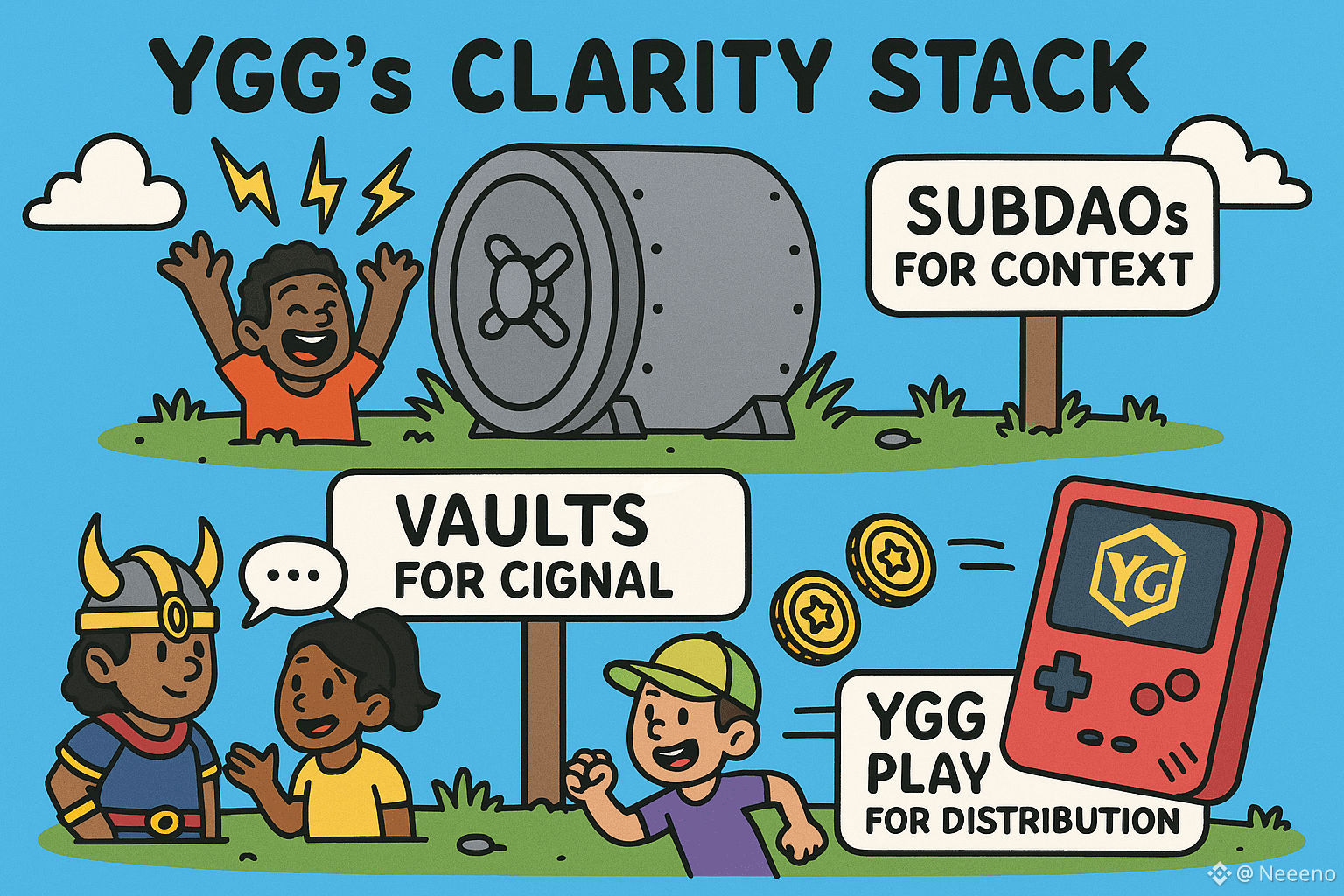
The idea behind what some now call YGG’s “Clarity Stack” is straightforward on the surface: Vaults capture signal, SubDAOs add context, and YGG Play handles distribution. But what makes it interesting is not the architecture itself. It’s the admission baked into it—that scale without interpretation is useless, and that communities don’t fail from lack of opportunity so much as from lack of shared understanding.
Vaults are the least glamorous part of the system, and maybe the most important. Anyone who has tried to follow Web3 gaming seriously knows the fatigue of fragmented information. Alpha lives in private chats. Metrics are scattered across dashboards. Governance decisions blur into noise. Vaults attempt to solve this by acting as deliberate containers for knowledge, not hype. They collect what works, what didn’t, what changed, and why. That may sound obvious, but in practice it is rare. Most ecosystems reward being early, loud, or speculative, not being accurate over time. A Vault shifts the incentive toward memory. It values continuity. From experience, that alone changes how people behave. When you know your decisions will be referenced later, you slow down. You explain yourself better. You care about coherence.
Yet signal without context can still mislead. This is where SubDAOs matter. YGG learned, partly the hard way, that one global narrative cannot serve dozens of games, cultures, and play styles. I’ve seen talented regional communities struggle because decisions were made too far from their lived reality. SubDAOs bring interpretation closer to the ground. They allow smaller groups to frame information based on local knowledge—player habits, regional economics, cultural preferences. What looks like a failing game in one market might be thriving quietly in another. Context reveals that difference.
There is also a human benefit here that rarely gets discussed. SubDAOs give people a sense of authorship.
Contributors stop being silent followers and start becoming guides. Instead of repeating data, they translate it into meaning their group can relate to and act on.In my experience, that shift—from consumer to interpreter—is where real ownership begins. It creates accountability without needing heavy governance rituals.
Still, clarity that stays internal has limited value. Distribution matters, and that’s where YGG Play enters the picture. What’s notable is that YGG Play isn’t framed as a megaphone, but as a filter. Rather than pushing everything to everyone, it focuses on matching players with experiences that fit their interests and capacity. That may sound modest, but it runs counter to much of Web3’s growth-at-all-costs mindset. Instead of chasing raw user numbers, the emphasis is on alignment. Are players actually enjoying what they’re playing? Do they understand why they’re there? Those questions are harder to answer, but they tend to produce more durable communities.
This layered approach is trending now because the market has changed. The speculative rush that once papered over weak design has slowed. Players are more cautious. Builders are more tired. Capital is more selective.
When everything competes for attention, systems that help people filter things out become extremely valuable. Clarity has moved from being helpful to being essential.
There is also real progress to point to. SubDAOs are no longer theoretical experiments; they’re operating units with track records. Vaults are being used, not just proposed. YGG Play has moved beyond concept into daily interaction. None of this guarantees success, of course. Structures don’t replace judgment. But they do shape behavior, and that’s where their power lies.
Even so, they change behavior, and that’s what makes them powerful. I find this approach refreshing because it recognizes something many avoid saying—most people don’t want unlimited options.They want guidance they can trust. They want to know that someone has thought through the tradeoffs. In Web3, we often pretend that decentralization means everyone should decide everything for themselves. In reality, healthy systems distribute decision-making without overwhelming participants. YGG’s stack feels like a step toward that balance.
There are open questions, and they matter. Can Vaults stay honest as incentives grow? Will SubDAOs fragment too much, or will they remain connected by shared values? Can YGG Play resist the pressure to optimize for volume over fit? These are not small challenges. I’ve seen similar efforts falter when attention wanes or when governance becomes performative. Sustaining clarity requires constant effort. There is no final state where the work is done.
Still, the direction feels right for this moment. Web3 gaming doesn’t need louder narratives. It needs quieter systems that help people make sense of complexity without flattening it. If YGG’s Clarity Stack succeeds, it won’t be because it introduced a new token or mechanic. It will be because it respected players’ time and intelligence. And honestly, that might be the most radical move left.
@Yield Guild Games #YGGPlay $YGG

