

When I first heard about @KITE AI earlier this year, I’ll admit I dismissed it as another niche blockchain experiment. But as autonomous AI agents go from sci-fi curiosity to real engineering reality, something about what Kite is trying to build feels genuinely consequential even if it isn’t yet a household name. At its heart, Kite isn’t just another crypto project chasing headlines; it’s an attempt to erect the plumbing for an emerging class of economic actors ones that never sleep, never ask for salary, and aren’t human at all. 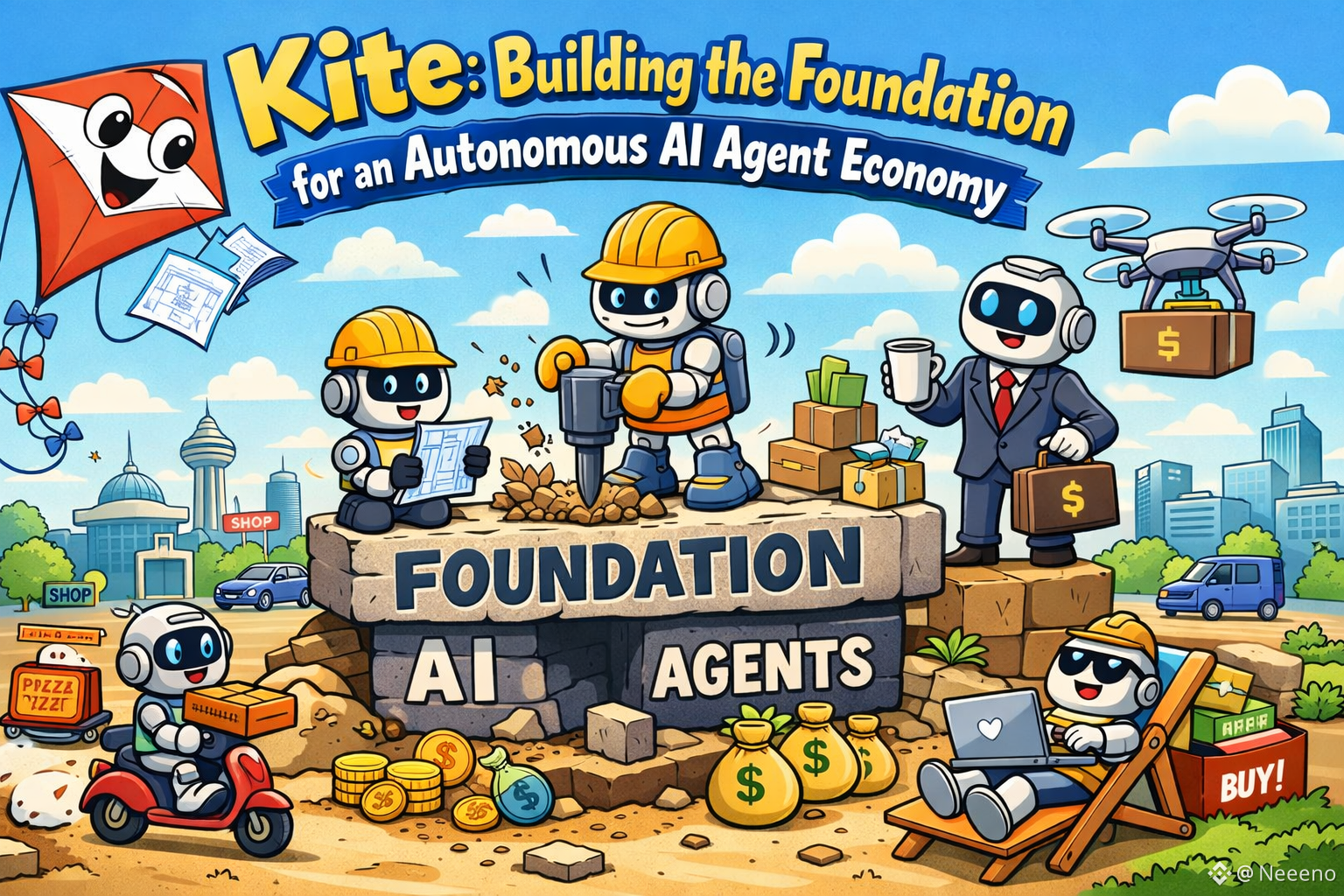
It helps to start with a simple question: what happens when AI isn’t just a tool you interact with, but an independent economic participant? Because that question isn’t theoretical anymore. Autonomous agents are already being embedded into workflows, supply chains, and customer service systems with increasing sophistication. In fields as varied as trading, logistics, and digital services, AI agents negotiate, coordinate, and execute tasks — yet they still lumber along like toddlers on crutches when it comes to identity, payments, and trust. In other words, there’s a gap between what these systems could do and the infrastructure they actually have. Kite’s thesis is that this gap matters if we expect AI agents to enter the economy in a meaningful, scalable way.
Kite positions itself as a purpose-built Layer-1 blockchain — that is, a foundational network designed from the ground up rather than repurposed from something else — where autonomous agents can hold verifiable identities, govern their behavior according to programmable rules, and transact value without a human in the loop. In practical terms, this means each agent could have its own cryptographic identity and wallet, pay for services like data feeds or compute, and even earn tokens for valuable work. Projects like this have been imagined before in academic papers about AI agent markets, but few have attempted to implement it as real software.
You don’t need to be a blockchain developer to see why identity and payments matter for autonomous systems. Today’s payment rails — credit cards, bank transfers, API billing — all assume a human is authorizing or reviewing them. An autonomous agent paying for computing resources would either have to be handed a human’s credentials (a huge security risk) or stall and ask for permission. Kite’s approach gives agents a native way to transact under human-defined limits: spend no more than $10 per task, never access more than a certain amount of compute, and so on. This reduces friction and opens up the possibility of machine-to-machine commerce happening at scale.
Why is that useful? Imagine an AI consultant that autonomously sources data, pays for the cleanest datasets it finds, performs analysis, and delivers results — without your server, your billing account, or your manual approval on each microtransaction. Or a supply-chain optimizer that dynamically negotiates service contracts across providers based on real-time conditions. These aren’t fantasies; they’re lining up as real engineering challenges right now. Kite doesn’t solve every technical problem here, but it does try to create a trust layer where these interactions can happen in a secure, verifiable way.
There’s also a deeper question at play about how we value contribution and coordination in AI ecosystems. Traditional blockchain systems reward human validators or token holders. Kite introduces ideas like Proof of Attributed Intelligence — mechanisms meant to reward agents for actual value creation, not just for staking tokens. Whether that specific approach will work in practice remains an open engineering question, but the conversation itself reflects a shift. We’ve moved from blockchains as digital settlement layers to a world where AI-native economics is a design consideration.
I’ve spent years observing tech platforms where economic incentives and governance are treated as afterthoughts — and the result is usually messy. Companies build powerful systems first and worry about how value flows through them second. Kite flips that script.
The team is thinking about the full picture: how autonomous systems behave, and how they handle payments between themselves when they do something useful. That’s why the token, identity tools, and shared rules matter, even if you’re skeptical of crypto trends.
Even so, what Kite is building has no guarantees. . There are hard questions about safety, regulation, and real-world adoption that aren’t solved by elegant architecture alone. For example, autonomous payments without human oversight raise compliance issues with financial regulators that haven’t yet grappled seriously with non-human actors. There’s also the broader issue of whether specialized blockchain layers are the right vehicle for AI coordination, or whether existing digital infrastructure can evolve to meet the same needs. These aren’t trivial problems.
Still, I find it telling that conversations about AI aren’t just about models anymore; they’re about ecosystems — about how these systems interact, exchange value, and make decisions jointly. Kite’s work is interesting because it’s forcing engineers and economists to think explicitly about an autonomous agent economy, not just autonomous agent software.
It doesn’t cover every detail, but it brings up the right questions right now, as AI is starting to move from experiments into real economic activity.
Kite isn’t only about building new infrastructure. It’s part of a wider trial run for a world where machines can participate in transactions and decisions, not just assist humans. Even if that world is still far off, the fact that people are taking it seriously shows how quickly our thinking about economic participation is changing.

