
"Community audits" and "open source code is security"—these pretty words have been repeatedly debunked on-chain in 2025.
In the world of smart contracts, free is often the most expensive: if you didn't pay the audit fee, you are the audit fee.
Now a decent full audit from CertiK/Halborn starts at a quote of 100,000 USD, and for more complex CeDeFi structures, it directly doubles.
Meme coin projects can't afford it and can only choose to run naked;
Meanwhile, Lorenzo Protocol, managing hundreds of millions of USD, does not have the qualification to "bet on luck"—it must set a price for security and incorporate this amount into the economic model.
Lorenzo's recently disclosed financial transparency report provides a very "DeFi" answer:
Use a 0.5% protocol management fee + BANK buybacks to elegantly shift the high audit costs to the entire market.
It's not hiding; it's transparently "taxing the bridge."
Safety is a luxury: a $100,000 audit can only rely on protocol bleeding.
Let's be clear: high-intensity safety is definitely not something that can be solved by "open source + prayer."
Top security companies (CertiK / Halborn / Trail of Bits) quote
Standard DeFi protocols: $100,000–$150,000 / time.
Complex multi-chain + RWA + CeFi mixed architecture: $200,000–$300,000 / time.
A truly reliable security system also needs to add:
Bug Bounty reward pool.
Internal Red Team pressure testing.
Continuous auditing (instead of a quick walkthrough before going live).
For a protocol that takes its work seriously, safety is no longer a one-time investment, but a "long-term fixed expenditure."
If this money is not institutionalized, it will either be delayed or saved, ultimately turning into hackers' "bonus pools."
Lorenzo's choice is very simple and straightforward:
Do not treat safety as a "cost center," but write it as protocol-level OPEX (operating rigidity expenditure).
As long as Vault is making money, it automatically cuts a piece out of the profits to specifically buy safety.
Lorenzo's solution: use a 0.5% management fee to write the safety budget into the contract.
Lorenzo does not make "we will invest part of the profits in safety" kind of verbal commitments, but directly writes a rule into the contract:
All real yields generated by Vaults (Yield), first deduct 0.5% as Protocol Fee,
This money is forced into the protocol treasury for safety expenditure + BANK buybacks.
The logic is very direct:
Technical dimension:
Fee collection → Treasury address (on-chain verifiable)
Every transfer out of the treasury has a clear purpose label:
Safety services (audit, monitoring, Bug Bounty)
BANK buyback / destruction / ecological incentives.
Economic dimension:
Users indeed received 0.5% less gross yield;
What is gained is:
the probability of the protocol not being hacked greatly increases.
BANK gains real value support due to continuous buybacks.
In short, it's one sentence:
"Are you willing to take out 0.5% of the yield to buy a life for your own position?"
The answer from institutions is very consistent: willing, this is called compliance premium / safety premium.
How does the money flow? From yield, to audit, to the BANK black hole.
If you lay out this "audit cost shifting" closed loop, you will find BANK standing right in the center of the flywheel:
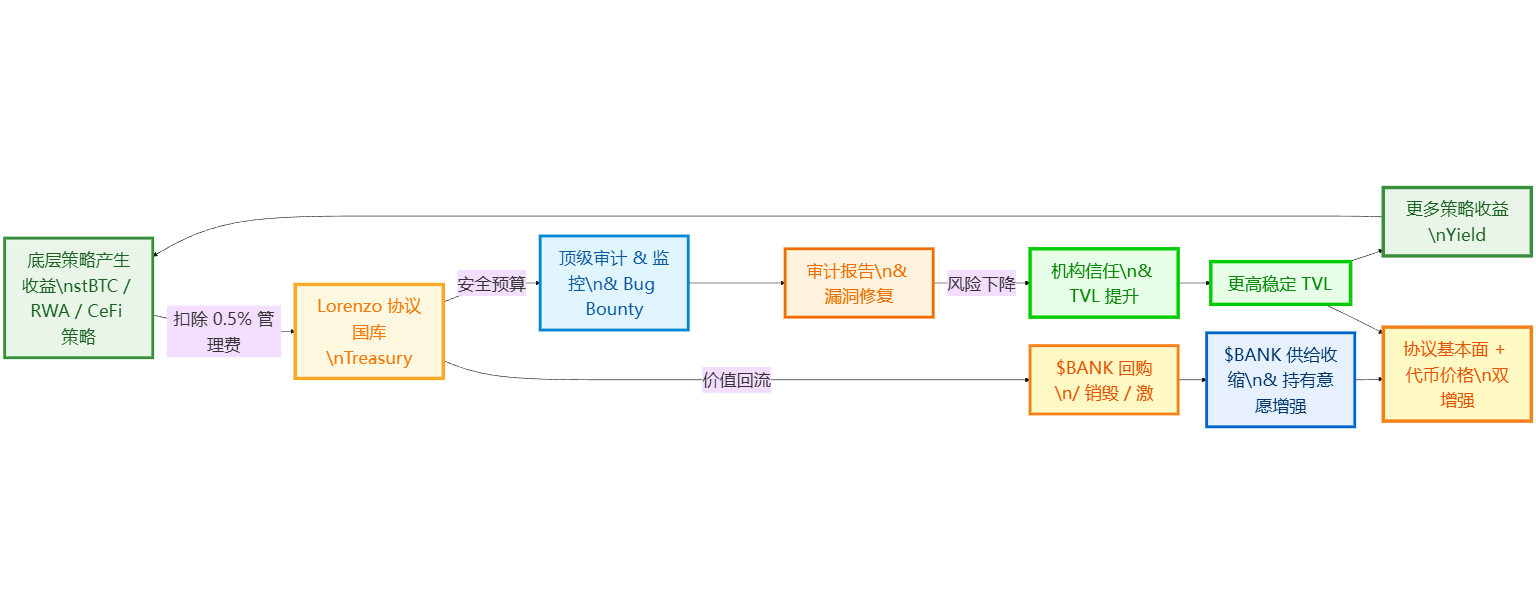
Several layers of meaning are very clear:
Safety is not a PPT, it has a specific budget and specific payees.
From Treasury to auditing firms / security service providers, all are on-chain transparent payments;
Anyone can see on the block explorer how much you actually paid for this safety.
BANK is not an air governance coin; it has stable buying pressure.
A portion of treasury income is written to be used for secondary market buybacks of BANK;
After buyback, destroy or lock up, directly reduce the circulating supply,
making BANK truly become an "index of protocol cash flow."
TVL increase & safety premium & BANK price, tied to the same rope.
The more people use Lorenzo, the more the protocol earns,
the more sufficient the safety budget, the higher the audit coverage,
The larger the BANK buyback, the more resistant the price is to decline.
This is not the kind of "storytelling tokenomics" but using cash flow to feed the economic black box of tokens.
The solution to the tragedy of the commons: use 0.5% safety tax to exchange a life for everyone.
There has been a long-standing "tragedy of the commons" in DeFi:
Retail investors:
Cannot understand the code, nor willing to pay for audits;
Defaulting to "someone else has checked it is enough," and as a result everyone is waiting for someone else.
Project parties:
In the early days, there was no money, and the audit budget was always squeezed out by various "marketing / listings / BD;"
By the time the TVL grows to hundreds of millions, it has already become the hackers' favorite fat meat.
The result is:
No one is really paying for safety until the hackers come to harvest.
Lorenzo directly bypassed this step of human nature and did a "forced socialism" with code:
If you use Vault, you automatically pay this 0.5%;
Every user contributes a little bit,
but together they create a budget sufficient to pay for the top security stack in the industry;The safety premium flows back to the BANK that everyone holds together.
This is a very typical "public good financing model":
Using everyone's small yields to exchange for everyone's huge safety,
then use safety to obtain a larger TVL, using a larger TVL to feed BANK.
Continuous auditing: Lorenzo has turned safety into a long-term moat.
Many protocols do it this way:
Spend money on audits before going live → Issue a PDF → Hang a LOGO on the website → Boast forever.
The reality is:
The contract is being upgraded.
Strategies are changing.
External dependencies (oracles / bridges / RWA) are changing.
Hacker techniques are iterating every day.
One-time audit = took a family photo before going live, and then never checked again.
Lorenzo's approach is much tougher:
New Staking Agent online? Re-audit.
New strategy access? Re-audit.
Changes to key parameters of the protocol? Safety assessment + simulated attack.
After the safety budget is written as continuous OPEX,
"Continuous auditing" becomes the default action of the contract, rather than an optional item in operating costs.
It's both expensive and hard to replicate—
For Lorenzo's competitors, this model itself is a long-term moat:
To replicate Lorenzo's yield, you first need to replicate its level of safety expenditure;
If you can't replicate safety, it's hard to attract institutional funds of the same level.
For BANK holders: that 0.5% is actually raising their own valuation.
From the perspective of BANK holders, let's recalculate:
What you hold is Lorenzo's "quasi-equity asset;"
The protocol takes out a portion of the yield generated by TVL every year,
to buy safety + buy back that "equity" in your hand.
This means:
Safety expenditure is essentially to uplift the valuation of the protocol.
Without safety, all cash flows are illusions;
The more you can afford the audit fees, the more the protocol resembles a "sustainable operating" company.
Buybacks + destruction are the most direct shareholder returns.
There are no verbal commitments of "we will consider dividends later;"
It is through on-chain buyback transactions,
that the "safety tax" ultimately becomes BANK's "shareholder dividends."
The larger the safety budget, the higher the attack cost, and the lower the BANK risk premium.
The market will give higher valuation multiples to protocols that "won't go to zero overnight;"
This part of the "valuation uplift" will also reflect on BANK's market performance.
So that 0.5% on the surface is "a little deducted from user yields,"
but essentially it is BANK holders reinforcing their underlying assets.
Finally: safety has never been free; you either pay money or pay with your life.
Safety has never been a free public good.
Either you pay to buy others' expertise, or you use your principal to make a practice target for hackers.
Lorenzo chose the former and has taken this route very thoroughly:
Write safety costs into contract logic rather than into PPT;
Use a 0.5% protocol management fee to forcefully buy insurance for all positions.
Using this "safety tax" again, to buy back and destroy to reinvest in BANK.
This is a design that turns "safety" into financial engineering and cash flow.
It's not romantic, but extremely realistic.
When in 2026, regulators require all DeFi protocols to provide real audit records, SOC2 level security certification to operate in compliance,
you will look back and find:
That 0.5% management fee that you once found "a bit expensive,"
is actually a ticket you bought in advance, leading to the next cycle.
I am a boatman seeking a sword, in line after line of audit bills and one buyback transaction after another,
have seen Lorenzo truly turn "safety" into an asset that can be priced and settled.@Lorenzo Protocol #LorenzoProtocol $BANK


