

The regulatory direction for crypto assets in the United States is undergoing a fundamental shift. On December 15, 2025, the U.S. Securities and Exchange Commission (SEC) cryptocurrency working group held a closed-door roundtable meeting on financial monitoring and privacy.
This meeting, along with a series of new policies to be launched by the SEC in the second half of 2025, clearly outlines a path from strict 'enforcement regulation' to seeking 'dialogue regulation' and 'compliance innovation'. This is not only an adjustment of regulatory philosophy but may also reshape the flow of global crypto capital and the pattern of innovation.
 1. Core of the roundtable: Walking a tightrope between monitoring and privacy
This roundtable meeting directly addresses a core contradiction: how to protect individuals' legitimate financial privacy while leveraging the transparency of blockchain technology.
● SEC Chairman Paul Atkins issued a clear warning in his opening speech. He pointed out that blockchain is essentially an unprecedented transparent ledger, and if regulators instinctively treat every wallet as a broker and every piece of code as an exchange, then the government has the ability to turn the entire crypto ecosystem into a 'financial surveillance prison'. This statement rarely acknowledges the threat of excessive monitoring to personal freedom.
● Atkins also advocates for privacy-enhancing technologies (such as zero-knowledge proofs). He believes these technologies provide a balanced solution: for example, allowing regulated platforms to prove their users have been screened without submitting a complete mapping of every payment to the government. This provides a theoretical framework for 'regulatable privacy'—privacy is not a legal gray area, but protecting legitimate privacy should be the norm, not an indicator of crime.
Two, Paradigm Shift: From 'Enforcement as King' to 'Innovation Exemption'
This roundtable meeting is not an isolated event, but a reflection of the SEC's overall regulatory paradigm shift. In 2025, with the change of the U.S. administration, the SEC's regulatory tone shifted from Gary Gensler's era of 'regulation is enforcement' to the 'categorical regulation' and 'encouraging innovation' advocated by the new chairman, Paul Atkins.
The most iconic policy is the 'Innovation Exemption' expected to take effect in January 2026. This policy aims to provide a time-limited 'safe harbor' for crypto projects, with key points including:
● Lowering the threshold: Allowing eligible projects to operate during a 12-24 month exemption period with simplified disclosure, without the immediate need to complete the full set of expensive and time-consuming registration procedures for traditional securities.
● Clear Pathway: The exemption policy collaborates with the 'Token Classification Law' that the SEC is constructing. Under this framework, digital assets are classified as commodity-like, functional, collectible, and security-type. When the networks of the current three categories of assets achieve 'sufficient decentralization', they can be exempted from the securities regulatory framework. This provides projects with a clear compliance development path.
● Setting Boundaries: Exemptions are not without limits; projects must meet basic investor protection measures such as regular reporting, risk warnings, and implement KYC (Know Your Customer) and AML (Anti-Money Laundering) procedures.
Three, Multi-dimensional Strategy: Administrative, Legislative, and Institutional Collaboration
The SEC's transformation is not a solo endeavor but is embedded within a larger, parallel administrative and legislative new regulatory system for U.S. crypto.
1. Coordination with congressional legislation: The SEC's 'Innovation Exemption' is designed to align with the 'CLARITY Act' being advanced by Congress, forming a combination of 'temporary exemptions' and 'permanent standards'.
● The bill aims to clarify the regulatory responsibilities of the SEC and the Commodity Futures Trading Commission (CFTC), and will set legislative-level decentralized standards for 'mature blockchains'.
● At the same time, the (GENIUS Act) that took effect in July 2025 has excluded payment stablecoins from the definition of securities, establishing an independent banking-style regulatory framework for them, allowing the SEC's innovation exemption to focus more on emerging areas such as DeFi.
2. Regulatory Agency Cooperation: The SEC and CFTC have announced enhanced coordination to resolve jurisdictional gray areas through joint statements and roundtable meetings. For example, both parties have clarified that exchanges registered with either agency can facilitate the trading of certain spot crypto products, encouraging free choice among market participants.
Four, Investment Context: Seeking New Alpha Within Compliance Framework
The clarification of the regulatory environment is reshaping the investment map in the crypto field. The policy uncertainty that has long plagued the market is beginning to dissipate, and new opportunities are emerging.
1. The Privacy Technology Track: From the Margins to the Mainstream
The discussion of privacy technology at the roundtable resonates with market dynamics.
● In November 2025, Grayscale, the world's largest crypto asset management company, submitted an application to the SEC to convert the Zcash Trust into a spot ETF. If approved, this will become the first ETF in the U.S. linked to privacy coins, which is highly symbolic.
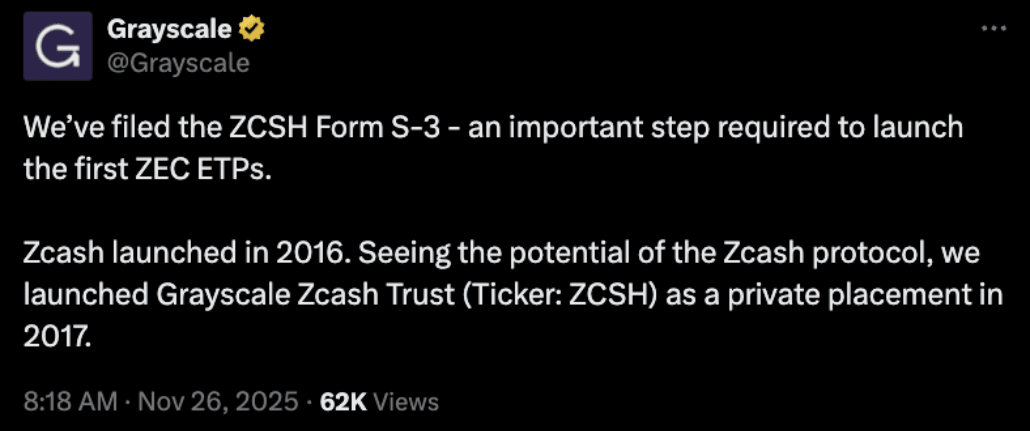
● It indicates that under a clear compliance framework (such as a regulated ETF structure), previously suppressed privacy technologies are now gaining packaging into mainstream financial products, with the potential for value reassessment. The prices of tokens like Zcash have recently shown significant increases.
2. Compliance innovation subjects: Two core beneficiaries
Under the new regulatory framework, two types of entities will encounter development opportunities:

3. Infrastructure and 'Compliance as a Service'
For both native and traditional participants, compliance itself has become a rigid requirement. This creates a huge market for infrastructure projects or companies that can provide the following services:
● Compliance tools: On-chain identity verification, transaction monitoring, and automated audit report solutions.
● Middleware: Oracles or data protocols that help projects meet regulatory reporting requirements.
● Professional services: Law firms and consulting agencies regarding 'Innovation Exemption' applications and compliance architecture design will see a surge.
A typical case is that Coinbase, in response to the SEC lawsuit, transformed its developed KYC/anti-money laundering technology into a 'Compliance as a Service' product for external sales, achieving substantial revenue growth.
Five, Global Competition: The Struggle Between the American Model and the European Model
The shift in U.S. regulation is also participating in a global regulatory competition. The flexibility represented by its 'Innovation Exemption' and categorical regulatory model stands in stark contrast to the unified, pre-authorization model represented by the EU's (Crypto Assets Market Act) (MiCA).
● The American model: Tolerating higher initial uncertainty and risks in exchange for the speed and flexibility of innovation, making it attractive to startups and venture capital.
● The EU model: Provides stability and predictability through unified rules, which are favored by large traditional financial institutions hoping for robust expansion.
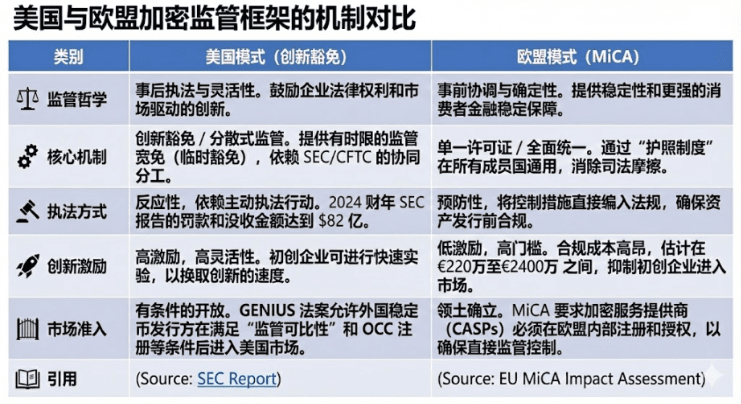
This strategic divergence implies that global crypto companies may need to prepare two sets of compliance strategies. In the short term, a more lenient and flexible U.S. regulatory environment may attract global crypto talent and capital back, reshaping the geography of innovation. The EU and other regions (such as the UK, Singapore, and Hong Kong) may need to assess and adjust their policies to remain competitive.
Six, Pragmatic Outlook and Risk Warning
In 2026, with the official rollout of the 'Innovation Exemption' and the advancement of the (CLARITY Act), the U.S. is expected to welcome a wave of 'compliance innovation'. However, challenges remain:
● The Art of Balance: How to achieve a sustainable balance between privacy and monitoring, decentralized ideals and necessary compliance, encouraging innovation and investor protection remains a significant challenge.
● Political stability: The direction of regulation is closely related to the administration, and the stability of long-term policies remains to be seen.
● Market volatility: The expectations of regulatory benefits have been partially reflected in asset prices (such as privacy coins), and the introduction of specific rule details may still trigger volatility.
For market participants, the pragmatic strategy is to study the details of specific rules such as the 'Innovation Exemption' and evaluate the compliance fit of their projects; focus on projects with technological advantages and first-mover advantages in clear tracks such as privacy technology and compliance infrastructure; at the same time, compliance costs and requirements must be incorporated into the core business model, rather than remedied afterwards.
The SEC's roundtable meeting and new policies mark a turning point for an era. The crypto industry is transitioning from a regulated 'Wild West' to a new continent where rules are becoming clearer, although competition remains fierce. On this new continent, innovation and compliance are no longer a multiple-choice question, but a mandatory answer that must be addressed. The correctness of the answer will determine the winners of the next cycle.
Join our community to discuss together and become stronger!
Official Telegram community: https://t.me/aicoincn
AiCoin Chinese Twitter: https://x.com/AiCoinzh
OKX Welfare Group: https://aicoin.com/link/chat?cid=l61eM4owQ
Binance Welfare Group: https://aicoin.com/link/chat?cid=ynr7d1P6Z


