Do you know what has always amazed me about the crypto industry? We all talk about the revolution of finance, about how blockchain will change the world, about a future without banks. And then you look around and realize: 99% of assets in the world still exist outside of blockchain. Real estate, stocks, bonds, commodities, art, intellectual property — all of this is trillions of dollars living in the traditional financial system with paper certificates and intermediaries.
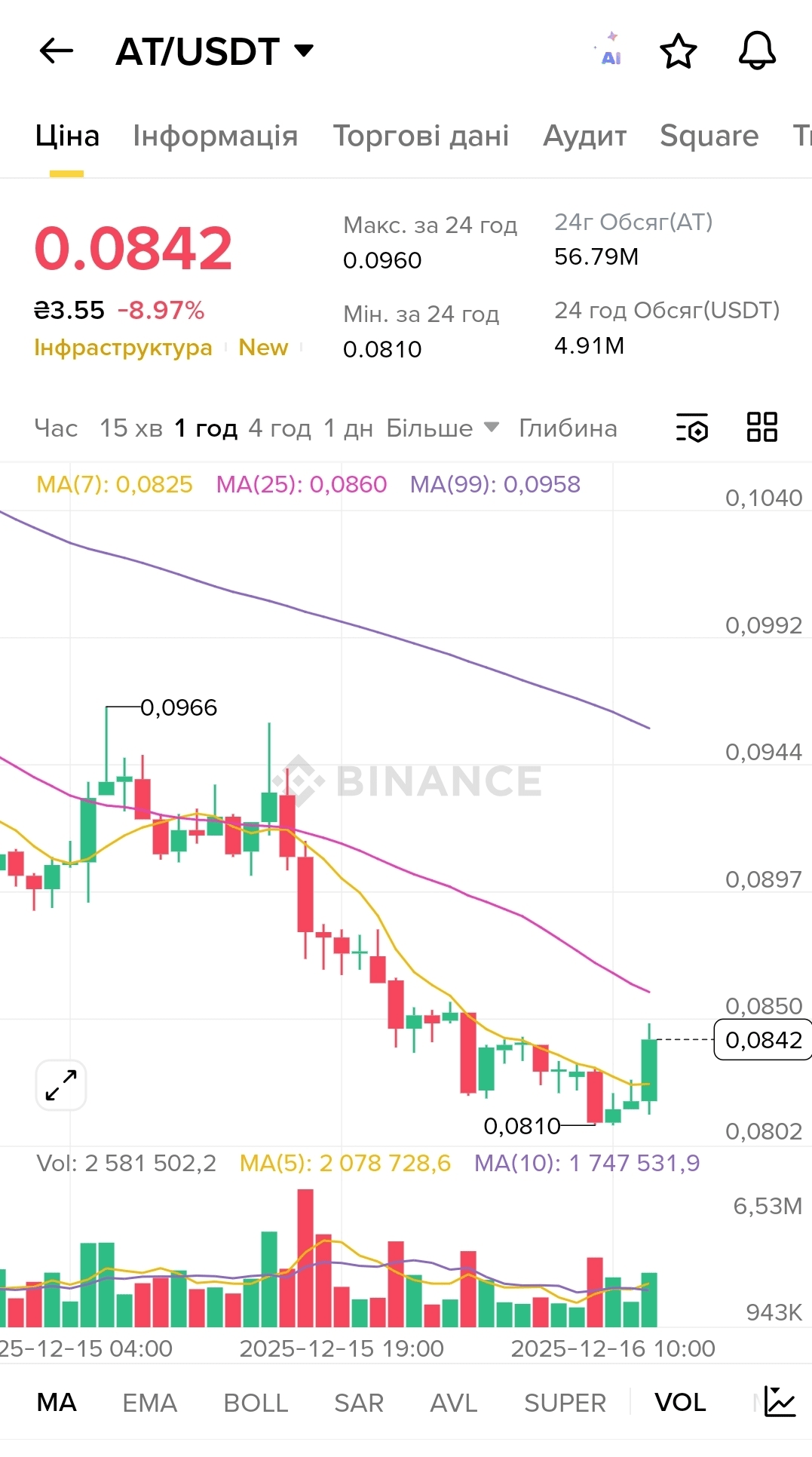
I look at the chart of $AT, which collapsed to 0.0842 with a drop of 8.97%, and think: the market is red, panic, everyone is selling. A minimum for the day of 0.0810 — that hurts for holders. But you know what? It’s in moments like these that it becomes clear why tokenization of real assets is so important. Because cryptocurrencies are volatile, unpredictable, they can drop 10% in a day. And tokenized stocks of Apple or tokenized real estate in downtown Munich — that’s a tie to real assets that won’t disappear tomorrow.
And here arises a key problem: how to tie a blockchain token to a real asset in a way that can be trusted? How to prove that a token really represents a share of an apartment and not just a promise from a fraudster? How to verify that the asset exists, that it is valued correctly, that everything is alright with it? This is where oracles come into play. And @APRO-Oracle positions itself as a bridge between TradFi and Web3.
Let me tell you how it works and why it can change everything.
Let me start with an example that is close to me — real estate. Imagine: there is an apartment in Kyiv worth $100,000. The owner wants to tokenize it — break it into 1000 tokens, each representing 0.1% of the apartment. Now people all over the world can buy tokens and own a share of this apartment. The apartment is rented out, and the rent is distributed among token holders proportionally to their shares. The apartment appreciates in value — the tokens also rise.
Sounds ideal, right? But how to do this technically? The first problem: how to verify that the apartment exists and belongs to the one who tokenizes it? Data from the real estate registry is needed. The second problem: how to assess its fair market value? Data from appraisal companies and comparisons with the market are needed. The third problem: how to verify that the apartment hasn’t been destroyed, sold twice, or is under arrest? Continuous status monitoring is required.
#APRO can integrate with all these data sources. With government registries (where technically possible), with appraisal companies, with real estate monitoring platforms. The oracle collects data from many independent sources, AI verification checks them for validity, and only after that does the smart contract confirm: yes, this token does indeed represent real estate.
The trading volume of 4.91 million USDT shows that even on a red day, activity continues. But imagine what will happen when the tokenization of real assets becomes mainstream. When millions of people will trade shares of apartments, commercial real estate, land just as easily as cryptocurrencies are traded now. Volumes will grow exponentially.
The second example is stocks and securities. Right now, if you want to buy Tesla stock, you need a brokerage account, identification, often a minimum deposit amount. The process takes days. And if you live in a country where access to international markets is limited? Just unlucky to be born in the wrong place.
Tokenized stocks solve this. You can buy a token that represents a share of Tesla stock from anywhere in the world, with just a crypto wallet. No intermediaries, no KYC (well, at least ideally), no restrictions. Trade 24/7, not just during stock exchange hours. Buy fractional shares — not a whole stock for $200, but a token for $10.
But how to ensure that a tokenized stock is indeed tied to a real stock? Confirmation is needed from the custodian who physically holds the shares. Data about the current price from traditional exchanges is needed. Information about corporate actions — dividends, splits, buy-backs — is needed. All this has to come into the blockchain through a reliable oracle.
@APRO-Oracle can aggregate data from various price data sources — NYSE, NASDAQ, Bloomberg, Reuters. If one source shows an anomalous price, others will detect it. Multiple verification ensures accuracy. And smart contracts automatically distribute dividends among token holders, without delays and intermediaries.
The maximum in a day was 0.0966, now 0.0842 — almost a 13% drop from the peak. This is a reminder of why diversification is important. If your portfolio consisted not only of volatile crypto but also of tokenized stocks, bonds, real estate — the drawdown would be much softer. Tokenization allows building truly diversified portfolios within Web3.
The third example is commodities and raw materials. Gold, silver, oil, wheat, coffee. Traditionally, investing in commodities is difficult. Futures accounts are needed, understanding of market specifics, large sums. And physically buying gold or oil? Where to store it, how to verify quality, how to sell quickly?
Tokenized goods solve this. One token = one gram of gold stored in a certified warehouse. Or one token = one barrel of oil in a specific tank. You own the token, which means you own a share of the physical goods. Want to sell — sell the token on a DEX in seconds, without thinking about logistics.
But again: how to prove that real goods stand behind the tokens? Data from custodians, audit checks, information about the location and condition of goods are needed. #APRO can integrate with warehouse accounting systems, with IoT sensors that track goods, with independent auditors. All this information flows through an oracle into the blockchain, where anyone can verify: yes, there are real assets behind these tokens.
I spoke with the founder of a startup that tokenizes coffee plantations in Africa. He said: "The hardest part was not the blockchain technology. That’s relatively simple. The hardest part was convincing investors that the tokens really represent real plantations, that there will be a harvest, that we are not fraudsters. We needed a way to prove this cryptographically. Oracles became the solution."
They use satellite data to monitor the condition of plantations, drones to assess the harvest, IoT sensors to track yield. All this data goes through an oracle into the blockchain. Investors can see in real-time how their coffee is growing, how much harvest is expected, what market prices are. Transparency breeds trust.
The volume of 56.79 million $AT per day is the liquidity of the oracle token itself. But imagine the trading volumes of tokenized assets when this industry scales up. When tokenized real estate, stocks, commodities are traded daily in billions. The demand for reliable oracles will grow exponentially.
The fourth example is intellectual property and royalties. Musicians, writers, artists create content that generates income for years. But they usually sell rights to publishers and studios for pennies, while those earn millions. What if we tokenize the rights to a song or a book?
Imagine: a musician releases a new song and tokenizes future royalties. You buy tokens, and every time the song plays on Spotify, YouTube, radio, a portion of the income is automatically distributed among token holders. The musician receives funding immediately, without waiting for years. Investors receive passive income from popular music.
How to implement this technically? Data is needed from streaming platforms about the number of listens. Data about royalty payments from collecting societies is needed. All this has to come into the smart contract through an oracle. @APRO-Oracle can integrate with the APIs of Spotify, Apple Music, YouTube, with copyright accounting systems. Data is collected, verified, sent to the blockchain, and payments are made automatically.
This is no longer science fiction. There are platforms that do this right now. And they need reliable oracles because if the royalty data is inaccurate or manipulated, the whole system collapses. Trust in data = trust in the system.
The fifth example is insurance products. Traditional insurance is a nightmare with paper policies, long claims reviews, and denials for silly reasons. Parametric insurance on the blockchain solves this. An event occurs (flood, earthquake, flight delay) — payment is automatic, without applications and reviews.
But how does a smart contract know about an event? Through an oracle. Flood? Data from hydrological sensors and satellites. Earthquake? Data from seismic stations. Flight delay? Data from airlines and flight tracking services. #APRO aggregates all these sources, verifies through AI, and the smart contract automatically pays compensation.
Tokenizing insurance products allows for the creation of new types of coverage that were previously impossible. Microinsurance for farmers in developing countries. Cyberattack insurance for small businesses. Coverage for climate change risks for coastal regions. All this becomes possible thanks to automation through smart contracts and reliable data from oracles.
A minimum of 0.0810 on the chart is a painful drop. But tokenization of real assets is not about quick enrichment through pump-and-dump schemes. It’s about building a bridge between $400 trillion of traditional assets and Web3. It’s about making investments accessible to billions of people who are currently excluded from the financial system.
I’m not saying that @APRO-Oracle will solve all tokenization problems. There are legal challenges — how do regulators view tokenized assets? There are technical challenges — how to ensure security and scalability? There are social challenges — how to convince people to trust tokenized assets?
But oracles are a critical part of the puzzle. Without reliable data from the real world, tokenization is impossible. You can create a token that supposedly represents an apartment, but if there is no way to independently verify that, it’s just a promise, not an asset.
#APRO is building infrastructure for verifying real assets on the blockchain. This is a bridge between a world where trillions of dollars of real value exist and a world where true financial inclusion, programmability, and liquidity are possible. If this bridge is built correctly, we will see a massive migration of assets from TradFi to Web3.
Imagine a world where anyone with a smartphone can own a share of an office building in Manhattan, stocks of Microsoft, gold in a Swiss vault, rights to a hit by Taylor Swift. Where all these assets are traded 24/7, with instant settlements, without intermediaries, with complete transparency.
This is a world made possible by tokenization. And oracles like @APRO-Oracle are the critical infrastructure that makes this world a reality. Not today, not tomorrow, but gradually, step by step, we are moving there.
The chart may fall, the market may be red, but technological progress does not stop. The bridge between TradFi and Web3 is being built. And when it is completed, it will change the financial system forever. The question is not whether this will happen. The question is who will build this bridge and who will control the infrastructure.
I believe that the future belongs to decentralized solutions, where no single company controls the data, but a multitude of independent sources create a consensus of truth. And if #APRO is moving in that direction, they deserve attention. No matter what the token price is doing today.