

As the world's first all-in-one DeFi super application built on a "Dual Liquidity Architecture (GLP + CLP)", all the value in CloudBank's ecosystem will ultimately be captured in the platform token COD, giving it potential long-term growth momentum.
The value logic of COD can be summarized in three main lines:
1) COD is the "value capture engine" of CloudBank;
2) COD has strong scarcity and a locking model;
3) The multi-business overlay of CloudBank provides the foundation for COD to reach a market value of 10 billion.
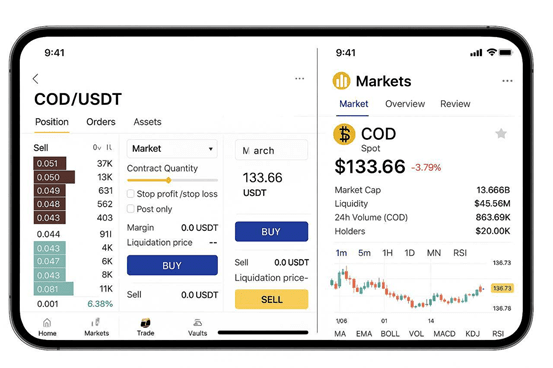
1. COD is the value capture engine of CloudBank
As CloudBank's five major products gradually go online, COD will become the most important value carrier and distribution vehicle of the entire ecosystem.
1. All trading-related business revenues will continuously flow back to COD
The various trading businesses of CloudBank include:
- Spot trading fees
- Perpetual contract trading fees
- Funding rate income
- Liquidation fees
- Market making profits (GLP)
- Fees and additional revenues from community liquidity pool CLP
Among them, 20%-40% will be achieved through:
- Buy back COD
- Dividend COD or USDT
- Staking rewards COD
and other methods, continuously feedback to COD stakers and node holders.
This means that the larger the trading volume of the platform, the more users, and the richer the application scenarios, the more scarce and valuable COD becomes.
In other words: The business growth of CloudBank directly drives the value increase of COD.
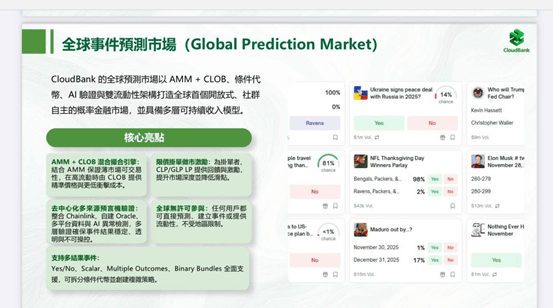
2. COD is a necessary asset for Launchpad and prediction markets
The two major high-frequency application scenarios of CloudBank:
- Decentralized asset and event issuance platform (Launchpad);
- Global prediction markets (Prediction Markets).
In these two types of scenarios:
- When new projects issue tokens, they need to use COD to participate, stake, or pay certain fees;
- Creating prediction events and participating in prediction markets will also use COD as one of the participation assets, margins, or settlement mediums;
- Partial governance and voting rights are also bound to COD.
This will constantly create rigid demand for COD:
- Every quality project goes online
- Every round of hot prediction activities
Will lead to a peak in demand for COD.
3. COD is the core 'fuel' of AI Quant Lab
CloudBank deeply integrates AI into DeFi, providing:
- AI automatically generates trading strategies
- Smart investment research and quantitative portfolio management
- Automated execution and risk control
In this system:
- Using AI strategies may require subscription fees;
- Advanced strategy calls, API usage, automated execution by bots, etc., will also be bound to COD;
- In the distribution of strategy profits, part will be settled, allocated, or repurchased through COD.
AI applications typically have:
- Continuous payment attributes
- High stickiness
- High-frequency use scenarios
Therefore, the more successful the AI module, the stronger the long-term demand for COD will be.
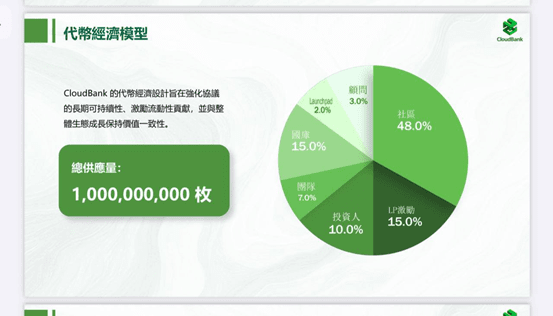
Two, the scarcity model of COD: locking + demand dual drive
1. Fixed total supply: 1 billion pieces, the actual circulation is far less than the total supply
The official set total supply of COD is 1 billion pieces, but:
- A portion will be locked in nodes and protocol treasury for the long term;
- A portion will be used for long-term incentives and ecological support;
- The more people participate in nodes and staking, the more COD will be locked up.
From a practical market perspective:
The COD participating in circulating transactions will be far less than 1 billion pieces, leaving plenty of room for future price increases.
2. Node subscriptions and staking mechanisms will lock a large amount of COD
CloudBank has designed a hierarchical node and long-term dividend model:
- Node subscriptions require investment and obtaining COD;
- Nodes need to choose to stake or lock in COD to obtain higher dividends;
- The number of nodes is limited, and the earlier participants have more motivation to hold coins for the long term.
The result is:
- Nodes and high-level users will continue to lock in COD;
- The more locked, the fewer chips can circulate in the secondary market;
- The less circulation, the easier the price is to be driven by funds.
This forms a classic 'scarcity + locking' model.
3. The dual liquidity structure of GLP + CLP brings structural demand
GLP (Global Liquidity Pool) carries the basic liquidity of mainstream assets;
CLP (Community Liquidity Pool) serves:
- Community assets
- Long tail tokens
- Creator economy
- AI/games/community derivative assets
To participate in this liquidity system:
- Whether it is market making, opening trading pairs, or building community markets, it will directly or indirectly rely on COD;
- As the number of communities grows and CLP continues to increase, the demand for COD will exhibit structural increases.
Three, CloudBank's multiple business combinations support COD to impact a market value of 10 billion.
To determine whether a token has '10 billion market value potential', the key lies in the following points:
1. Is there a real business that can transcend cycles?
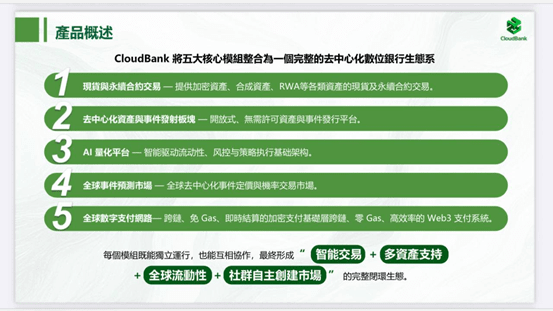
CloudBank is not just a DEX, but:
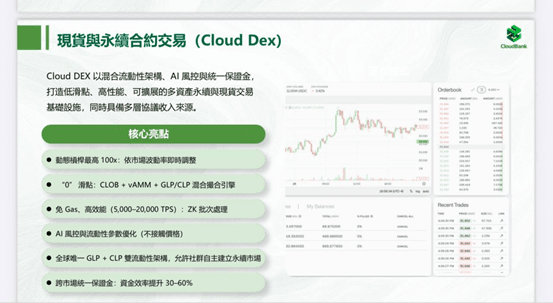
- DEX (spot + perpetual)
- Decentralized issuance platform (Launchpad)
- Global prediction markets (Prediction Markets)
- AI Quant Lab (AI quantitative strategy center)
- PayFi (global payment and settlement network)
These five business lines all have long-term growth space and possess mutual flow and enhancement effects.
2. Does it have a strong supply-demand structure?
COD in CloudBank's ecosystem plays the role of 'necessary asset' rather than 'optional governance token':
- Participation in Launchpad requires COD;
- Participation in certain predictions and staking requires COD;
- Using advanced AI features cannot be separated from COD;
- Node subscriptions, dividend models are highly bound to COD.
This makes the demand for COD have strong rigidity.
3. Is there a network effect?
Since CLP allows every community, creator, and team to build their own markets:
- The more communities, the more CLP;
- Every CLP brings its own user group and liquidity;
- All CLP and GLP form a huge network.
Thus:
CloudBank is not a single project growing, but rather 'countless communities jointly pushing an ecosystem' that is growing.
4. Does it have high yield and high dividend attributes?
CloudBank has designed:
- 20%-40% of platform revenue enters the dividend pool;
- Nodes and stakers share the long-term growth dividends of the platform.
This is similar to the model of high-dividend DeFi protocols like GMX and dYdX.
The difference is that CloudBank's revenue sources are not limited to contracts or spot trading, but rather a 'collection of five major businesses.'
5. Does the ecosystem have extensibility and imaginative space?
CloudBank's five major modules can be integrated with:
- AI track
- RWA (Real World Assets on-chain)
- Web3 games
- Creator economy
- Community DAO
Combining various narratives, it has the potential for continuous expansion.
It is more like a 'Web3 financial operating system (Web3 Financial OS)', rather than a single protocol.
Four, benchmarking mainstream projects: Where is the market cap space for COD?
——————————————
In comparison with mature overseas projects:
- GMX: primarily engages in perpetual contracts, with a market value of about several billion USD;
- dYdX: decentralized derivatives protocol, with a market value of about 2 billion USD;
- UNI: primarily DEX, with a market value of several billion USD;
- Meme and community assets on Solana have already surpassed a market value of 10 billion combined.
The uniqueness of CloudBank lies in:
- It integrates five major components: DEX + Launchpad + Prediction + AI + Payment;
- Token COD is the unified value carrier of these sectors;
- Therefore, the theoretical market value limit of COD is far higher than that of a single functional protocol token.
If CloudBank in the next few years:
- The number of DeFi users continues to grow;
- Launchpad and prediction markets become popular entry points;
- AI Quant Lab forms a stable, high-quality user group;
- PayFi creates real payment scenarios in some areas;
Thus, endowing COD with a market value of 10 billion is logically supported.
Five, COD value flywheel: Why will it continue to rise?
The growth logic of COD can be summarized as a flywheel model:
1. New projects entering CloudBank →
Using Launchpad and creating CLP increases the demand for COD;
2. User trading and prediction behaviors increase →
The overall platform fee and revenue growth →
20%-40% of profits are injected into the dividend and repurchase pool;
3. Nodes and stakers receive high dividends →
More willing to hold COD for the long term, increasing their COD holdings;
4. The circulating supply continues to shrink, and chips concentrate →
The COD available for purchase in the market decreases, making it easier for the price to be pushed up;
5. COD price increases →
Driving more users and institutions to pay attention to and participate in nodes and the ecosystem;
6. New funds and new users entering →
Promoting more projects to go online and more trades to happen →
Platform revenue rises again, and the flywheel accelerates once more.
This is typical:
'The more it is used → the higher the revenue → the more repurchases → the less circulation → the higher the price → the more use increases' positive cycle.
Six, summary: Why does COD have the opportunity to impact a market value of 10 billion?
Overall, the core value of COD lies in:
1. It is not a single functional token, but the value center of CloudBank's full-stack DeFi ecosystem;
2. The growth of all major platform businesses will be sedimented into COD through fees, dividends, repurchases, etc.;
3. The continuous contraction of circulating supply by nodes and staking mechanisms gives COD the dual characteristics of 'high dividends + high scarcity';
4. The complete ecosystem of 'trading + issuance + prediction + AI + payment' that CloudBank has integrated provides a very high growth ceiling for COD.
Therefore:
From a medium to long-term perspective, under the premise of continuous development of the CloudBank ecosystem and the continuous accumulation of users and projects, COD has a structural basis and logical support to impact a market value of 10 billion.
