1. Core Background
◦ In 2025, the Trump administration returns to the White House, implementing a trade policy centered on 'reciprocal tariffs,' applying differentiated tariffs to over 70 countries.
◦ Imposing an additional 100% comprehensive tariff on China and strengthening export controls on key software is a continuation of the United States' strategy of 'destructive reconstruction' of the global economic governance system, impacting the multilateral trading system.
2. The Evolution and Differentiation of the Global Trading Order
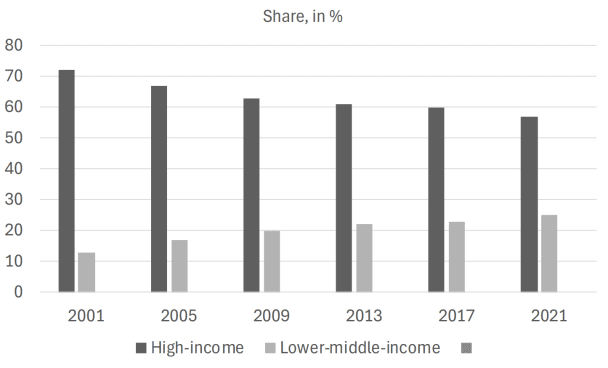
◦ Prosperity period: The post-World War II multilateral trading system (GATT/WTO) laid the institutional foundation, the share of global value chain trade increased, and in 2007, the manufacturing-related share exceeded 50%; middle- and low-income countries (such as China with an average annual increase of 5% in value chain participation from 2010 to 2020) integrated into the value chain, promoting economic growth and poverty reduction.
◦ Differentiation Period: After the 2008 financial crisis, trade restrictions increased, and the US-China trade war in 2018 intensified protectionism; US tariffs were passed on domestically, failing to reduce the trade deficit and harming employment; the rise of 'reshoring/nearshoring/friendshoring' outsourcing, with geopolitical competition driving global economic differentiation into two major blocs; simulation results of US-China technological decoupling indicate a decline in global GDP, with low-income countries suffering the most.
3. The logic of the US's support for and destruction of the global governance system
◦ Previous support motivations: Leading the Bretton Woods system, gaining three major benefits—seigniorage and financial sanction capabilities from dollar hegemony; financial industry gains from the 'dollar circulation' mechanism; occupying a dominant position in the high end of the global value chain to capture excess profits.
◦ Deep-rooted reasons for the shift towards destruction: intrinsic contradictions of dollar hegemony (new form of the Triffin dilemma) and rising maintenance costs; hollowing out of manufacturing leading to governance dilemmas of domestic employment and geographical development imbalance; the rise of emerging economies represented by China, impacting the institutional discourse power of the US.
◦ Destructive manifestations: Withdrawing from multilateral agreements, paralyzing the WTO dispute resolution mechanism, initiating tariff and technology wars, and forming exclusive 'small circles'.
4. Path to Breakthrough: Resilient Governance and Construction of a Non-US Economic and Trade Order
◦ Defending the multilateral trading system: Economies affected jointly suing the US for tariff violations, promoting the restoration of the WTO appellate body's functions, deepening RCEP implementation, and advocating for a 'Global Trade Stability Initiative'.
◦ Filling the governance vacuum: Expanding market openness to provide alternative markets for affected countries; providing financing through the Asian Infrastructure Investment Bank and establishing trade financing support funds; promoting cross-border payments of digital RMB and building a supply chain partnership network.
◦ Insisting on a depoliticized orientation: Responding to trade issues with economic logic, exercising caution in implementing countermeasures, and establishing a 'de-securitized cooperation alliance' with third parties.
◦ Building a self-circulating system: Breaking through key core technologies, establishing a unified national market, promoting diversification of trade partners, and reducing reliance on a single market.
5. Conclusion
◦ The destructive restructuring of the US forces a transformation of the global governance system, while the core values of the multilateral trading system still exist.
◦ China promotes the construction of a more inclusive and just new global economic and trade order by defending rules, providing public goods, and adhering to win-win cooperation.