Since its launch nearly two months ago, Aster DEX has been crazily focused on research and development, primarily emphasizing continuous performance refinement.
Recently, the team officially announced a new feature designed specifically for perpetual traders - the 'Shield mode'.
Aster DEX launches Shield mode
On December 15, Aster DEX officially launched a brand new trading mode for high-leverage players, marking a significant milestone.

This brand new Shield mode supports up to 1001x leverage, and features instant execution, zero slippage, and zero Gas fees.
All operations are integrated into a very smooth interface, primarily featuring one-click multi/open, orders not listed on the order book, shield trading pairs basically having no slippage, etc.
Essentially, this 'shield mode' can be understood as an early prototype of Aster Chain's future privacy features.
Aster whale is doubting life after losing up to 35 million dollars!
But what’s a bit absurd is that even though the shield mode has been launched, some major holders of Aster are still bleeding.
The Aster giant whale, known for 'buying high and selling low', has completed another classic operation. This time he held 13.44 million tokens for 6 days, selling all for 11.67 million dollars, while his buying cost was 13.04 million dollars.
The result is—that after selling, the account shows a loss of 1.37 million dollars, and this whale's cumulative loss has exceeded 35.8 million dollars.
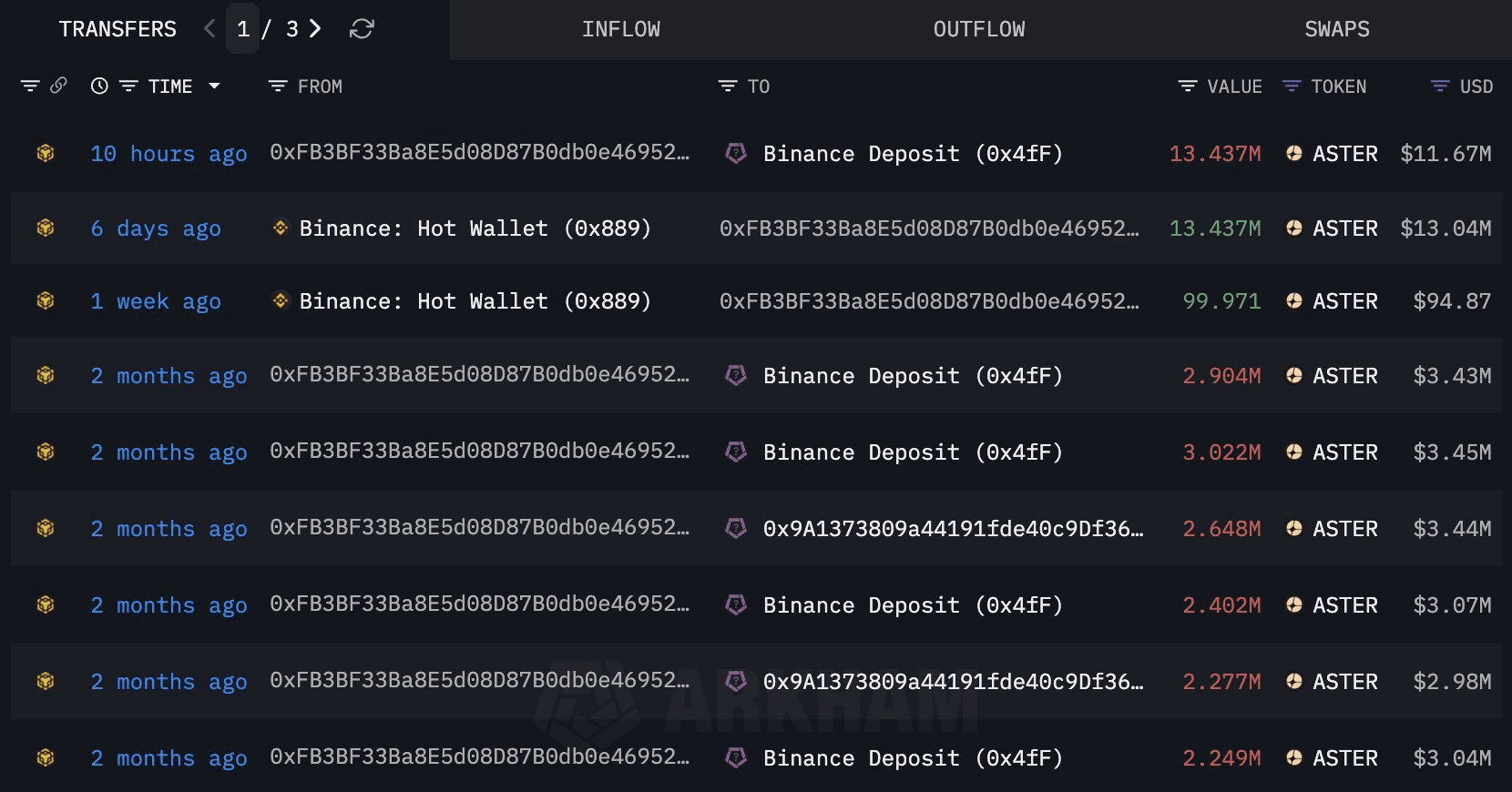
From historical experience, as long as whales start to recognize losses and exit, it basically indicates that market confidence is not very strong; they often anticipate further declines ahead. More critically, this situation is not an occasional phenomenon; the overall market is clearly still dominated by sellers.
ASTER has had three consecutive days of negative trading volume. During this period, the selling volume reached 150.82 million, while the buying volume was only 123.77 million.
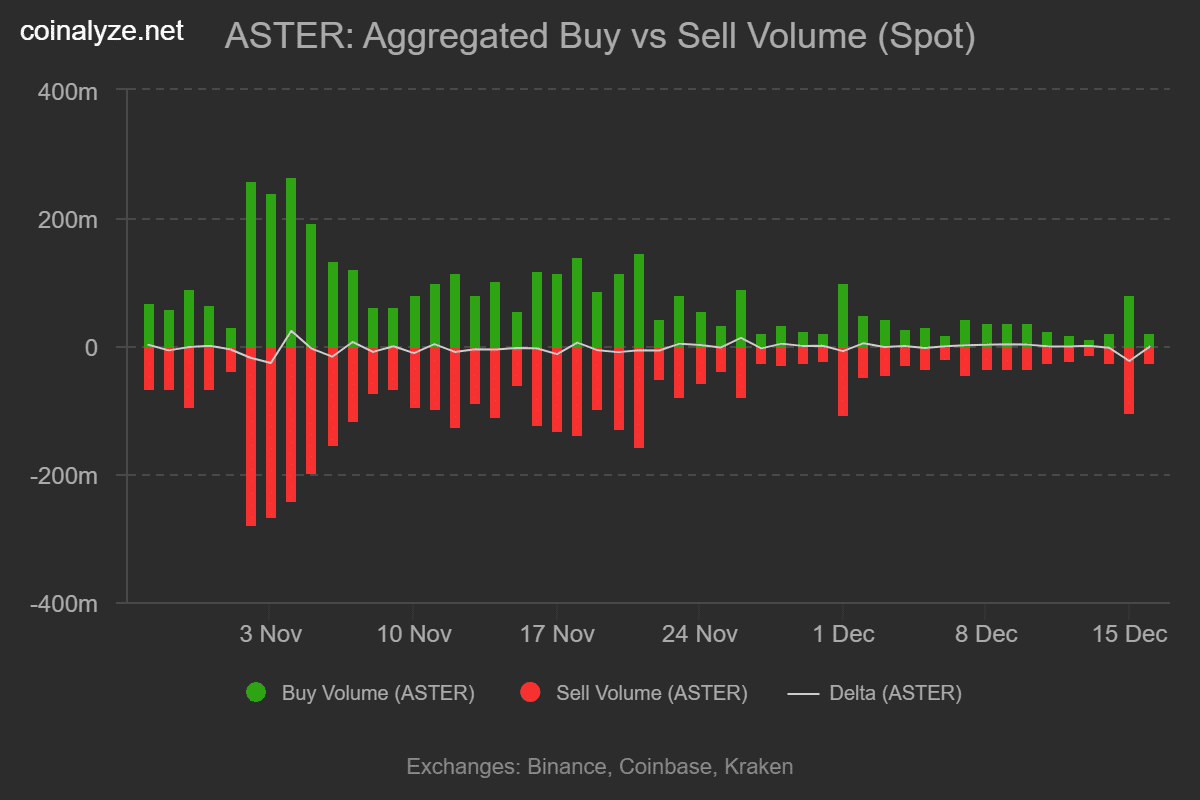
Therefore, the buy-sell gap has directly pulled down to -27.05 million, which clearly indicates that the selling pressure on the spot market is significantly amplified. Generally speaking, once the selling pressure continues to increase, the decline is often further amplified, and a weakening price is basically a signal in advance.
What will be the next step for ASTER?
Starting from the peak of 1.5 dollars a few weeks ago, ASTER has been sliding down in a descending channel, hitting a low of 0.76 dollars at one point. As of the time of writing, the coin price is around 0.815 dollars, having dropped directly by 10.8% in a day, with bearish sentiment quite heavy.
Additionally, from a technical indicator perspective, the relative strength index (RSI) of ASTER has dropped to 33, nearing the oversold zone, further confirming what was mentioned earlier—that the selling pressure in the current market is indeed very high.
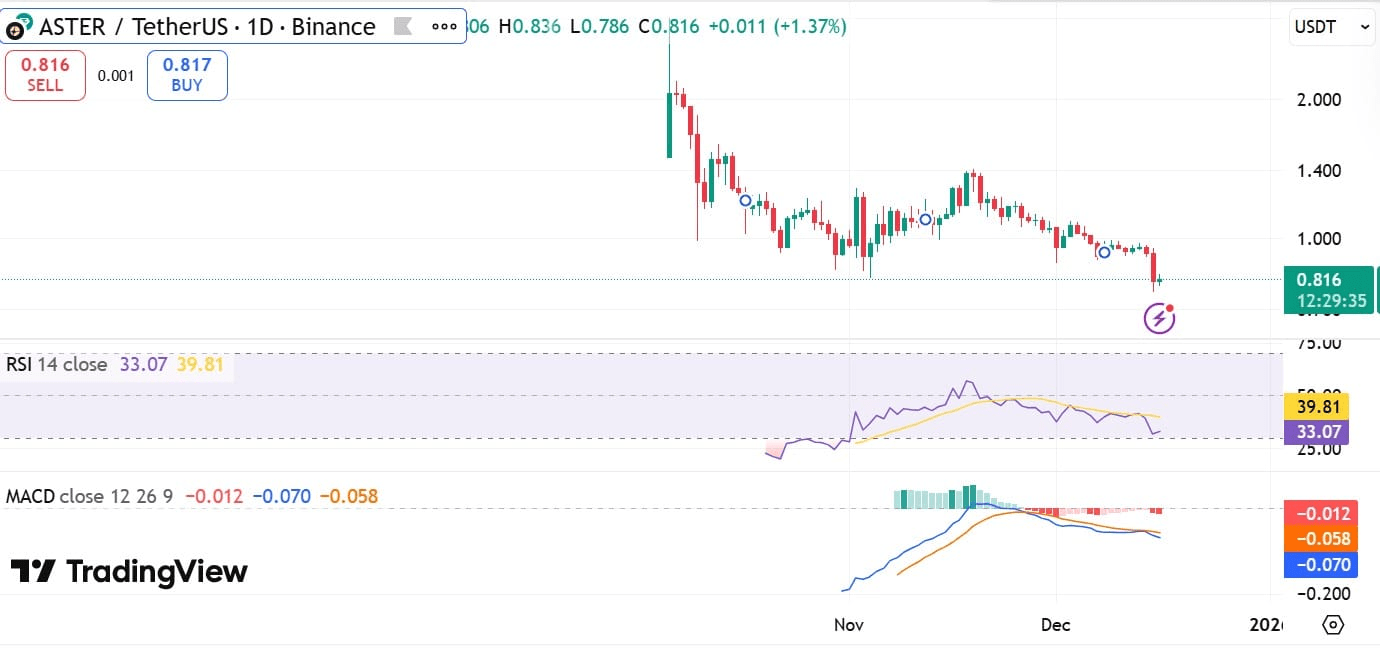
At the same time, the MACD has also clearly fallen below the zero axis, indicating that the downward momentum is still increasing, and the bears have not let go. From these signals, it is highly likely that this wave of movement will continue to go down.
So, as long as the selling pressure does not decrease, ASTER is likely to retest 0.76 dollars, with key support below at 0.70 dollars. Of course, another scenario is that if the decline attracts funds to enter and buy the dip, ASTER's price may also have a chance to rebound, initially targeting 0.95 dollars.