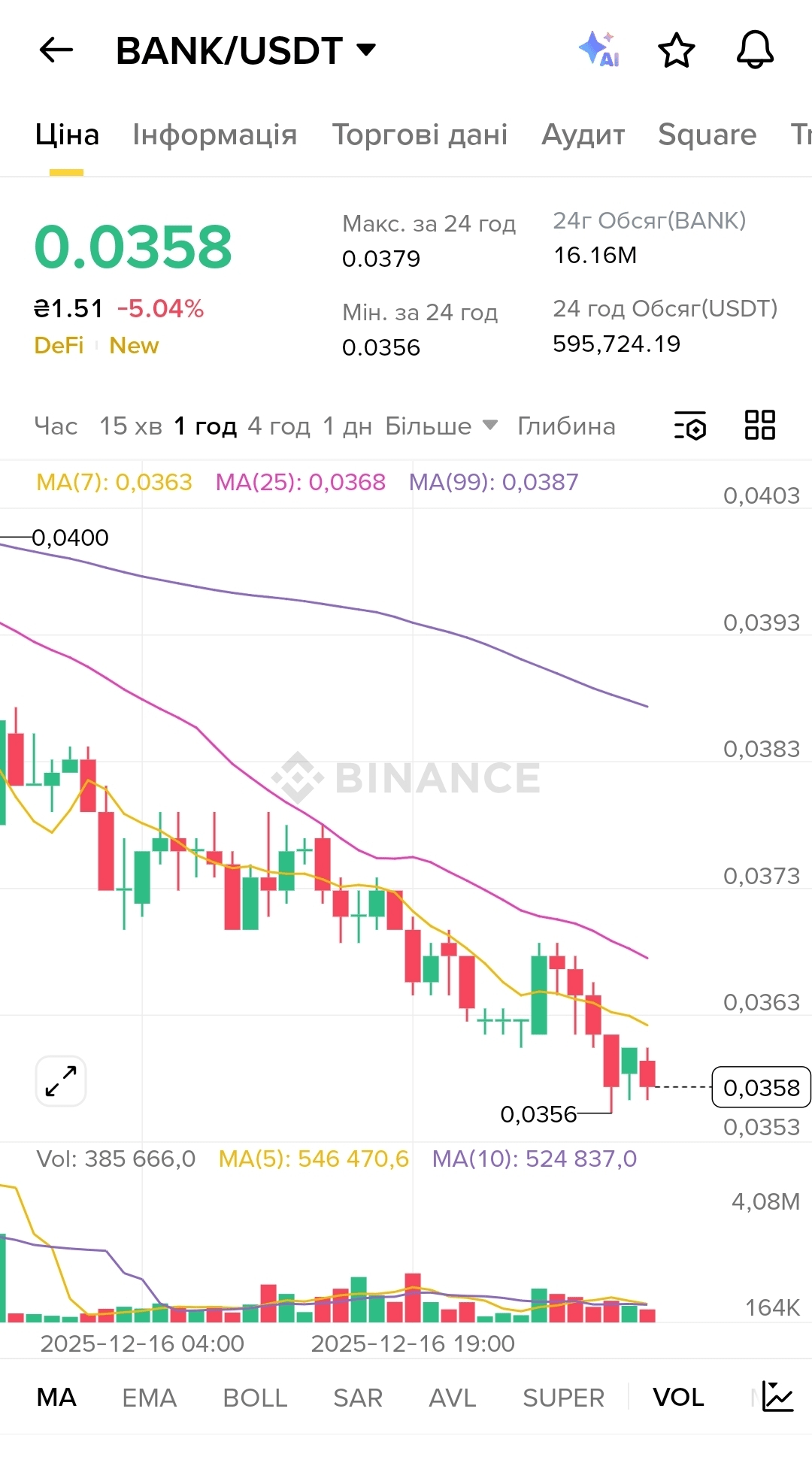
I woke up today, opened the chart $BANK and my heart stopped. Minus 5.04% for the day, price 0.0358, touched the bottom at 0.0356. Trading volumes 16.16 million in BANK and almost 600 thousand in USDT, people are clearly in panic selling something. All moving averages are going down like a waterfall, MA for 7 periods 0.0363, for 25 periods 0.0368, for 99 periods 0.0387. And you know what’s the scariest? This is not the first such drop recently, and every time you think, now we will bounce back, but it continues to fall.
I'm sitting, drinking coffee, and wondering how @LorenzoProtocol is even surviving this horror? Because one thing is when the market corrects slightly, and quite another when everything is collapsing like now. And here it's important not just to panic along with everyone but to understand what is really happening under the hood of the protocol, which strategies are working and which are not.
The first thing I did was look at how different strategies behaved in Lorenzo during this crash. They don’t have one universal strategy but several different approaches depending on the user's risk profile. There are conservative strategies with minimal risk and low returns, aggressive ones with high risk and potentially high returns, and balanced ones somewhere in the middle.
The conservative strategy, which mainly holds stBTC and minimally rotates in DeFi, showed the least losses. Logically, it is also the least exposed to volatility. The decline is somewhere within the overall market, nothing extraordinary. This is a case where boring stability turns out to be the best friend. I personally keep part of my funds in such a strategy, and I am very glad about this decision.
Aggressive strategies that use leverage and actively farm in various protocols have suffered much more. Losses there can reach 15-20% in a short time because when the market drops, leverage works both ways. This is a risk that everyone theoretically knows about, but when it actually materializes, it still hurts. A friend of mine said she was in an aggressive strategy and barely managed to switch to a conservative one before the biggest drop; otherwise, she would have lost a lot more.
Balanced strategies are somewhere in the middle; they are diversified across different protocols and do not use too much leverage. The decline there is noticeable, around 7-10%, but not catastrophic. This is a compromise between yield and safety, and in crisis moments, this compromise justifies itself. Most sensible people stay in such strategies because they understand that extreme greed in crypto often ends badly.
What impressed me was how quickly the Lorenzo team reacts to market conditions. They don't sit idle; they actively rebalance portfolios, moving funds from riskier protocols to safer ones, reducing exposure to the assets that are falling the most. These are not automatic algorithms that blindly follow set rules; this is a live team that makes decisions in real time.
For example, when one of the partner protocols started showing signs of trouble, Lorenzo immediately withdrew all liquidity from there. This saved users from potentially large losses because that protocol was actually exploited a few days later. Such a quick reaction is costly; it shows that the team is indeed monitoring the situation 24/7, not just launching the protocol and forgetting about it.
There's one more thing I noticed. The insurance fund mechanism in Lorenzo works precisely in such moments. A portion of the fees that the protocol collected in good times was set aside in a reserve fund. This fund is now being used to cover part of the users' losses in the most affected strategies. This doesn’t cover all losses, of course, but it’s something, and it shows that the team thinks about users, not just about their profit.
Liquidity is a separate issue during crashes. When everyone tries to exit at the same time, slippage becomes terrible; you sell at a much worse price than expected. Lorenzo maintains deep liquidity pools specifically for such cases, and this allows users to exit positions without catastrophic losses from slippage. It's not perfect, but it's much better than many other protocols where people lose 10-15% just on slippage during exit.
Staking rewards have also been adjusted downward; this is inevitable when activity decreases. But they haven't fallen to zero, as in some other projects. Lorenzo continues to pay real rewards from real fees, albeit smaller. This is fair and sustainable; it's better to receive less but steadily than to see large figures that turn out to be worthless after a month because the token dropped by 90%.
It's interesting to observe the behavior of the community during such crisis moments. Some panic and sell everything, losing money by the day. Others coldly analyze the situation and even buy on dips. The third group simply holds and waits. I belong to the second category, trying to think with my head, not emotions. Although, of course, when you see your portfolio melting away before your eyes, it's hard to stay calm.
I entered their Discord during the biggest panic; it was lively. The team answered questions, explained what was happening, and calmed people down. This is worth a lot because most projects disappear during such moments, ignoring the community. Lorenzo stays in touch, and this adds confidence that they are not going to abandon the project.
Technical analysis now shows a horror; all indicators scream to sell. But I've already learned not to blindly trust technical analysis, especially in extreme situations. Technical analysis describes the past; it does not see fundamental value or take into account the team’s work or product development. The chart may look terrifying, while the project can still be quite healthy and promising.
What did I personally do? I transferred part of my funds from an aggressive strategy to a conservative one, which reduced my exposure to risk. I bought a small amount of $BANK on the dip because the price of 0.0358 looks like a good entry point if you believe in the long-term perspective. I increased my share in staking to earn passive income even during the crisis. I didn’t sell anything in panic because I know that’s the worst decision you can make.
The main lesson I've learned from this crisis is that diversifying strategies is critically important. You can't keep everything in one strategy, even if it promises the highest yield. You need to distribute among conservative, balanced, and slightly aggressive approaches. When one strategy suffers, others compensate for losses, and the overall portfolio remains more or less stable.
The current price is 0.0358, and honestly, I don't know where it will go next. It may drop even lower, or it may bounce back. But I know that Lorenzo is doing the right things during this crisis – reacting quickly, protecting users, remaining transparent, and continuing to develop the product. And that is the most important thing for long-term survival. Projects that behave correctly in a crisis deserve trust in the future.
#LorenzoProtocol @Lorenzo Protocol $BANK