

The launch of the @KITE AI token feels like one of those moments when a technical milestone and a cultural shift happen to line up. Not because another governance token hits an exchange that’s nothing new but because of what it represents. Kite’s entry into the so-called agent economy, where autonomous AI agents interact and transact on-chain, speaks to a broader transition that’s been quietly taking place across decentralized systems. The timing, the tone, even the rollout approach all point toward a maturing stage in the relationship between artificial intelligence and blockchain governance.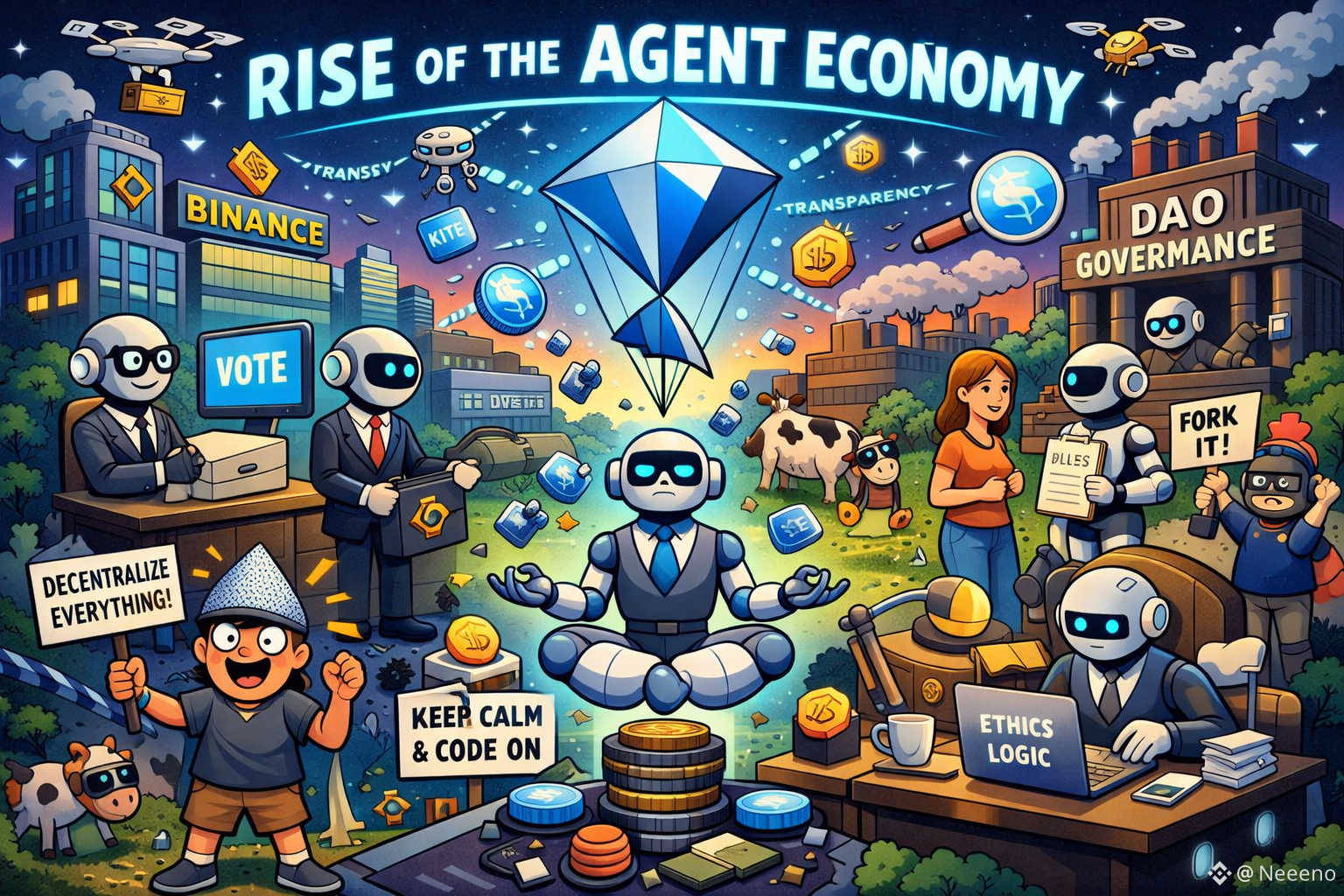
I find the premise both bold and surprisingly grounded. Kite isn’t positioning itself as the next grand infrastructure play or speculative arena; it’s presenting itself as a foundational layer where autonomous software can operate with transparency, identity, and economic alignment. In short, it’s trying to build a system where AI agents can hold value, pay for services, and follow enforceable on-chain rules. The KITE token anchors that logic—it’s the mechanism for coordination, trust, and policy enforcement among agents that otherwise might act independently. Governance tokens often sound abstract, but here, the connection between token and purpose is unusually direct.
Kite’s architecture is designed so that every autonomous agent has a verifiable identity and bounded permissions. Agents can transact, but they also need to comply with programmable rules set by the network’s participants. KITE holders, through governance, shape those rules—deciding what constitutes acceptable behavior, how risks are managed, and how disputes are resolved. The intent is to prevent agent economies from devolving into chaos or becoming controlled by opaque intermediaries. That ambition feels like a quiet nod to how the early DeFi era struggled with unchecked experimentation and composability that outpaced accountability.
There’s a sense of restraint in how Kite is rolling things out. The token’s introduction via Binance Launchpool earlier this quarter wasn’t framed as a hype cycle but as a necessary step to bootstrap governance participation. The team has repeatedly emphasized gradual rollout, conservative assumptions, and real-world testing before scaling. That’s an encouraging signal in a space where projects often chase user numbers before understanding system behavior. It reminds me of how certain open-source communities build slowly and deliberately—valuing trust over traffic.
What makes this moment compelling isn’t just the technical framework but the timing. Over the last year, decentralized finance and blockchain infrastructure have been evolving from speculative sandboxes into systems that need to demonstrate durability. Investors, developers, and even users seem less captivated by “what if” and more focused on “what lasts.” In that context, KITE’s emergence feels less like another crypto launch and more like a case study in pragmatic innovation. Governance tokens used to symbolize speculation; now, they might be the foundation for automated accountability.
There’s a human irony to all of this. The more we design for machines, the more our systems have to reflect human priorities—fairness, transparency, and trust. The KITE token doesn’t just let agents pay each other; it lets people define the guardrails for how those agents behave. That’s not trivial. It suggests that governance in the age of autonomous AI isn’t about voting on chain parameters; it’s about embedding ethical and economic alignment into code. The old question of “who decides?” takes on new depth when decision-makers could be synthetic entities bound by logic but guided by human intent.
Still, I think skepticism is healthy. Governance tokens, no matter how thoughtfully implemented, can easily slide into centralization if participation shrinks to a handful of large holders. Bonded collateral and attestor mechanisms, like those described in Kite’s documentation, help mitigate that by requiring accountability at multiple layers. But real resilience comes from distribution and engagement—how many people care enough to vote, challenge, or fork when needed. Transparency is essential, yet participation is the lifeblood. The balance between the two will determine whether Kite becomes a resilient ecosystem or just another controlled network wrapped in decentralized language.
The connection between AI and blockchain often gets framed as futuristic, but Kite’s take is more practical. AI agents already perform tasks in markets, logistics, and creative industries. What’s been missing is an open financial and identity layer that lets them act with autonomy while staying accountable. Kite’s “agent economy” tries to fill that gap: agents can hold wallets, make payments, and follow enforceable rules without a centralized overseer. It’s not a concept designed for tomorrow’s world; it’s responding to what’s already unfolding.
There’s also a subtle philosophical shift here. Early crypto culture thrived on anonymity and permissionlessness; Kite’s model introduces the idea of verified identity and bounded freedom. That might sound like a constraint, but it’s arguably what’s needed for systems that mix humans and machines. The next phase of decentralization isn’t about removing all structure—it’s about designing structures that can be trusted by both code and conscience. In that sense, KITE is less a coin and more a social contract expressed through software.
The agent economy trend is spreading fast. Many teams are working on how AI agents can run on-chain with governance, payments, and reputation. Kite is one of many, but its focus on trust, gradual scaling, and safety makes it stand out. It seems to understand that legitimacy comes not from slogans but from the systems that quietly work as intended. Governance debates in crypto can get extreme—either fully decentralized or heavily managed. Kite chooses the middle path, recognizing you need both openness and checks to keep things stable.
It’s an experiment in how far we can trust code to enforce human intent without losing sight of accountability. If it works, the implications could be broader than just one protocol. We might be witnessing the start of a governance era where AI systems aren’t just tools but participants—agents with economic incentives and ethical boundaries baked into their code.
It’s tempting to see this as a grand technological shift, but it’s really an organizational one. Kite’s token doesn’t promise wealth; it promises coordination. Its real challenge will be cultural—how to maintain integrity and inclusion as it scales. Tokens can enforce logic, but only communities can enforce trust. The success of the KITE economy will depend not just on its codebase but on whether people choose to treat it as a shared responsibility.
As the agent economy takes shape, the lines between automation and autonomy will keep blurring. We’ll have to decide, over and over, what transparency means when machines start to make decisions for us For now, KITE seems serious: it’s focusing on systems and guardrails instead of slogans. No matter where it ends up, it proves that governance doesn’t stop being human just because machines get smarter.

