

@GoKiteAI A strange thing has happened in the last couple of years: the conversation about AI has shifted from “can it answer questions?” to “can it do chores?” Not the fun, creative chores. The boring ones. Book the shipment. Renew the license. Move money from one account to another at the right time. Once you start imagining AI agents as little workers running in the background, you run into a very old problem in a new outfit: payments.
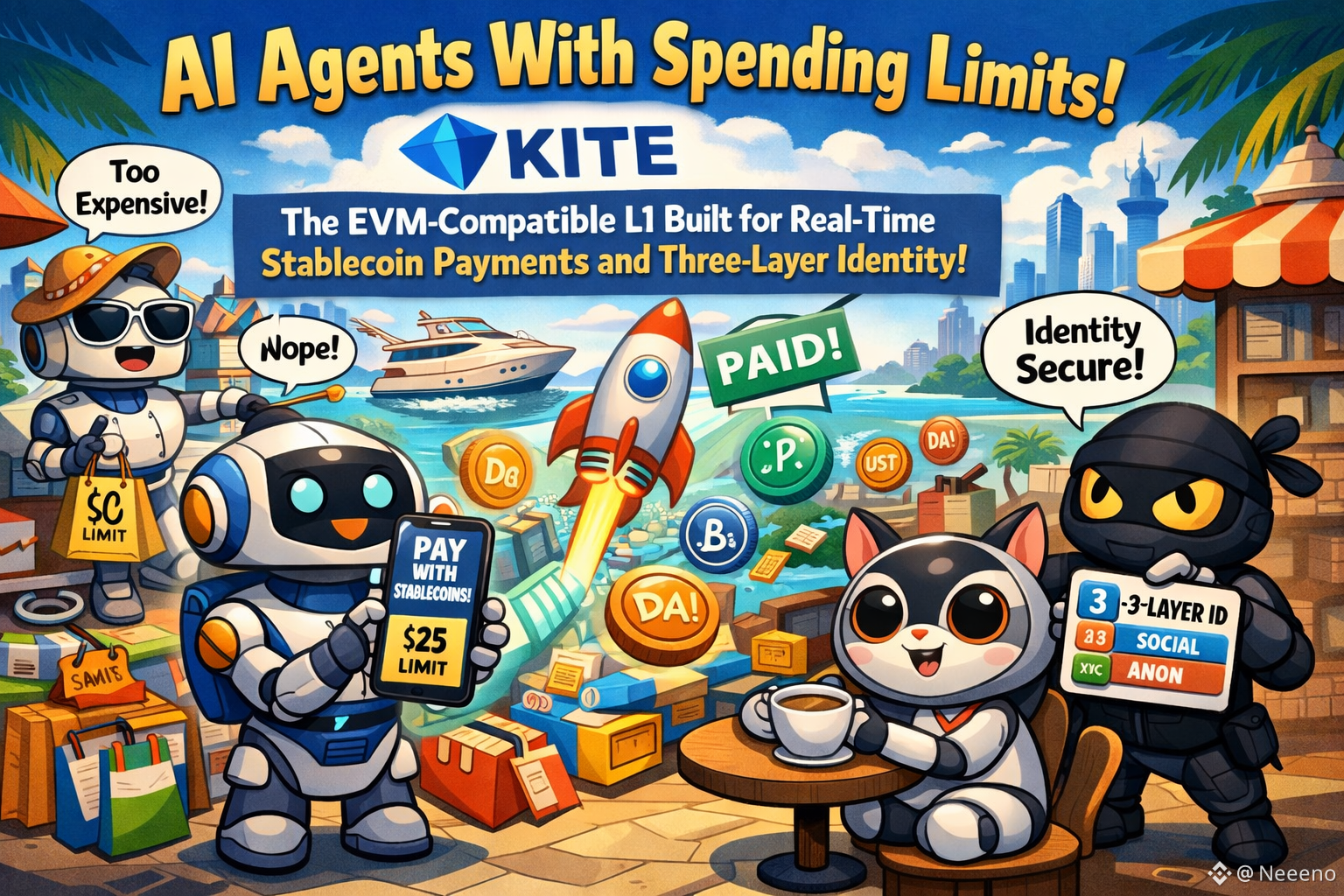
If an agent can place an order, it also needs a way to pay, and it needs limits. Online payments were built around humans approving a purchase, noticing a weird charge, pausing at checkout. Agents don’t pause. They execute. So the question becomes less “should agents spend?” and more “how do we let them spend safely, under rules we can understand and audit?”
This is one reason stablecoins are back in the spotlight. For a long time they lived in a niche: useful inside crypto markets, awkward outside them. Now you can feel the mainstream rails inching closer. Visa’s December 16, 2025 announcement that it is bringing USDC settlement to U.S. institutions is a concrete signal that stablecoins are being treated as settlement infrastructure, not just trading fuel. Stripe has also been telling businesses that stablecoin circulation doubled over an 18-month period in 2024 and 2025, the kind of quiet line that signals a market is turning into plumbing.
At the same time, agentic software has become more capable than the chatbots many people remember. It can chain tools, keep context, monitor budgets, and act continuously.It sounds great, but it can also worry people. Autonomy can mess up in small, quiet ways—not just big ones.It fails in mundane ones: a misread invoice, a brittle integration, a vendor API that changes quietly, or permissions that are simply too broad. In payments, mundane mistakes can become expensive at machine speed.
Kite is an attempt to meet that reality by treating payments and identity as first-class features for agents, not afterthoughts. It describes itself as an EVM-compatible layer-1 blockchain, so developers can use familiar Ethereum-style tooling while the network runs as its own base chain. The focus is narrow on purpose: its documentation emphasizes stablecoin payments and transaction patterns that look like software talking to software. The bet is that if agents are going to make lots of small payments, the chain should be optimized for that rhythm from day one, not retrofitted later.
Speed is only part of the story. Trust is the heavier part. The uncomfortable question is not “can an agent pay?” It’s “who is accountable when it pays the wrong party, or pays too much, or pays under coercion?” Kite’s three-layer identity model is one answer aimed at containment. In Binance’s research summary, the layers separate user, agent, and session keys so that a compromise in one layer doesn’t automatically become total control. That’s not philosophical identity; it’s a practical way to limit how far a breach can spread, and to keep accountability attached to the right actor.
Spending limits fit naturally into that model.Picture a seatbelt: it doesn’t stop you driving, it just helps if something goes wrong.You still drive where you need to go, but you’ve accepted that mistakes happen and you’d like them to be survivable. Limits can be blunt—“no more than $100 a day”—or nuanced: caps per vendor, per task, per time window, plus rules about what kinds of payments are even allowed. The goal isn’t to predict every failure. It’s to keep a failure from turning into a disaster at machine speed.
The broader context here isn’t purely technical. It’s cultural. We’ve already learned to accept machine-initiated commerce: subscriptions, autopay, usage billing that updates quietly. Agents push that one step further because they don’t just trigger known charges; they make decisions. That can feel eerie, even when it’s efficient, which is why payment rails that assume a constant “human in the loop” start to feel brittle when the spender is software.
Regulation is moving too, and that matters for anything that touches money. In December 2025, Axios reported that the OCC conditionally approved national trust bank charters for several crypto firms, including stablecoin-related companies, which suggests parts of the U.S. system are trying to create formal lanes rather than leaving everything in limbo. That doesn’t settle every debate, but it changes the tone. Businesses can pilot, and compliance teams can write policies that are about operating, not guessing.
None of this guarantees that Kite, or any single chain, becomes the default home for agent payments. But the direction is real: stablecoins are moving closer to mainstream settlement, and agents are moving closer to real authority. The overlap creates a risk surface, because software can now spend. It also creates a new chance to make delegation feel safe: clear identity, enforceable limits, predictable settlement, and a trail you can follow when something goes wrong.


