

@KITE AI is positioning itself as a purpose-built blockchain infrastructure for autonomous AI agents essentially, a network where AI agents can authenticate, transact, coordinate, and settle payments on-chain with verifiable identity and programmable constraints. Its core narrative revolves around filling infrastructure gaps that legacy systems (both traditional fintech rails and general-purpose blockchains) aren’t designed to solve namely identity, trust, and high-frequency machine-to-machine settlement. 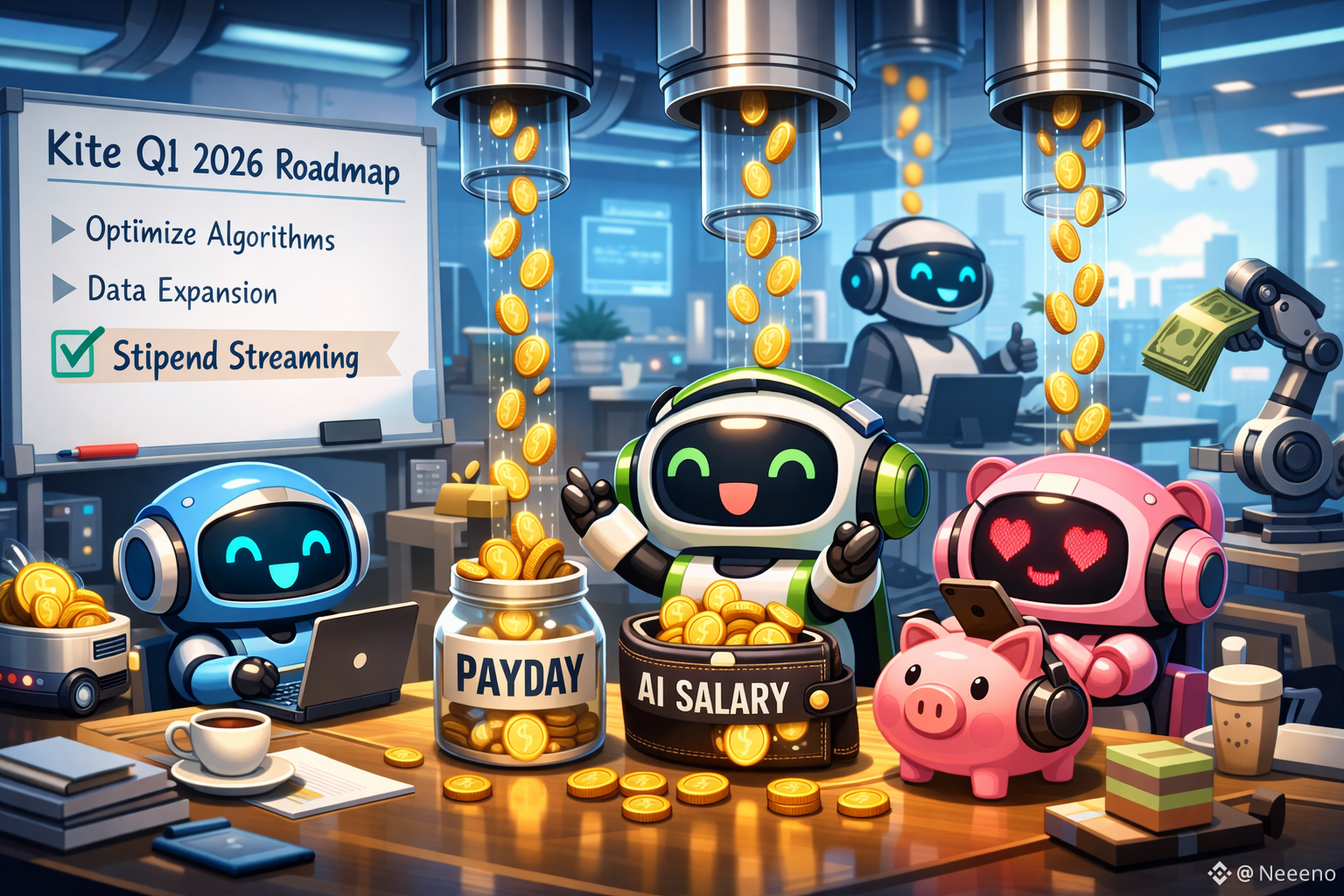
One of the milestones highlighted in recent public roadmaps and ecosystem summaries is exactly what you mentioned: under “Agent-Aware Modules (Q1 2026)” Kite plans to roll out upgrades to its multisig / agent payment tooling that include “stipend streaming: automated salary payments for AI agents.” This phrasing has circulated recently in press and analysis pieces — particularly in crypto market coverage — and is not invented by third-party speculation. The project’s own documents on GitBook also reference multi-signature governance and advanced payment capabilities in the context of agent utilities, though the GitBook content typically focuses more on high-level features than catchy roadmap banners.
So yes, the claim that Kite’s Q1 2026 roadmap includes “stipend streaming” or automated salary mechanics for AI agents is rooted in real reported project plans, not an outright misinformation meme. It’s a genuine roadmap item being discussed publicly in project summaries and ecosystem analyses.
However, to provide clarity — and this matters — it’s essential to unpack what this really means, because the language used (like “automated salary”) carries significant semantic baggage that doesn’t fully align with the technical reality:
First, Kite is not literally hiring AI agents in the way a corporation hires human workers. There’s no HR, no employment contracts, no payroll department. Rather, within Kite’s economic model, agents are autonomous software entities equipped with cryptographic identity and programmable governance rules. The “stipend streaming” concept refers to continuous or scheduled on-chain payments routed to an agent’s wallet address based on pre-defined conditions and smart contract logic — essentially micropayment flows that can be triggered as an agent operates over time.
This kind of payment mechanism resembles models like streaming micropayments or subscription-like transfers on chain, where value flows gradually (or in discrete units) depending on usage or contractual triggers, rather than in one lump sum after human intervention. It’s similar to how some blockchain systems enable recurring payouts to developers, validators, or liquidity providers — but here it’s framed for machine-driven economic actors.
Second, the reason this concept is trending now has less to do with Kite alone and more with broader trends in the emerging “agentic economy” narrative:
Across Web3 and AI circles, people increasingly talk about AI agents as economic actors, not just problem-solving tools. That means giving them *native mechanisms to earn, spend, collaborate, and be accountable without constant human oversight.
As autonomous systems proliferate — from shopping assistants to research workflows — there’s a real technical problem to solve: how do autonomous software units settle value with each other and with services without manual billing reconciliation? Traditional payments systems aren’t designed for hundreds of thousands of microtransactions generated in milliseconds by machine workflows.
Projects like Kite argue that blockchain infrastructure uniquely enables trustless, verifiable, programmable money flows that can be tied to agent actions — and “stipends” or “salaries” are just one way to describe continuous reward flows tied to work output.
Third, there’s a practical reality that often gets lost in the buzz: the roadmap dates and specific features are planned, not fully deployed yet. Kite’s mainnet public launch is still positioned for Q1 2026, and features like multi-sig governance, identity modules, and agent payment tooling are being incrementally released or tested. Roadmaps in crypto are notoriously fluid, and precise timing — even when published — often shifts in response to technical challenges, audits, and user adoption cycles.
From a broader perspective, this roadmap item reflects a deeper philosophical shift people are debating today: are we comfortable treating autonomous software — with economic agency, identity, and settlement power — as participants in financial systems? It’s one thing to pay an AI micro-fee for a specific API call; it’s another to stream ongoing value to a process that runs independently. These questions touch on blockchain design, AI governance, regulatory compliance, and even ethical considerations of autonomous economic rights.
Whether Kite will succeed in operationalizing this vision — and whether “stipend streaming” becomes a widely adopted primitive for agent activity — remains an open question. But what is not in doubt is this: the specific phrase you saw isn’t misinformation. It reflects a real roadmap entry in Kite’s public ecosystem materials. It’s just a blockchain-based financial building block, not something like a payroll system for people with jobs.

