

 Multi-chain DeFi does not fail because blockchains are slow.
It fails when capital moves based on bad assumptions.
Every liquidation cascade, every broken bridge, every mispriced collateral event traces back to the same quiet weakness: the system acted on information it should not have trusted. Execution layers did their job perfectly. The data layer did not.
APRO exists because the industry is finally being forced to confront this truth. In a world where capital flows freely across chains, the real bottleneck is no longer throughput or composability. It is whether the system can correctly interpret reality before money moves.
This is not an oracle problem in the old sense.
It is a cartography problem.
Multi-Chain DeFi Needs Maps, Not Megaphones
Most oracle networks behave like megaphones. They take a number, amplify it, and broadcast it everywhere as quickly as possible. That worked when DeFi was mostly single-chain and speculative.
Multi-chain DeFi breaks that model.
When capital moves across chains, it does not just ask what is the price.
It asks:
Is this data still valid across time?
Is it consistent across chains?
Is this movement safe under stress, not just under normal conditions?
APRO approaches oracles as navigation infrastructure. It does not simply tell protocols what exists. It helps them understand where capital can move without falling into uncertainty gaps.
That distinction matters more than speed.
Why APRO’s Architecture Starts With Separation, Not Aggregation
APRO’s two-layer design is not an optimization choice.
It is a philosophical one.
The off-chain layer exists to observe reality without burdening execution. This is where data is gathered, normalized, compared, and contextualized. Markets, real-world sources, structured feeds, and unstructured signals all live here. Speed matters, but interpretation matters more.
The on-chain layer exists to finalize only what deserves to influence capital. Validators do not blindly accept inputs. They confirm that data has passed through the appropriate filters before it is allowed to affect smart contracts.
This separation is intentional.
It recognizes that observation and execution should never share the same trust surface.
Capital deserves a checkpoint.
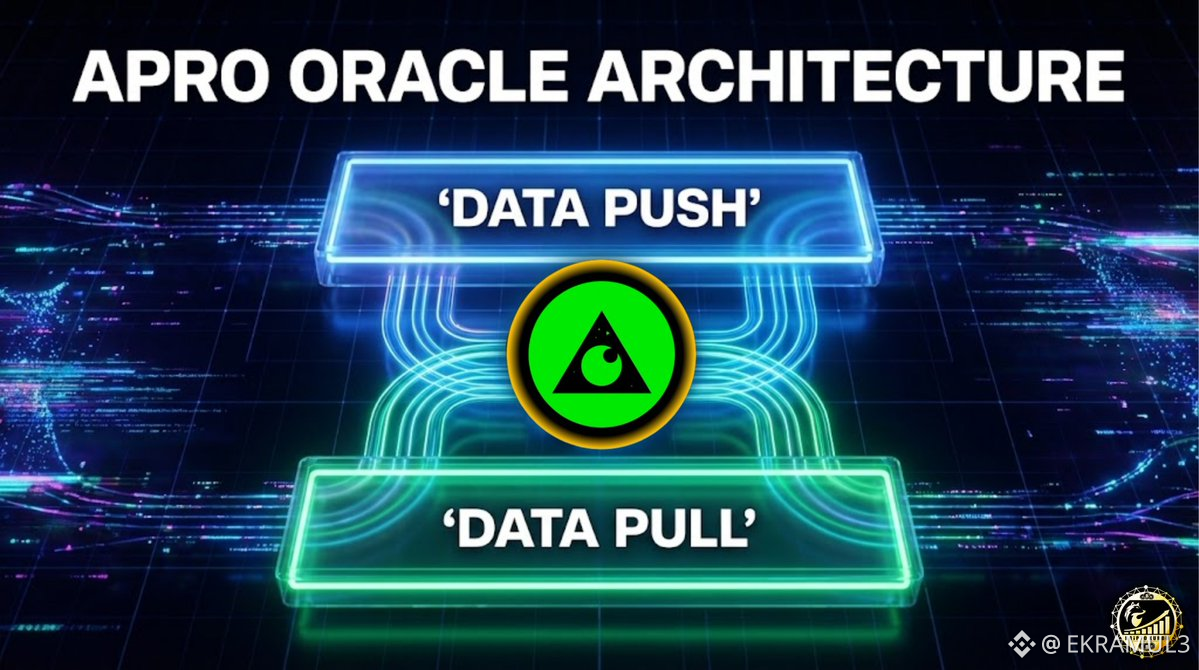
Data Push vs Data Pull Is Not a Feature It’s Risk Management
APRO’s push and pull models are often explained as convenience. That misses the point.
Data Push exists for environments where latency is existential. Liquidations, derivatives, automated strategies these systems must react immediately, or they fail. Here, APRO behaves like a constant signal, keeping protocols synchronized with fast-moving reality.
Data Pull exists for environments where precision matters more than frequency. Cross-chain transfers, settlement moments, collateral checks. In these cases, broadcasting constant updates is wasteful and dangerous. What matters is correctness at the exact moment of action.
This is capital-aware data delivery.
APRO does not assume all information deserves equal urgency.
AI Is Not There to Decide Truth It’s There to Question It
The most misunderstood part of APRO is its use of AI.
APRO does not use AI to declare what is true.
It uses AI to ask whether something should be trusted at all.
Markets lie. APIs drift. Sources disagree. Humans manipulate edges. AI is introduced not as an authority, but as a pattern recognizer that flags inconsistencies humans and static rules miss.
If a price behaves correctly numerically but incorrectly contextually, that is a warning sign. If data aligns with historical patterns but diverges from real-time signals, that matters. APRO’s AI layer exists to surface these tensions before capital reacts.
This is what turns oracles from messengers into risk filters.
Why Capital Mapping Matters More Than Data Availability
The reason APRO feels different is because it is not obsessed with data quantity. It is obsessed with capital consequences.
A lending protocol does not just need a real-estate valuation. It needs to know whether that valuation remains defensible under volatility.
A GameFi economy does not just need randomness. It needs outcomes that remain fair even when incentives shift.
A real-world asset token does not just need an appraisal. It needs confidence that the data backing it can survive dispute, delay, and stress.
APRO treats every data feed as a potential capital routing decision. That framing changes everything.
The AT Token Is an Accountability Instrument, Not Just Incentive Glue
AT is not designed to reward noise.
Staking in APRO functions more like professional liability than passive yield. Operators are economically exposed to accuracy. Being wrong is costly. Being careless is costly. The system does not reward volume; it rewards reliability.
Governance, likewise, is not cosmetic. Decisions around data standards, model updates, and network expansion directly affect how capital flows across ecosystems. That responsibility is intentionally distributed.
In infrastructure, trust is not promised.
It is priced in.
Why This Matters Now
As Binance-centric DeFi and multi-chain ecosystems mature, capital becomes more conservative. Mistakes compound faster. Cross-chain exposure increases blast radius.
The next generation of winners will not be the fastest chains.
They will be the systems that move capital correctly under uncertainty.
APRO is positioning itself where that decision happens not at execution, but right before it.
It is not loud.
It is not flashy.
It is building the maps others rely on without noticing.
And in a multi-chain world, the projects that quietly define where capital can safely go will always matter more than the ones that simply help it move faster.

