
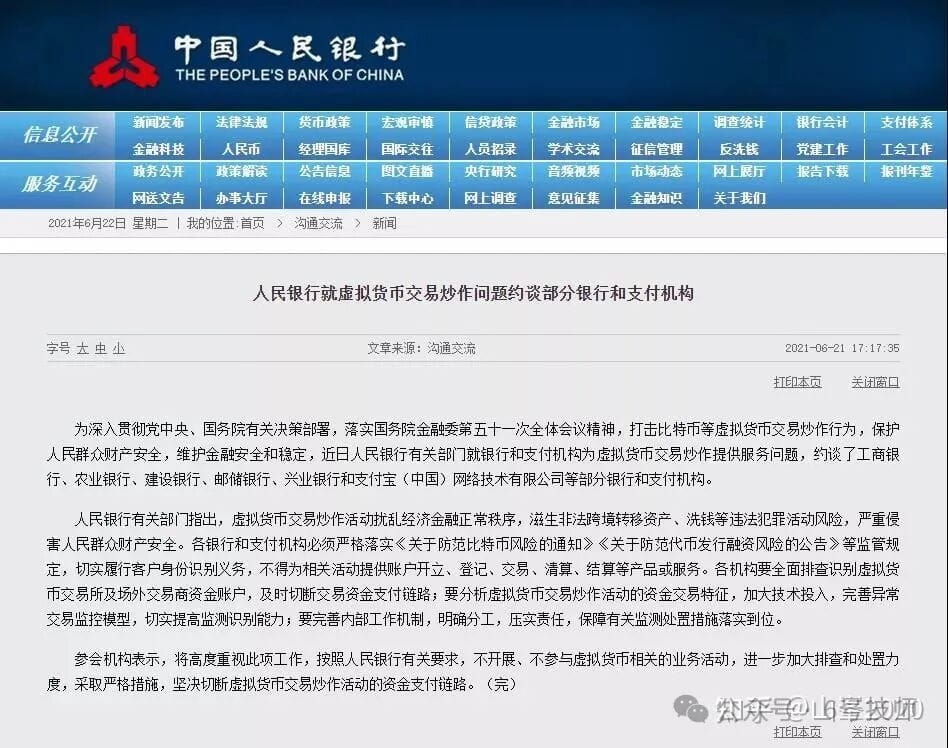
On June 21, 2021, at 5:17 PM, the central bank issued a notice: To deeply implement the decisions and deployments of the Party Central Committee and the State Council, carry out the spirit of the 51st plenary meeting of the State Council Financial Committee, combat the speculation behaviors of Bitcoin and other virtual currency transactions, protect the property safety of the people, and maintain financial security and stability, recently, relevant departments of the People's Bank of China interviewed some banks and payment institutions, including the Industrial and Commercial Bank of China, Agricultural Bank of China, China Construction Bank, Postal Savings Bank of China, Industrial Bank, and Alipay (China) Network Technology Co., Ltd., regarding the issue of providing services for speculation in virtual currency transactions.
Reasons for Bitcoin's popularity: Why does China vigorously crack down on Bitcoin?
01 Reasons for Bitcoin's popularity
The concept of Bitcoin was first proposed on November 1, 2008, and officially born on January 3, 2009, making it 11 years old now. From being worth nothing at the beginning to a peak of 64,778 yuan per coin this year, and still priced in US dollars!
Why is Bitcoin so popular? What is its use?
Bitcoin has six outstanding characteristics:
1. Decentralization: Bitcoin is the first distributed virtual currency, with the entire network composed of users and no central bank. Decentralization is the guarantee of Bitcoin's security and freedom.
2. Global circulation: Bitcoin can be managed on any computer connected to the internet. No matter where one is, anyone can mine, buy, sell, or receive Bitcoin.
3. Exclusive ownership: Controlling Bitcoin requires a private key, which can be securely stored on any storage medium. No one other than the user can access it.
4. Low transaction fees: Bitcoin can be sent for free, but each transaction will ultimately incur a transaction fee of about 1 satoshi to ensure faster execution.
5. No hidden costs: As a payment method from A to B, Bitcoin has no cumbersome limits or procedures. Knowing the other party's Bitcoin address is sufficient for making payments.
6. Cross-platform mining: Users can explore the computing capabilities of different hardware across many platforms.
However, the main reason Bitcoin is so popular is due to its several functions: anonymity, global circulation, cross-platform mining, and financial capital speculation. The anonymity function can be exploited by criminals for money laundering and opaque transactions, such as hiring “hitmen” on the dark web, selling “drugs,” and trading illegal items (sensitive terms replaced with homophones). Global circulation allows for cross-border capital transfer, i.e., asset transfer. Cross-platform mining enhances the popularity and speculation surrounding Bitcoin. More importantly, financial capital speculation is the key driving force behind Bitcoin's significant price fluctuations.

Previously, on April 20, Chenxi discussed in an article (Beware of the Financial Crisis Triggered by Bitcoin's Plummet) that the capital behind Bitcoin is not simply ordinary financial institutions and retail investors; the vast majority of Bitcoin is controlled by Jewish capital, among which the most famous is Tesla CEO Elon Musk, who initially claimed he would not buy Bitcoin but ended up using company funds to buy Bitcoin. Additionally, financial groups like Goldman Sachs, Morgan, and Rothschild are involved. What is more surprising is that the CIA of the United States and the Russian military are also participating. In early March this year, a segment of video was released by the Russian Defense Ministry's (Red Star TV), revealing a large Bitcoin mining farm controlled by the Russian military.
In summary, the reason Bitcoin is so popular is mainly due to these functions: money laundering, asset transfer, opaque transactions, mining, financial speculation, and great power games.
Why is Bitcoin recognized in countries like Japan, Ukraine, Switzerland, the Netherlands, the UK, Germany, and the US, and even just last week, El Salvador (a small country in North America) announced that Bitcoin would be its legal tender, while China is relentlessly pursuing Bitcoin?
02 Why China is vigorously cracking down on Bitcoin
1. Bitcoin mining consumes electricity
In the first part, Chenxi mentioned that the reason Bitcoin still exists is related to one of its functions: mining. Users can use computers to perform extensive calculations according to algorithms to 'mine' Bitcoin. When users 'mine' Bitcoin, they need to search for a 64-bit number and compete with other miners by repeatedly solving puzzles to provide the required numbers for the Bitcoin network. If a user's computer successfully generates a set of numbers, they will receive a corresponding amount of Bitcoin.
Due to the current high price of Bitcoin, many people are motivated to mine for profit. Mining is based on the computer platform, and continuous operation will consume a large amount of electricity. Driven by money, many people will specifically build such mining equipment, leading to massive electricity consumption.
A mining machine consumes between 1.6 to 2.5 kilowatt-hours of electricity for normal operation over an hour. It seems like a small amount, comparable to the energy consumption of an energy-efficient air conditioner over a night. However, mining machines differ from other appliances. To make a profit, mining machines run almost all year round without interruption as long as there is no malfunction or power outage.
Roughly calculating, assuming a mining machine consumes 2 kilowatt-hours per hour, 2*24*30=1440, a mining machine will normally consume 1440 kilowatt-hours in a month! A typical household's electricity consumption in a month is only about 200-400 kilowatt-hours, meaning a mining machine's monthly electricity consumption is equivalent to nearly half a year's electricity consumption of an average household. However, this is just the power consumption of one mining machine; if we stack multiple machines to build a mining farm, the electricity consumption is staggering!
Typically, mining farms have many mining machines densely packed together, leading to a substantial total electricity consumption, which simultaneously releases a large amount of heat. This means mining farms must be equipped with large fans for ventilation and cooling, and the power consumption of these cooling devices is not a small number. A large three-phase fan has a power of around 1000 to 2000 watts, and this is just a standard fan; it’s unlikely that only one is used. Additionally, some network and monitoring equipment is also needed in the mining farm, and all these power consumptions must be taken into account.
This is why the Russian military has set up mining locations in the snow-covered, uninhabited Siberia, where the Angara River connects to the world's deepest lake, Lake Baikal, and the largest hydropower station in Russia, the Bratsk Hydroelectric Power Station, is located at the river's most voluminous point. Firstly, the low temperatures in Siberia can naturally cool the mining machines, and secondly, being close to the hydropower station ensures a continuous supply of electricity without the risk of outages.
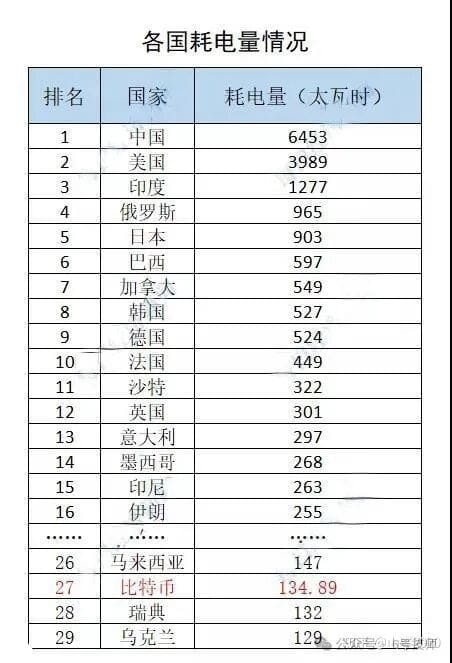
Among various digital currency mining, Bitcoin mining machines are the top electricity consumer, consuming about 145,400 megawatts, while Ethereum consumes 46,900 megawatts. Completing a single Bitcoin transaction requires 163 million watt-hours, while Ethereum requires 49 million watt-hours. The electricity consumption for completing one Bitcoin transaction can power a mainstream American household for 5.5 days. Research conducted by Oxford University’s Center for Economic Research shows that as of May 10, 2021, the annual electricity consumption for mining worldwide is approximately 149.37 terawatt-hours (1 terawatt-hour equals one billion kilowatt-hours). 149.37 billion kilowatt-hours—what does that mean? Look at the ranking of electricity consumption by country to understand how frightening Bitcoin mining's electricity consumption is.
2. Crack down on abnormal capital flows
In the first part, Chenxi has already mentioned that the popularity of Bitcoin is due to its convenience for money laundering and illegal activities. Nowadays, our country is cracking down on money laundering activities and criminal activities. I wonder if everyone has noticed the changes around them. Since the beginning of this year, the entrances of hospitals, vegetable markets, and residential buildings, even elevators, are filled with promotional information about anti-fraud and anti-money laundering. Even the formerly routine micro-business order brushing has become a fraudulent crime. This shows that the state is vigorously conducting a sweep against organized crime. Bitcoin can provide convenience for crime, so it is naturally an enemy of China's legal system.
3. Defend the sovereignty of the Renminbi
Many people may not understand the issue of monetary sovereignty. Bitcoin is a 'currency' issued by a non-governmental organization. Although it has functions similar to digital currencies, its issuer is not legitimate. Many people might think it doesn’t matter as long as they can buy things, so the difference between Bitcoin and Renminbi might not be significant. In terms of application functions, Bitcoin and regular currencies have similar functionalities, but fiat currency symbolizes a country's sovereignty. It is important to know that the reason the US has thrived (before 2020) is mainly due to the dollar's monetary hegemony. The US can control the global economic lifeline by controlling the issuance of dollars. It can be said that whoever masters the right to issue currency controls the lifeblood of a country.
If Bitcoin is widely circulated globally, given time, it will challenge the status of fiat currencies and impact the status of the Renminbi both internationally and domestically, threatening China's economic lifeline. Algorithmically, because the Bitcoin system uses decentralized programming, one can only receive 25 Bitcoins every 10 minutes, and by the year 2140, the circulation limit of Bitcoin will reach 21 million. It seems unlikely to be artificially controlled. However, technology, as it evolves and updates, has a great possibility of overturning previous technologies, so it is unreliable. Only by holding monetary sovereignty in one's own hands can national security be guaranteed.
4. Reduce financial risks and counter American finance
Regarding the current macroeconomic background and international situation, Chenxi has mentioned in previous articles that we are currently on the right side of the 90-year economic cycle turning point since 1929, and the global economy is entering a recession. Economic recession will intensify international competition. The management has repeatedly warned everyone in public that the current financial risks are extremely high, the capital markets and economies of Europe and America are severely out of sync, and China's real estate market has significant risks. Therefore, the management often reminds and rectifies the market during periods of overheating to achieve cooling.
Currently, the management is vigorously cracking down on Bitcoin to clear all potential financial risks domestically before external risks are released. From this, it can be seen that China and Russia may take further actions against the US to provoke the release of American financial risks. The strengthening of the US dollar can be inferred from the depreciation of the Renminbi, indicating that the capital market will be very turbulent in the coming month. What is more noteworthy is that the US dollar experienced a significant correction yesterday, but the Renminbi continues to maintain an independent depreciation trend. This shows that the Renminbi has already embarked on an independent trajectory away from China, gradually moving towards the goal of countering the US financial market.
Additionally, China's crackdown on domestic Bitcoin speculation has a significant impact on Bitcoin's trends. As mentioned earlier, a considerable portion of Bitcoin participants are American financial groups, specifically Jewish capital groups. By cracking down on Bitcoin, China can target these Jewish capital groups.
In summary, China's crackdown on Bitcoin speculation is mainly to reduce domestic risks and prepare to counter American finance! A storm is about to arrive. The final fate of Bitcoin is dust to dust, earth to earth! Moreover, the plummeting of Bitcoin will eliminate market liquidity, leading to declines in other markets. Do not speculate in Bitcoin!!!!
Note: This article is from a Zhihu author:

(Welcome to like and comment) !!!
Having been caught in the rain, I am willing to hold an umbrella for the leeks! I am living in the B circle, follow me, and let's walk hand in hand on the road of cryptocurrency!


