

As a long-term observer of blockchain infrastructure, I believe that evaluating a project's long-term value hinges on whether it addresses the core bottlenecks of ecological development. What attracts me to APRO (AT) is its precise targeting of a fundamental issue in the era of Web3 and AI integration: how to provide verifiable and tamper-proof real-world data for smart contracts and AI agents.
This is not only a technical issue but also the key to unlocking trillion-dollar application scenarios.
1. The essential evolution of oracles: from data transportation to value generation
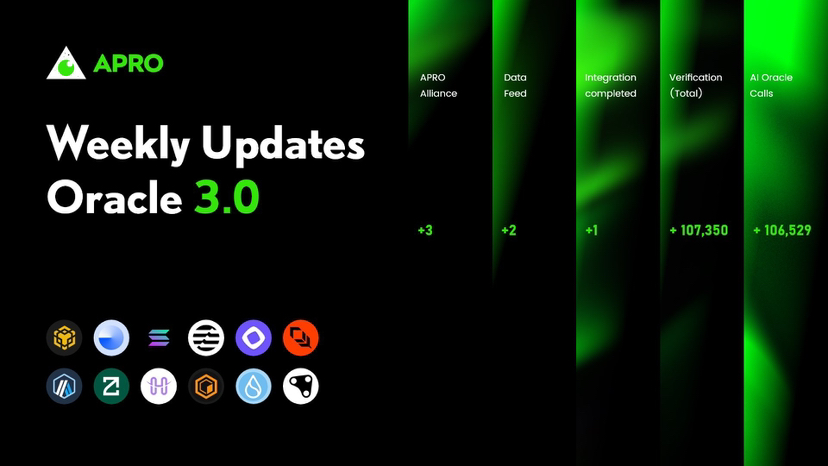
The traditional oracle mainly plays the role of a one-way data mover, addressing the single need for on-chain contracts to obtain off-chain prices. However, with the complexity of DeFi, the on-chaining of real-world assets (RWA), and the rise of autonomous AI agents, the market requires the next-generation protocol capable of handling multidimensional, non-standardized data, equipped with preliminary cognitive and verification capabilities. APRO's positioning is oracle 3.0! An AI-enhanced data protocol stack that generates trustworthy knowledge. It dynamically fetches and processes on-chain transactions, order book depth, public sentiment, and other multi-source information, utilizing cryptographic technology to generate standardized data units with timestamps and anti-counterfeiting labels. This process essentially transforms chaotic information flows into structured, trustworthy knowledge for intelligent system decision-making.
Two, Two Core Application Scenarios: Overcoming the Trust Barriers of AI and RWA
The realization of APRO's value closely revolves around two of the most promising frontier fields, which constitute a solid foundation for the practical value of its token AT.
First, serving decentralized AI agents. The current hallucination problem in AI partly stems from its training data being disconnected from real-time, verifiable reality signals. APRO aims to provide AI with end-to-end encrypted, multi-source verified real-time data streams through its secure AgentText transmission protocol. This allows AI to make decisions based on tamper-proof data when performing asset allocation, risk hedging, and other operations, significantly enhancing the credibility and reliability of its actions.
Second, empowering the scaling of real-world assets (RWA) on-chain. The core obstacle to the development of RWA lies in how to reliably map non-standard asset information such as property contracts, invoices, and legal documents, which have high trust thresholds, onto the blockchain. APRO proposes a dual-level processing framework: first, using AI models to parse documents and extract key elements; then reaching consensus on the authenticity of the information through a decentralized node network, ultimately generating immutable on-chain records. The goal of this process is to become a trust bridge connecting trillion-level traditional assets with the DeFi world.
Three, The Economic Model of the AT Token and Value Capture
In the APRO ecosystem, the AT token is the core element driving the operation of the network. Its setting of a fixed total supply of 1 billion tokens clarifies its attributes as a functional asset and governance vehicle. The value support for AT mainly comes from three aspects: users need to stake AT to participate in network maintenance and earn rewards; developers or AI agents need to consume AT to pay for high-order data service fees; holders of the token will have governance rights over the future development of the protocol. This design deeply binds the value of AT to the usage demands of the network. As the number of AI agents it serves and the scale of RWA assets increase, the demand for AT is expected to form an endogenous growth cycle.
Four, Future Prospects and Key Challenges
Looking ahead, the development of APRO is highly correlated with the maturity of the AI and RWA tracks. Its demonstrated cross-chain compatibility supports over 40 public chains, including BNB Chain and the Bitcoin ecosystem, laying the foundation for wide accessibility. If its technical route can be successfully realized, APRO is expected to evolve from a key component to an indispensable infrastructure layer.
However, the challenges ahead are clearly visible. The oracle track is highly competitive, with giants already occupying significant market shares. As a technically complex project, the actual efficiency of its AI data processing, the degree of decentralization of its node network, and the execution power of its anonymous team all need to be tested over long-term practice. In addition, the phased unlocking of tokens may create continuous supply pressure on the market.
Summary
In my view, APRO (AT) represents an investment logic focused on solving underlying key issues.
It does not chase superficial trends but is committed to solidifying the data foundation for the interaction between Web3 and the real world and AI.
For rational observers, focusing on the achievement of its technological milestones, the integration progress on mainstream public chains, and real adoption cases in specific RWA or AI projects is far more important than tracking short-term price fluctuations.
If it can successfully execute its vision, the value capture of AT will gradually manifest alongside the expansion of the entire ecosystem.


