
When the Bitcoin candlestick on the screen struggles repeatedly at the $85,000 mark, an experienced trader does not panic and close their position, but calmly executes a second DCA (Dollar Cost Averaging) buy order, while another portion of their funds quietly lies in a decentralized stablecoin staking pool, continuously generating returns.
At 10 AM today (Vietnam time), all eyes were on Tokyo — the Bank of Japan made a historic decision to raise the policy interest rate to 0.75%. This seemingly distant decision, like a boulder thrown into a global funding pool, triggered 'liquidity ripples' that quickly affected the cryptocurrency market thousands of miles away. Last night, concerns about interest rate hikes, combined with a weak U.S. market, led to a collective plunge in Bitcoin and various altcoins, resulting in significant hits to many traders' accounts.
However, amidst this panic, true veterans are pondering a deeper question: How to build an asset fortress capable of withstanding any macro storm while embracing Bitcoin's long-term growth potential? At this moment, a decentralized dollar (Decentralized USD) that relies on no central bank decisions and is entirely based on on-chain transparent mechanisms has increasingly clear strategic value amidst turmoil. It is not an offensive weapon to replace Bitcoin, but the ultimate defensive structure and logistical support that ensure your long-term survival on the battlefield until victory.
01 Event review: When 'Tokyo catches a cold', why does the 'global crypto community sneeze'?
The Bank of Japan's interest rate hikes are far from just domestic affairs. Their core impact lies in ending the decades-long era of cheap funding for 'yen carry trades'.
In the past, international capital borrowed yen at nearly zero cost, exchanged it for dollars, and heavily invested in high-yield assets such as U.S. Treasury bonds, tech stocks, and cryptocurrencies. Continuous interest rate hikes in Japan mean that this trillion-dollar global liquidity 'lifeline' is being narrowed or even partially reversed.
Therefore, yesterday's market decline was not without reason. It is a necessary transmission of macro logic:
Anticipatory reactions: Smart money exits risk assets before decisions are made to avoid uncertainty.
Manifestation of interconnected effects: U.S. stocks (especially tech stocks) decline due to tightening liquidity expectations, further dragging down crypto market sentiment.
Liquidation of leverage: Market declines trigger forced liquidations of high-leverage long positions, creating a chain reaction of 'decline → liquidation → sell-off → further decline'.
In this context, simply asking 'how are the brothers' accounts doing' seems rather pale. The more crucial question is: Does your investment system hold up against this level of macro volatility?
02 Veteran thinking: Why insist on DCA during a crash? This is behind the 'armory' mindset.
Continuing to execute Bitcoin DCA (dollar-cost averaging) during a market crash is a typical 'ignore the noise, focus on the essence' long-term strategy. Its core belief is that the long-term value narrative of Bitcoin (digital gold, inflation-resistant asset, decentralized network) has not changed due to a single interest rate hike; rather, short-term price fluctuations provide better cost-averaging opportunities.
However, mature investors never invest all their 'ammunition' at once on the front lines. In their 'armory', besides Bitcoin as the 'main weapon', there must be a category of tactical assets for 'defense, maneuver, and standby'. This is the role played by decentralized stablecoins.
Take the TRON ecosystem's @usddio as an example; it creates a value-stable 'safe zone' on the blockchain through transparent mechanisms like over-collateralization. Holding such assets during extreme volatility last night and this morning means:
Asset net value safe haven: Avoided the simultaneous shrinkage of assets alongside the overall market decline, preserving precious principal.
Ready reserve on standby: When the market experiences irrational drops due to panic (e.g., Bitcoin breaking key support levels), having stablecoins is equivalent to having a reserve that can be deployed at any time to buy the dip, turning a crisis into an opportunity.
Continuous income from 'logistics support': Even during observation periods, these stablecoins can generate income through DeFi staking, allowing your 'reserve' to self-sustain and grow while on standby.
03 Build your 'offensive and defensive' crypto asset portfolio
Based on the logic above, a 'combined offensive and defensive' portfolio that adapts to macro cycles should include the following elements:
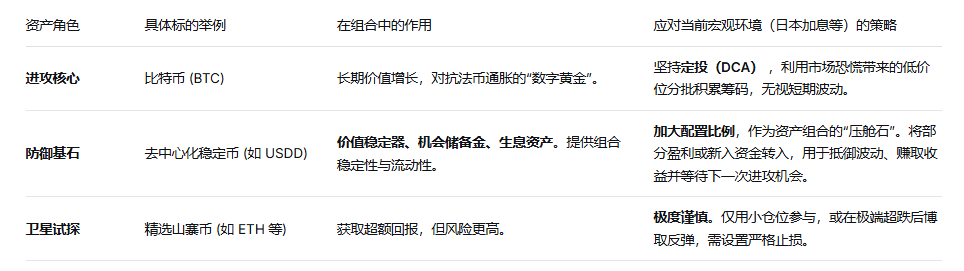
Specific tactical actions can be:
Divide the total funds planned for investment in Bitcoin into a 70% DCA budget and a 30% stablecoin reserve.
Execute regular Bitcoin purchases as planned, regardless of price fluctuations.
Convert the entire reserve into decentralized stablecoins like USDD and stake it in secure DeFi protocols to earn stable returns.
When the market experiences a dramatic drop far beyond normal due to macro shocks (e.g., Bitcoin dropping more than 10% in a single day), utilize part of the reserve to increase positions, then quickly replenish the reserve.
04 Conclusion: In an uncertain world, build your own certainty
The Bank of Japan's interest rate hikes remind us that the crypto market is no longer an island; it is deeply embedded in the tides of the global macro economy. In the future, similar black swan events will only increase, not decrease.
In the face of such uncertainty, the greatest weapon for retail investors is not to predict every rise and fall, but to build a system with antifragility. This system allows you to incur limited losses when wrong (through stablecoin reserves and position control), and achieve substantial long-term returns when right (by consistently investing in core assets like Bitcoin).
When you no longer worry about 'how are the brothers' accounts doing' and instead start examining and optimizing your own 'asset armory', you transform from a passive recipient of the market to an active helmsman of your wealth journey.
The market is always volatile, but true winners can always find ways to move forward or even profit amidst the fluctuations. Their secret lies not in catching every rise, but in ensuring that their sophisticated asset allocation prevents them from being crushed by any downturn.


