
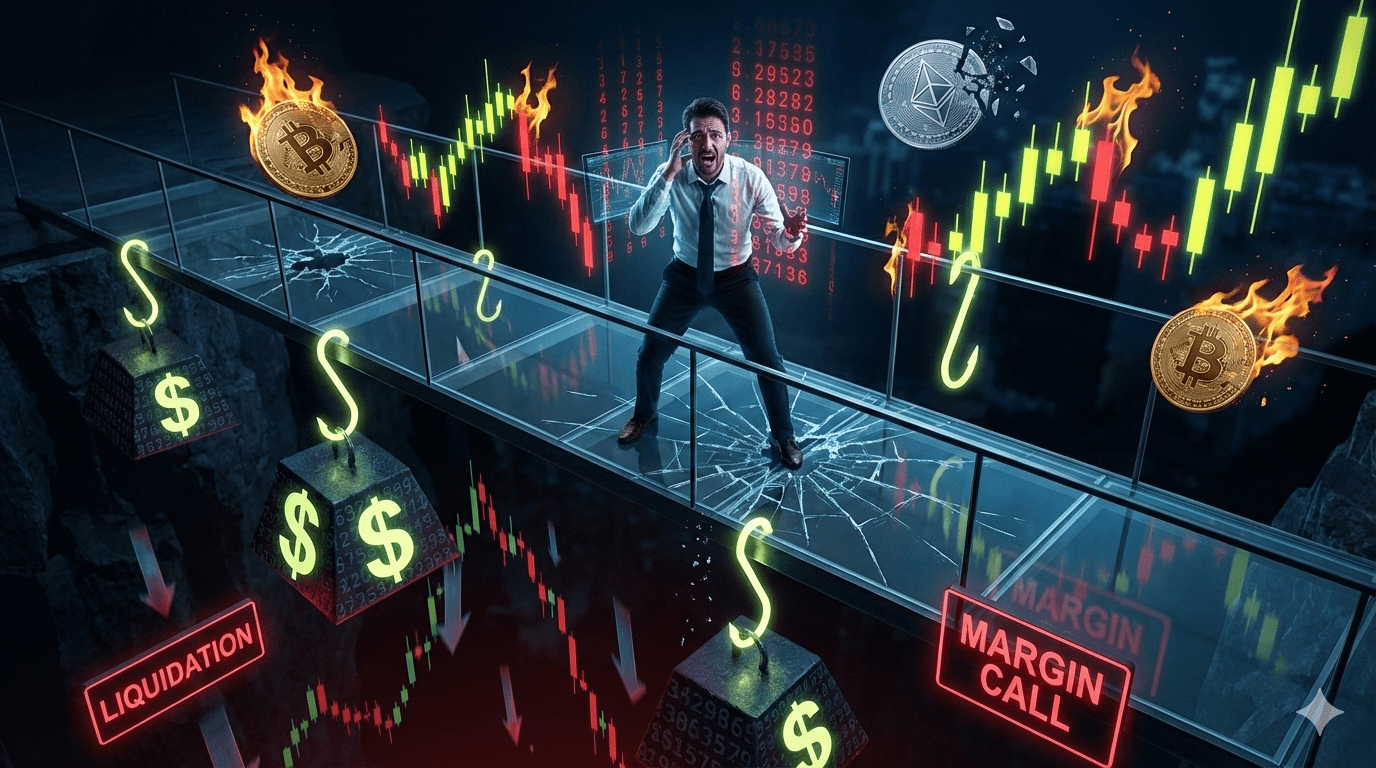
 The cryptocurrency market, with its characteristic volatility and potential for significant returns, has attracted millions of global investors. Meanwhile, trading platforms offer sophisticated tools such as leverage and margin trading, which amplify both gains and losses. Understanding the risks associated with these practices is essential for any participant in this market.
What are Margin and Leverage Operations?
Margin trading allows a trader to borrow funds from a broker to open larger positions than their own capital would allow. Leverage is the multiplier of this effect - for example, a leverage of 10:1 means that with $1,000 of own capital, one can control a position of $10,000.
Specific Risks in the Crypto Context
1. Extreme Volatility
Cryptocurrencies are notorious for sharp value fluctuations. A movement of 10-20% in a day is not uncommon. With leverage, this volatility is multiplied. What would be a 10% drop in a traditional trade becomes a 50% loss with 5:1 leverage, potentially leading to forced liquidation (when the broker automatically closes your position to recover the loan).
2. Cascading Liquidations
In times of high volatility, many liquidations can occur simultaneously, creating cascading effects that accelerate market movements and amplify losses beyond expectations, even for traders with seemingly solid strategies.
3. Hidden Costs and Interest
Margin loans accumulate interest, which in crypto markets tends to be significantly higher than in traditional markets. In positions held for the long term, these costs can erode or exceed any gains.
4. Platform and Counterparty Risk
Many platforms offering leverage in crypto operate in less stringent regulatory regimes. Exposure to hacks, operational bankruptcies, or even price manipulation within the exchanges themselves represents additional risks.
5. Amplified Psychological Effect
The psychological pressure of leveraged trading is intense. Anxiety can lead to impulsive decisions, such as increasing leverage to quickly recover losses - a strategy that often results in total losses.
6. Lack of Regulation and Resources
Unlike traditional markets, many crypto trading environments do not offer the same protective mechanisms, such as guarantor funds or coordinated trading halts during extreme volatility.
Recommendations for a Cautious Approach
1. Educate yourself before trading - Fully understand the mechanisms of margin, margin calls, and liquidations.
2. Start without leverage - Familiarize yourself first with the spot market before considering margin trades.
3. Use strict stop-losses - Set automatic exit levels to limit losses.
4. Never leverage your entire capital - Use only a small part of your portfolio for higher-risk trades.
5. Consider leverage as a risk, not an opportunity - The mindset should be risk management, not gain multiplication.
6. Keep a reserve for margin calls - Have additional capital available to cover potential margin calls.
Conclusion
Margin trading and leverage in cryptocurrencies represent a combination of high risk: dangerous financial instruments in an already naturally volatile market. While stories of exponential gains circulate widely, catastrophic losses - often silenced - are equally frequent.
The fundamental principle remains: never invest or trade more than you can afford to lose completely. In the cryptocurrency environment, where volatility is the norm and not the exception, leverage often transforms not into a lever for wealth but into an accelerator of losses. The wisest approach for most investors is direct exposure, without loans, with a long-term horizon and a solid diversification strategy.