

In a major crackdown on the hidden engines of Libya’s digital economy, authorities have intensified their war against an underground Bitcoin mining boom that has turned the war-torn nation into an unlikely global hub.
The surge, fueled by the world’s cheapest electricity and a decade of institutional fragmentation, has now reached a breaking point as the government links these clandestine “farms” to crippling national power shortages.
The Zliten Verdict: A Turning Point
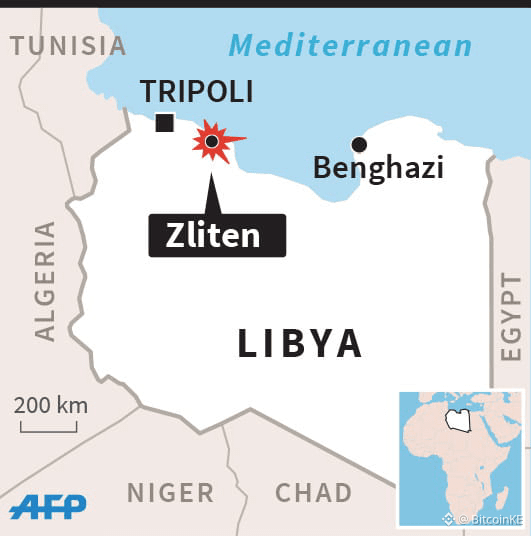
In November 2025, Libyan prosecutors handed down three-year prison sentences to nine individuals caught operating an industrial-scale Bitcoin mining farm within a steel factory in Zliten. Beyond the prison time, the court ordered the total seizure of their machinery and the forfeiture of all “illicitly generated” profits to the state.
This sentence follows a series of high-profile raids:
April 2024: Security forces in Benghazi dismantled a hub housing over 1,000 devices, which was reportedly netting $45,000 monthly.
June 2023: In one of the largest raids on the continent, authorities arrested 50 Chinese nationals and seized an estimated 100,000 mining units in Zliten and Misrata.
The Economics of $0.004 Power
The catalyst for this boom is purely mathematical. At approximately $0.004 per kilowatt-hour, Libya’s electricity is among the cheapest on Earth. This rate is heavily subsidized by the state to support a population already struggling with economic collapse.
This pricing creates a unique “hardware arbitrage.” In high-cost markets like Europe or North America, miners must use the newest, most efficient ASICs (Application-Specific Integrated Circuits) to stay profitable. In Libya, however, the electricity is so cheap that even “obsolete” machines – essentially scrap metal elsewhere – can generate significant profit margins.
A Nation’s Lights Flickering
While profitable for operators, the industry has become a parasite on Libya’s fragile energy infrastructure. Prime Minister Abdul Hamid Dbeibah has stated that illegal mining operations can waste between 1,000 and 1,500 megawatts of electricity – enough to power hundreds of thousands of homes.
Libya’s grid, already battered by civil conflict and theft, loses up to 40% of its power before it even reaches consumers. During the peak of the mining boom in 2021, Libya accounted for 0.6% of the global Bitcoin hash rate, the highest share in Africa and the Arab world. Experts warn that this “always-on” industrial load is a primary driver of the 18-hour blackouts that have sparked public protests.
LIST | A Look At 10 Key Milestones Behind Ethiopia’s Rise As a Bitcoin Mining Haven in 2024
In this article, we explore the key milestones that propelled #Ethiopia into the ranks of global Bitcoin mining powerhouseshttps://t.co/EtQcpEBTBr @KalKassa @qrb_labs @WestDataGroup pic.twitter.com/tCxj4Wye4f
— BitKE (@BitcoinKE) January 3, 2025
The Legal Labyrinth
The crackdown is complicated by a “legal grey zone.” While the Central Bank of Libya (CBL) banned cryptocurrency transactions in 2018 – citing risks of money laundering and terrorism financing – there is no specific law that explicitly criminalizes the act of mining.
Instead, prosecutors are using a “constellation of offenses” to target operators, including:
Illegal Electricity Consumption: Tapping into lines without meters.
Smuggling: Violating a 2022 Ministry of Economy decree that bans the import of mining hardware.
Money Laundering: Linking the digital assets to illicit financial flows.
To evade detection, operators have become increasingly sophisticated, reportedly pouring concrete over setups to mask heat signatures from thermal imaging drones and operating out of windowless, fortified warehouses in industrial zones.
The debate in Tripoli is now split between total prohibition and regulation. While security officials advocate for stamping out the industry to save the grid, some economic experts argue that the state should instead license and tax mining. They suggest that by metering these farms and charging a “market rate” for power, Libya could convert its energy surplus into much-needed foreign currency.
For now, the sirens of raid teams remain more common than the hum of regulated servers, as Libya struggles to decide whether its cheap power is a resource to be protected or a commodity to be sold to the highest digital bidder.
REGULATION | The Central Bank of Libya Moves to Shut Down ‘Informal Markets’ and Unlicensed FX Bureaus
Want to keep up with the latest news on crypto in Libya and North Africa?
Join our WhatsApp channel here.
Follow us on X for the latest posts and updates
Join and interact with our Telegram community
___________________________________________

