

 Blockchains did not fail because they lacked computation power or cryptography. They failed whenever they had to make decisions about the real world. A smart contract can execute flawlessly, yet still produce a wrong outcome if the data it consumes is flawed, delayed, or manipulable. Prices, asset backing, market events, game outcomes, regulatory states none of these exist natively on-chain. This is the silent weakness beneath almost every Web3 application. APRO does not approach this problem as a simple “data feed” issue. It treats it as a verification problem. Its core insight is that Web3 does not need more data; it needs data that can be enforced with confidence.
Most oracle systems focus on delivery. APRO focuses on transformation. The difference matters. Real-world information is messy by default: fragmented sources, inconsistent formats, delayed updates, and conflicting signals. Feeding that chaos directly into smart contracts simply shifts risk rather than removing it. APRO positions itself as an intelligence fabric that absorbs this messiness off-chain, normalizes it, verifies it, and only then commits it to the blockchain. In this model, the oracle is not a messenger. It is an adjudicator.
Core of APRO’s design is a simple idea: trust isn’t automatic you have to earn it. Instead of betting everything on one trusted source or a static whitelist, APRO pulls in data from all over. It runs that data through layers of AI-powered checks. These systems look for patterns, flag anything weird, and score the data for confidence before it ever gets close to a blockchain. That step matters. It means smart contracts only see data that’s already faced serious scrutiny, not just a rubber-stamped signature. So APRO cuts down on uncertainty before any consensus even kicks in.
APRO splits its system into two layers, and that’s totally intentional. The first layer is off-chain. Picture a messy backroom wild market prices, reserve reports, sensor data, piles of random documents. The AI here isn’t trying to predict anything; it just makes sure all these sources line up and actually make sense together. Once that’s sorted, the process moves to the on-chain layer. Here, decentralized oracle nodes step in. They cross-check the cleaned-up data and, once they all agree, lock it in for smart contracts to use. By dividing things this way, APRO can grow fast without losing any of that crucial decentralization.
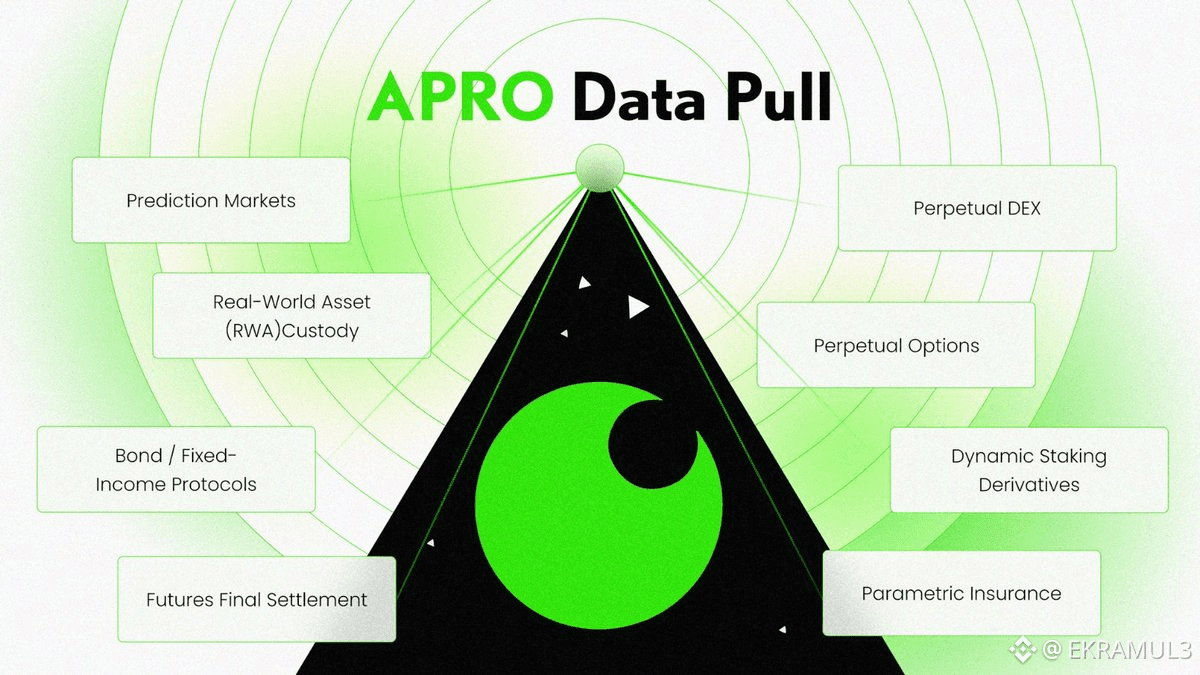
The real kicker? APRO’s super flexible. It doesn’t force every application to chug endless updates. Thanks to its Data Push and Data Pull options, each system can just do its own thing. Need rapid-fire updates, like for lending or derivatives? No problem APRO delivers nonstop. But if you’re running governance, insurance, or NFTs, you can just pull fresh data when you actually need it. No wasted gas. Fast when it matters. Just smart.
Security isn’t just about code here it’s economic. If you want to run an oracle node, you’ve got to stake APRO’s native token. That’s your skin in the game. Report honestly and you get rewarded. Try to cheat, and you lose your stake. The whole thing is set up so that being honest pays off in the long run. And the penalties aren’t random they kick in only when your data clearly doesn’t match what the rest of the network sees. So, instead of just trusting operators, APRO turns data accuracy into a game where honesty wins.
One of APRO’s underrated strengths? The sheer range of assets it covers. Most oracles just stick to crypto prices, but APRO goes way beyond equities, commodities, tokenized real-world assets, gaming stats, and even randomness you can actually verify. This isn’t just for show. As Web3 moves into real-world finance, supply chains, and AI automation, you need all sorts of data to interact safely with the outside world. APRO was built for that future it’s not just trying to catch up.
Multi-chain support changes the game. APRO connects with dozens of blockchains, so developers don’t have to keep rebuilding their data pipelines whenever they switch things up. One verification layer keeps everything simple and makes sure the truth shows up the same way on every chain. If your project runs on more than one network, that kind of consistency isn’t just convenient it gives you a real advantage.
And honestly, this isn’t just theory. APRO’s already powering real systems. In DeFi, its data feeds set lending ratios, figure out when to liquidate, and help with pricing all things where a tiny error can wreck solvency. For tokenized assets, APRO handles proof-of-reserves and transparent reporting stuff you just can’t do without rock-solid off-chain data. In gaming and randomness-driven apps, it delivers provable unpredictability, so you don’t need some central authority running the draw. These aren’t pilot projects these are live systems where mistakes cost real money.
Still, APRO doesn’t claim to have solved the oracle problem forever. External data will always be risky, and AI can’t work miracles. There’s always the chance of bad sources, delays, or big shocks. What APRO offers is containment, not total elimination. By spreading trust, putting real money on the line, and always double-checking credibility, it shrinks the room for failure and blunts the damage when something does go wrong.
APRO isn’t trying to be some flashy product you see everywhere. Instead, it’s quietly working its way into the foundation more like the plumbing than the faucets. As more real-world value moves on-chain, the line between “data provider” and “infrastructure” just fades away. Apps won’t stop to ask if they’re using APRO. They’ll just take it for granted, assuming there’s something solid and trustworthy underneath. That’s how true infrastructure works: you don’t notice it, but you can’t do without it, and once it’s in place, good luck trying to swap it out.
Web3 is slowly changing, and APRO is a big part of that shift. Oracles aren’t just pipes that carry data anymore. APRO turns them into judges, into filters, into the backbone of decision-making. If smart contracts are going to handle real economic activity, they need something reliable something that holds up, even when people try to game the system. APRO doesn’t make a lot of noise about this. Instead, it’s just building, piece by piece, letting the work speak for itself.
And in decentralized systems, that kind of quiet engineering is often what lasts the longest.


